
By Thane Grauel
WESTPORT — The Board of Finance on Wednesday endorsed spending $1.3 million of federal pandemic relief money to replace a timber tidal groin at Burying Hill Beach.
The funding must receive final approval from the Representative Town Meeting.
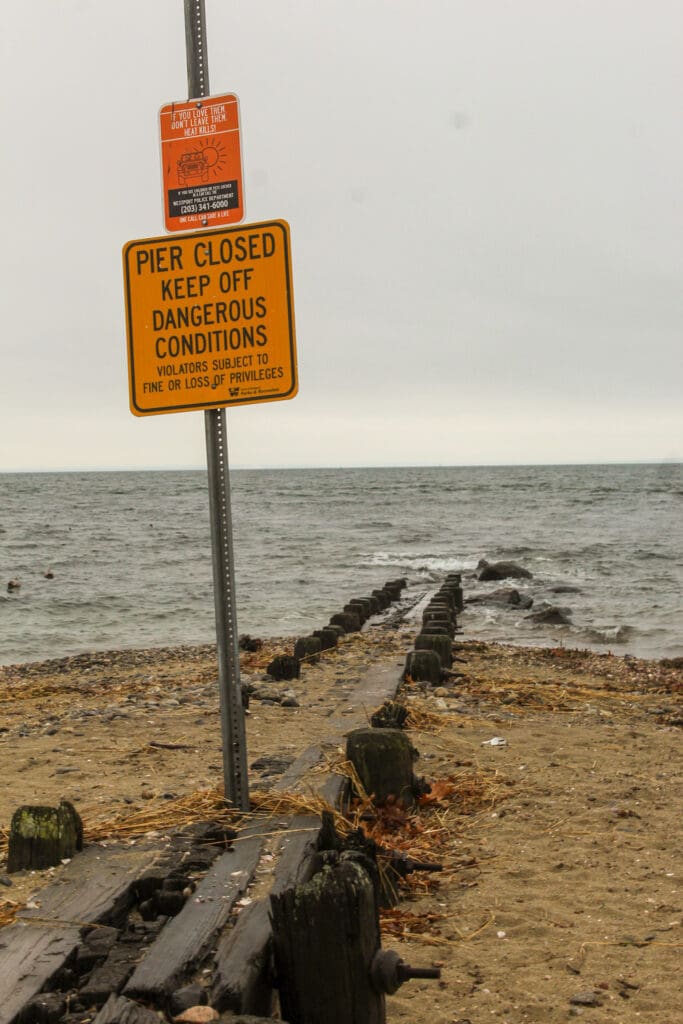
The 400-foot wooden structure at Burying Hill, which most would think of as a jetty, was built by the U.S. Army Corps of Engineers about 1950. The timber is tired and splintery, having served decades past its expected 50-year life span.
The structure is meant to stop sand from migrating east to west along the shoreline, and clogging the outlet of New Creek, a waterway between the beach and Sherwood Island State Park.
The board had a 90-minute discussion before voting unanimously to approve the expenditure.
A similar wooden structure of equal age is located across the river outlet from Burying Hill Beach. It is on state property at Sherwood Island State Park.
Members of the Board of Finance, as well as some RTM members, had a site visit to look at the structure Jan. 13.
Board of Finance member Brian Stern, a former chairman, had numerous questions about the project. He said he contacted a lumber supplier for pricing contained in the town’s cost estimates, and worried that the cost of timber was inflated, which could inflate bidders’ estimates on the project.
The cost has risen since carving up the American Rescue Plan Act (ARPA) money was first discussed by town boards. It originally was $900,000, but supply costs have driven the price up some $400,000.
Some members wondered if replacing the wooden structure with the same design was the best way to go, as opposed to rock or other materials.
Matt Rakowski of Race Coastal Engineering, who has been working with Public Works Director Peter Ratkiewich on the project and was asked to appear before the BOF, said newer materials or designs could be used, but the original designers had a solid plan that still translates.
“The Corps was onto something with regards to the simplicity,” he said of a timber structure.
A stone structure, he said, could still allow sand to filter through. And other methods would expand the footprint, and trigger a new round of required approvals from the state and federal agencies.
New to the discussion was acknowledgement that maintenance of the beach’s terrain, not just the timber structure, was important.
Ratkiewich said that for years, the contractor Kowalsky Brothers kept sand levels at beaches in check. The brothers are gone, and the company has moved away. State regulations regarding regrading beaches have been murky in recent years.
Ratkiewich said that, working with the Parks and Recreation Department, regular regrading would mean a rebuilt tidal groin could do its job effectively. The beach discussion and vote came after an hour-long executive session by the BOF to discuss security issues. No details were provided, but Police Chief Foti Koskinas and another ranking officer were on the Zoom call when the vote to go private was taken.







This is a disgrace. Not only are we picking the absolute worst time to contract for this based on the supply chain issues and inflation ($400K increase), but spending Pandemic Relief Funds for a simple, non-pandemic related infrastructure project mostly benefitting only a portion of the town is disgraceful. I only hope the RTM sees this for what it is. How does this help folks affected by the pandemic? How is this a benefit to all Westport residents? Wouldn’t the much needed replacement of our aging EMS ambulances/first responder trucks make more sense? How about the huge bill coming for health risks at Long Lots School? How about investing in our health district to help make sure we can respond more effectively to future pandemics/variants? This is not in the spirit for which all taxpayers are footing the bill for the relief funds, and not in the spirit of Westport’s record of civic / fiscal responsibility.
Good morning to the Westport Board of Finance.
I would like to make a few comments,
The Pier closed sign is a good idea, but the fine print is very unwelcoming.
How did the Board of Finance arrive at the $1.3 million dollars? (In 90 minutes)
When a homeowner wants to shingle their roof, add on an addition, or paint their house they would seek out recommendations from their friends and get 3 estimates.
Put the project out to bid and let the contractor draw the plans, etc.
I believe that Compo beach has 3 STONE Jetties.
Sincerely,
Gerald F. Romano, Jr.
I agree with Phillip and Gerald. The RTM will hopefully be the voice of reason on this.
The safety of all citizens in a public space is an investment in our health. With the pandemic raging over the last couple of years, with enclosed spaces posing risks, so many of our residents have turned to outdoor spaces and resources. Allowing them to safely access and enjoy these areas helps their mental health and physical health, because the isolation isn’t healthy and neither is getting sepsis when a kid walks out on the pier despite the sign and gets a jagged piece of wood in their leg. The resulting lawsuit would make the repair costs pale in comparison.
This isn’t a battle between the jetty and EMS, we are a town with wealth enough to finance $200k for arts groups from this award. Why would we make this a zero sum game?
The cost isn’t going to go down, so we do need to act with purpose. The town always puts projects out for bid and are well versed in how to proceed with large projects. Delayed maintenance costs us money, as will expired permits. Material prices aren’t going down. We
This project is not a disgrace and it will go to public bid. Let us hope it achieves is goals What is a disgrace is the process whereby the prior and present Administration, Parks & Rec. and DPW addressed the issues. For example, as the Westport Journal article reports (thank goodness for the Journal), the reclamation of the beach, creating a sandy beach as existed in the past, was only seriously discussed last night. Also, as you read in the Journal, there have been huge mistakes in that preservation and protection effort over the past ten years. Sometimes fault needs to be assigned. I suggest the fault lies with our Parks & Recreation management and our Office of the First Selectman. The BoF was dealt a “bad hand”. They did the best they could.
I commend Don Bergmann for his insightful comments. He is looking at the forest instead of the trees. We must avoid making the same mistake here in Westport that we have been doing nationally for decades, that is, kicking the infrastructure can down the road so that playing catch-up becomes almost an impossibility.