

By Thane Grauel
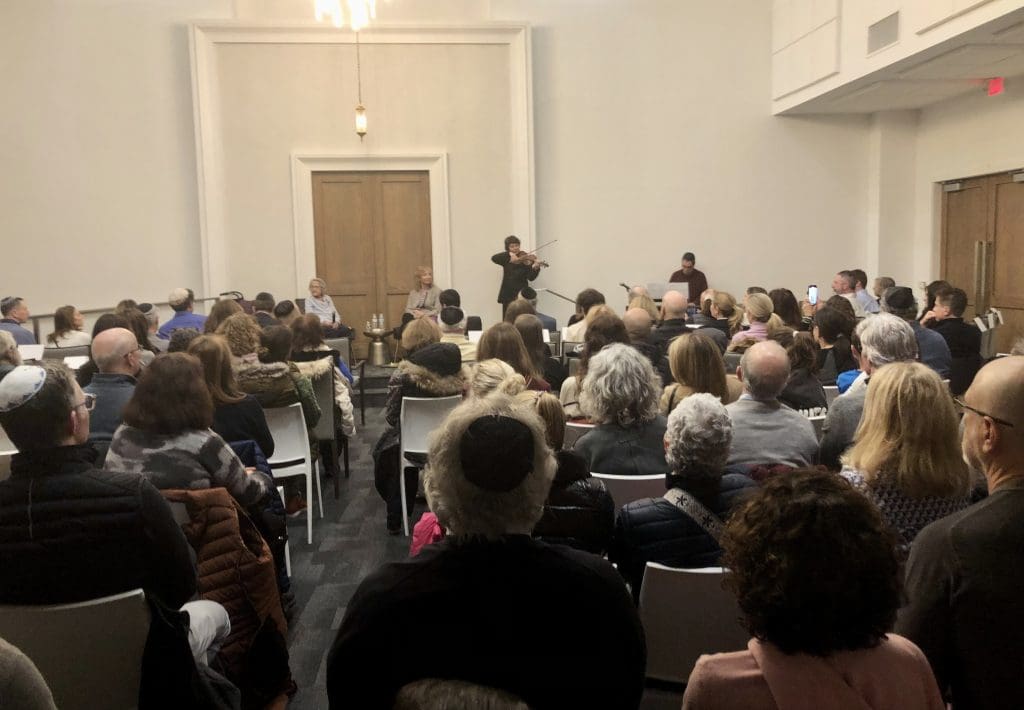
WESTPORT — A survivor of the Auschwitz death camp told her story to a packed audience at Chabad Lubavitch of Westport on Wednesday.
Esther Basch, born 95 years ago and now a resident of Prescott, Ariz., has been speaking in recent years with a message one might not expect from someone who’s been through what she has.
Basch focuses on forgiveness, and other values her parents taught her, love, love of God, live a happy life, think positively.
Rabbi Yehudah Leib Kantor welcomed Basch and told the crowd the discussion was “to learn not only the horrors, but also how to live a full life of love and forgiveness.”
The discussion was part of Chabad’s Critical Conversations speaker series.
Basch began by talking about her happy childhood in a village that has been in Czechoslovakia, Hungary, and is now Ukraine.
“Before they came, I had a wonderful childhood,” Basch said of the Germans. “Climbing the Carpathian Mountains, playing with all our friends, and when the Nazis came in, suddenly I was a dirty Jew.”
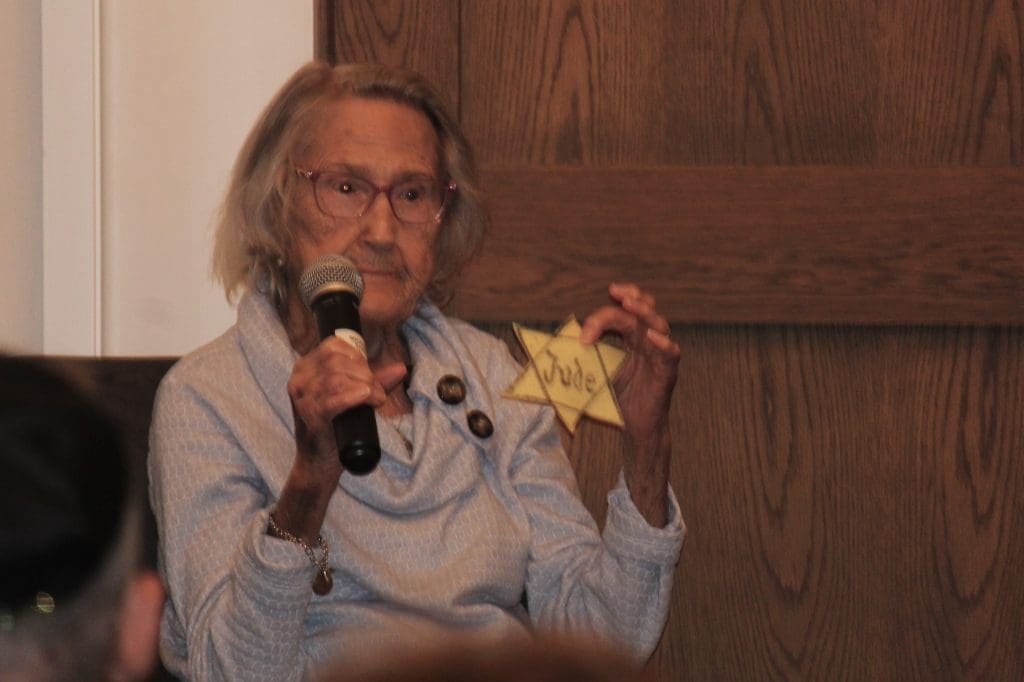
She held up a yellow Star of David patch given to Jews to wear “right away, the next day.”
When she went to school, her teacher said a dirty Jew did not deserve a higher education. Esther returned home in tears. She enjoyed school.
“I did not understand how I was clean yesterday, and today I’m dirty.”
After two years, her family was forcibly moved into a small, four-square-block Nazi-created ghetto across from their homestead. There was little food and fresh water. They could see their old neighbors to the right steal their cattle, geese and chickens.
But the other neighbors were different.
“The neighbor on the left, he risked his life to come out and call out my father’s name and throw a piece of bread over the fence,” Basch recalled. “If he had been caught, he would have been killed on the spot.”
Perhaps his family as well.
This went on for six weeks, she said, before she and her parents were put aboard a railroad cattle car that traveled for days before arriving at Auschwitz in Poland.
When it arrived at the now-infamous death camp, it was May 28, 1944. Esther’s 16th birthday.
“Right away, they took my father to the right, later finding out he went straight to the gas chambers,” Basch said. “I was still holding hands very strongly with my mom because she was crying.”
She recalled that her mother had hidden an egg or two a week from the Nazis “so she could make me a birthday cake.”
“It never happened,” she said.
As she was clenching her mother’s hand, it was wrested away and the Nazis took her mother to the right, for the same fate as her father.
In Auschwitz, some prisoners were chosen by the SS to serve as “kapos,” put in charge in charge of barracks and other oversight duties. Perhaps, Basch noted, for a little more bread than the rest of them.
“Sometimes, they were more mean to us than the Nazis,” she said, recalling how one man taunted three sisters who had been separated from a fourth.
The kapo said, “You see the chimney smoking,” meaning the gas chambers and ovens. “This is where your little sister is.”
But another kapo might have saved her life. After a food-line spat a Nazi guard beat Esther so badly she had to crawl into her bunk and could not get out the next morning.
Regardless, the woman listed Esther present at prisoner roll call.
Basch had encounters with the notorious Nazi doctor in charge of medical operations at Auschwitz, Josef Mengele, who instituted the camp’s left-or-right, live-or-die designations, sending people to instant death or labor. The world would eventually find out Mengele’s crimes against humanity went far beyond that.
In one instance, Basch recalled, Mengele reviewed her group of women.
“He’s pointing this horrible silver cane at me, so I step out of line, and he places that horrible cane, he pushes it into my bellybutton and pushes me back into line,” Basch said.
A friend of hers was called forward instead. The incident is among those she’s had nightmares about.
After three and a half months and some chance events, Basch was sent from Auschwitz to work at a munitions plant. Other transfers followed and then she was ordered on what has been called a death march to a prisoner camp deep inside Germany.
Some 3,000 other women also were gathered there.
But the Germans locked the women in, abandoned the camp, and American soldiers soon arrived.
The Americans shot open the lock and told the terrified prisoners, who had little idea what was happening, through a Jewish soldier, they were free. They could go to the nearby town and take whatever they wanted.
Esther went and found a jar of honey and ate it.
Like other emaciated prisoners, her body could not handle being fed again quickly. She was taken to an infirmary and treated for four weeks.
Later, she was sent to a displaced persons camp, and eventually met Joe Basch, who would become her husband. He was liberated from a labor camp and volunteered to take a group of orphans to Palestine, which in 1948 would become Israel.
The two, though with a six-year age difference, quickly fell in love. Married in another displaced persons camp, their journey eventually got them to Israel, but after one of her husband’s brothers died in the service, her father-in-law wanted the rest to come to America.
That took years, including a several-years’ stay in Canada.
Esther’s husband died about 20 years ago, and in recent years, so have two of their four children.
Basch told her family some years ago that she would like to again meet a U.S. soldier that liberated the camp.
They found one in nearby New Mexico named Max Lieber, who had heard of the honey incident. The two became close friends until his death.
The crowd had some questions, including if Basch had ever been back to her hometown. She said was told there was no reason.
She also was asked what she thought about most during her time in Auschwitz.
“I dreamed of seeing my parents again,” she said.
Has she ever gone back to Europe?
“If they didn’t want me there, then I didn’t want to be there,” Basch replied to applause.
“To go back to Israel one more time, that is my dream,” she said. “But I’m almost 96, I don’t know if I can take that trip.”
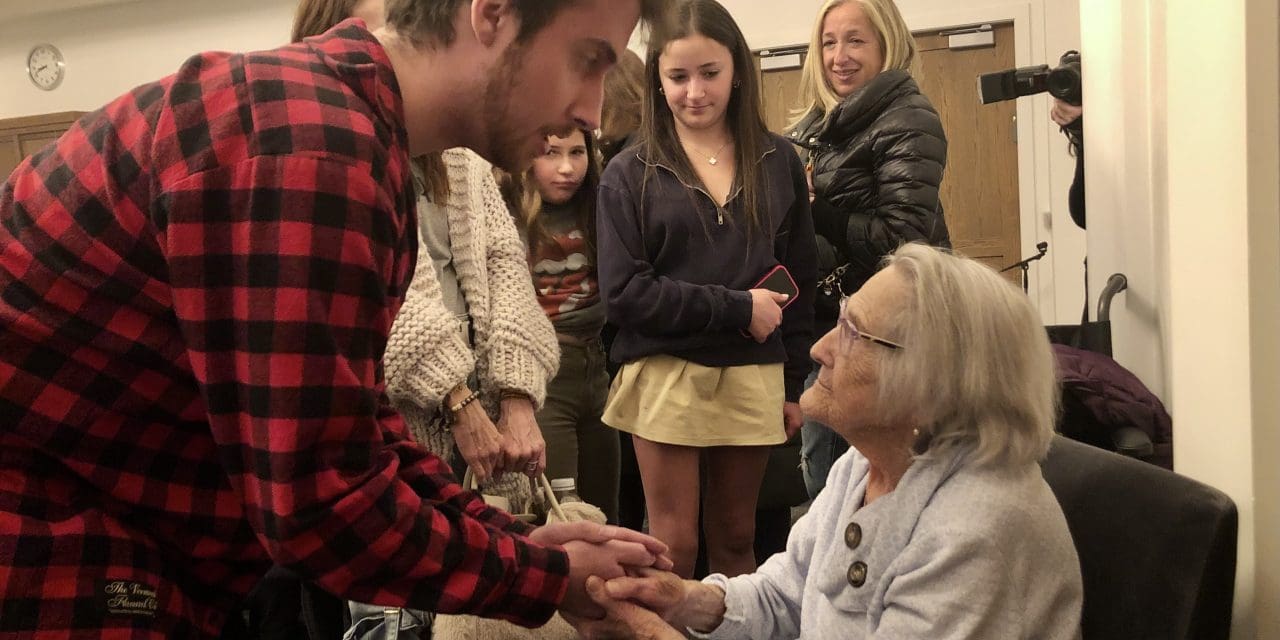
After the discussion, Basch met a long line of people. There were kind words, clasping hands, and hugs.
Basch’s daughter and other volunteers have been working on a documentary, called “The Honey Girl.”
Thane Grauel grew up in Westport and has been a journalist in Fairfield County and beyond for 35 years. Reach him at editor@westportjournal.com. Learn more about us here.




Recent Comments