
By Frank Szivos
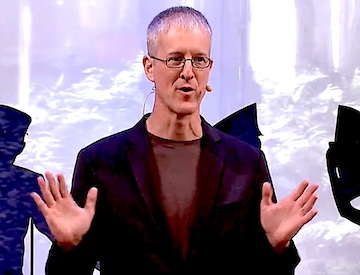
WESTPORT — The prescription for keeping Westport healthier and vibrant is making it as “walkable” as possible, according to Jeff Speck, a leading national urban planner.
Speck, speaking Tuesday night in Westport, said communities that promote a friendly walking environment are a better place to live and stimulate a thriving economic environment for local businesses.
A walkable community can save America, one step at a time, according to Speck, who also writes and lectures on the topic.
Speck told an audience of about 250 people at Bedford Middle School how critical a walking environment is to a community’s well-being. His appearance was sponsored by Sustainable Westport, which advocates for more environment-friendly and sustainable practices in town.
“Driving is the new smoking,” Speck said. “We drive everywhere. It has a lot to do with how our cities and towns are laid out. It’s an inefficient way to live.”
He focused on how the design of many American cities and towns has made driving essential for commuting to work and schools, as well as leading daily lives.
All this comes at a price, Speck said. He has authored and co-authored several books on urban planning, considered among the best in his field. His 2012 book, “Walkable City,” was named the best city-planning title of the past decade. His TED talks and YouTube videos have drawn more than five million views.
The high cost of car culture
As an advocate of the “New Urbanism,” focusing on “walkable” communities, Speck spells out a three-pronged fallout of the inordinate dependence on the automobile:
- Economics.
- Health.
- Environment.
Consider that, on average, Americans spend about $25,000 annually to get around in their cars, taking into account expenditures for gas, maintenance, taxes and insurance.
Because people spend so much time driving, it also exacts a hefty price on their health. Less walking results in more Americans battling obesity and diseases that result from it, such as diabetes and heart problems. In addition, more cars on the roads result in a more crashes and pedestrian deaths.
For example, in New York there are 3.9 pedestrian deaths per 100,000 in population. Orlando, Fla., has a whopping 17.8 pedestrian deaths per 100,000 residents.
It’s also commonly accepted that the heavy volume of cars and trucks pollute the environment. But the solution doesn’t lie in increasing reliance on electric vehicles. “Electric cars are not going to save us,” Speck said. “It’s just not happening fast enough. It will be 30 years before it has the impact we want.”
Tall with horn-rimmed glasses, Speck, 60, praised many parts of the Westport downtown area for its “walkabililty” and layout. In his estimation, Westport is on the right track for maintaining a vibrant downtown.
“Westport has good bones,” Speck said. “There’s some lovely areas with unique stores and shops and interesting architecture that are accessible to walkers.”
But in his eyes, there are plenty of opportunities for improvement. He highlighted the number of parking lots in the downtown area that detract from the overall aesthetics and appeal. He recommended one large parking structure, concealed from the street instead of the present sprawl of three major lots.
“Parking is always an issue,” Speck said. “But other cities and towns have created parking structures that don’t dominate the landscape, but still offer plenty of accessibility for people.”
A grander, greener plan for Parker Harding?


On reviewing the town’s master plan, Speck gave a thumbs down to the redesign plans for the Parker Harding Plaza lot. He thought the town should aim for a grander development of the riverside walkway than what is called for.
“Given the wealth and talent of town residents, there’s an opportunity to develop a magnificent water walkway befitting this town,” Speck said. “Make something really special.”
He recommended a “grander” park-like atmosphere along the riverfront that would draw more residents to the area and stimulate even more business for downtown merchants.
In Speck’s opinion, the present proposal focuses excessively on parking for area stores at the expense of a more “imaginative” development that would result in significant economic growth. He realized that his recommendation bordered on the controversial.
That acknowledgement is something of an understatement. Plans to redesign the Parker Harding lot have been hotly debated over the last year, with several revisions brought forward until a split Planning and Zoning Commission narrowly approved a positive 8-24 report for the project in April. And since then, the Representative Town Meeting tanked the option of making up for lost Parker Harding parking spaces on Jesup Green.
Throughout the back-and-forth over the proposals, merchants were adamant that the project preserve as many parking spots at Parking Harding as possible.
Speck also noted that renderings of the retail area called for a more cookie-cutter appearance. He suggested maintaining more of the varied look of existing storefronts.
If possible, he suggested creating a new walkway, connecting Main Street to the waterfront area, would provide better pedestrian flow.
“Don’t copy” designs of other towns
Overall, Speck valued the unique architecture of downtown buildings and recommended that Westport continue to maintain a distinctive look.
“Stay true to the look you have,” he said. “Don’t copy other towns. Westport has a uniquely interesting examples of architecture that are part of the fabric of this town.”
The planner also recommended:
- Cutting down four-lane streets to three lanes whenever possible. According to him, studies have shown that four lanes promote speeding because drivers have more room to maneuver and a wider vision of the road ahead. Town roads tend to be designed like highways, which invite speeding.
- Plant more trees. Speck cited dozens of benefits that trees provide for communities, such as cleansing the environment as well as keeping temperatures cooler.
- Keep and maintain bike lanes. They promote more bicyclists, but need to be planned wide enough for safety.
Audience reacts
Todd Cheema, a Westport resident for 23 years, said he appreciated Speck’s input because he’s interested in making Westport a better community. An avid biker and walker, he supports any dialogue that informs residents about the importance of more walkable parts of town.
“I love to walk and bike,” Cheema said. “But I tend to see people only walking or riding in small areas. We need to expand that throughout more of the town. His [Speck’s] comments about Parker-Harding resonated with me.”
Imke Lohs of Westport has two children who love to ride their bikes around town. She wants as much accessibility for biking as possible in Westport.
“We moved here so my kids could ride to the beaches,” she said. “I want the kids to be able to ride to town. They learn responsibility when they ride. I want them to be safe.”
Gately Ross, co-director of Sustainable Westport, pointed out that presenting the Speck lecture stimulates awareness and discussion of the issues he raised.
“Westport is a wonderful town,” Ross said. “It’s our goal to make it better. We’re pleased with Jeff’s presentation. It gets people discussing ideas.”
As Speck sees it, a “walkable” town is better place for its residents and merchants.
“The goal is to achieve a vibrant city,” Speck said. “A ‘walkable’ city is a better place for everyone.”
Frank Szivos is a freelance writer.


Now if only there was something to be done about the dozens of idling cars in front of the schools twice a day.
That’s easy to solve, have the parents walk their kids to school.