
By Thane Grauel
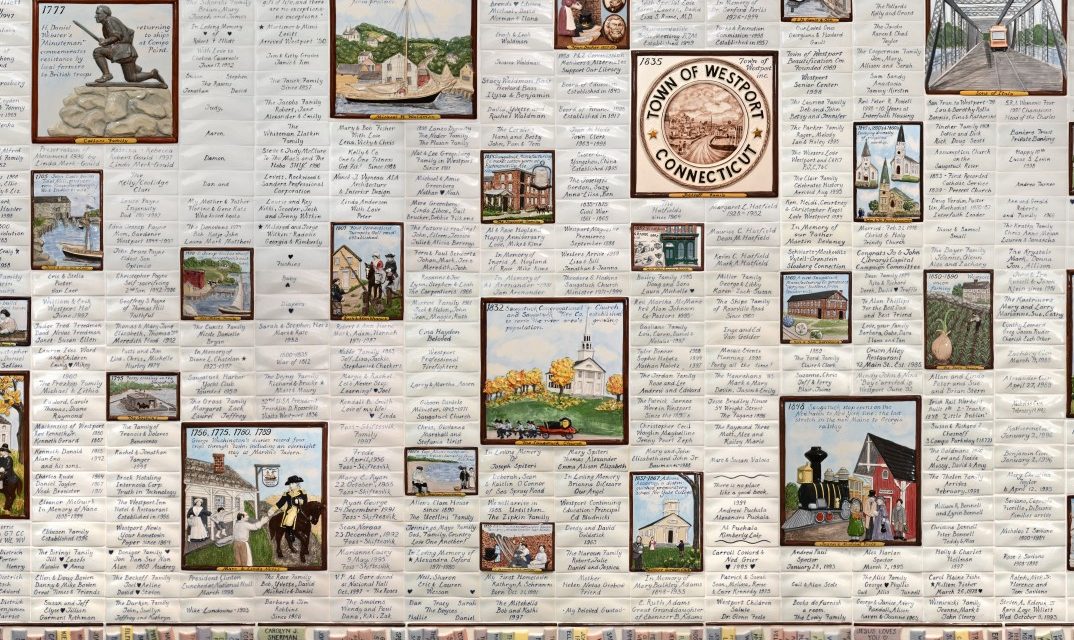
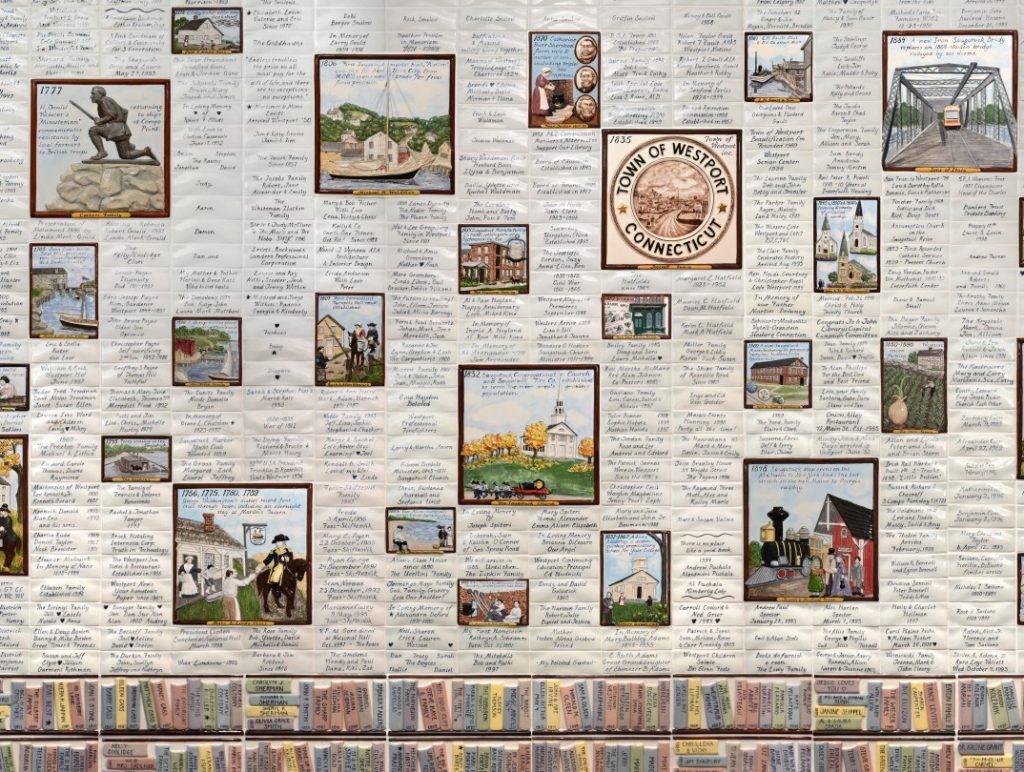
WESTPORT — A fundraising mural from a quarter century ago — a community cause to help fund the Westport Library’s reconstruction and remember the donors and town history in a mosaic of ceramic tiles — will not have a home in the new building.
The 26-foot-long, 6-foot-tall mosaic wall, known as the “River of Names,” was mothballed to a climate-controlled warehouse for the latest library overhaul a few years ago, with promises to return it.
But, fasten your seatbelts, the library on Friday posted a statement from its trustees “unanimously” declaring the tiled wall would not return after all.
“The decision was reached after the Library consulted with the Westport Arts Advisory Committee and the Westport Museum for History and Culture, which reviewed the content of the Tile Wall to determine if it depicted the town’s history in an accurate and inclusive way. Both organizations independently expressed concerns about historical inaccuracies and the lack of representation of diverse people who played a significant role in Westport’s history.”
The trustees’ decision is likely to get a bumpy ride, sparking debate about town history and how it might be reconciled with an organization that fights book bans and advocates for free access to information.
The “inaccuracies,” while not detailed in the library statement, apparently are related to depiction of indigenous peoples and the “lack of representation” concerns both racial and religious communities that have long been part of town history.
The donors’ names, according to the statement, instead will now be recognized on the “donor appreciation wall” on the library’s main floor.
A digital archive of the mural, with “an extensive narrative,” apparently will remain accessible online. Click here to view the digital River of Names.
Other issues that may arise are the “canceling” question, and the notion of donor disenfranchisement.
Inaccuracies, omissions cited in wall’s chronicle of Westport history
Library Executive Director William Harmer, who was not available to comment on the issue Friday evening since the library was hosting a program with former U.S. Poet Laureate Billy Collins, responded to the Westport Journal on Saturday, citing statements from several town boards supporting the decision not to re-install the River of Names.
The Westport Arts Advisory Committee, noting that artwork for the wall was created in 1996, said in a November 2021 statement: “While the piece aims to tell the chronology of our town, factual historical events and the diverse populations of Westport that played a significant role in the story of our town were omitted.
“We highlight these omissions because the commission claims to have weaved our town history
into the piece, yet it is incomplete. Also of concern is that at least one tile depicts the face of a white patron inappropriately overlayed in scenes of indigenous people. The importance of historical storytelling grounded in fact is vital to our growing efforts to come together as a society and embrace diversity and inclusion. As River of Names is not an accurate depiction of Westport’s history, it is inappropriate to be displayed in 2021 Westport.”
The arts group, however, suggests the digital version remain online with “an addendum, written by a town historian, to add historical omissions and to explain the context of the time in which the wall was created.”
In a November 2021 letter to Harmer, Nancy Diamond, then the chairwoman of arts advisory group, wrote that members of the panel’s diversity task force, had reacted to the wall with comments like, “This wall is a history of omission; no one on it looks like me,” and saying Westport’s history, as depicted on the wall was “white-washed.”
Other comments from the group, she said, were: “This wall was driven by donors and the need to raise money. It was not driven by history,” and “People go to the library to research the truth; this is not the whole truth.”
Several commenters also noted there was no mention of significant events in local Black and Jewish histories.
Harold Bailey Jr., chairman of TEAM Westport, in another letter to Harmer on the topic, said in his personal view, the wall lacks “historical inclusion and accuracy with respect to non-Europeans such as the enslaved Africans and African-Arnericans who were present from the Town’s founding through mid-1950’s.” That omission, among others, he wrote contrasts with “the currently celebrated presence of over 100 enslaved Africans within the Greens Farms Congregational Church’s segregated cemetery.”
Bailey also criticized the wall’s “portrayal of indigenous people as white visually and their history inaccurately,” as well as lacking any “portrayal of signature achievements and presence of non-Christian communities such as the Jewish community and its successes in having restrictive covenants eliminated legally and attracting [Martin Luther King Jr.] to Westport in recognition of its direct support to the Civil Rights movement.”
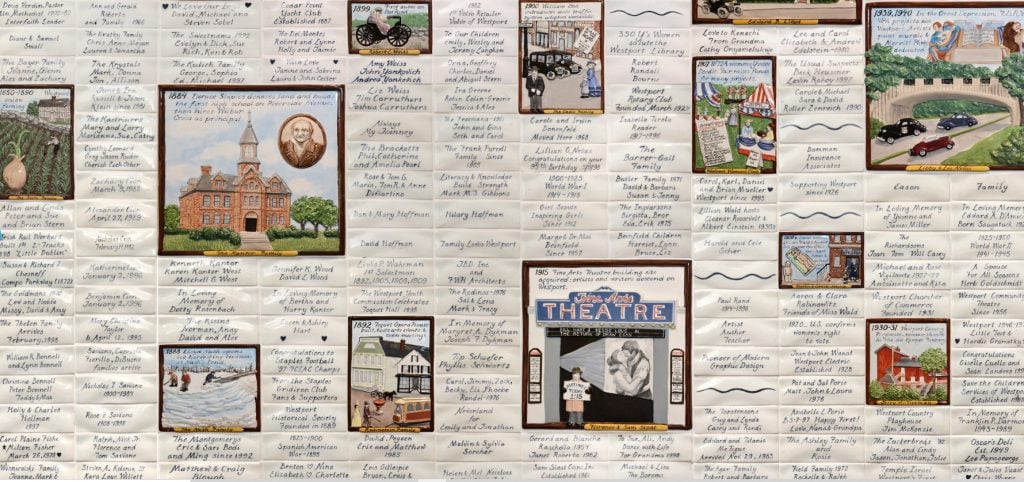
And, in another letter to Harmer, the Westport Museum for History and Culture similarly faults the River of Names as well intentioned, yet “rife with historical inaccuracy and a myopic view of history that will be hurtful and unwelcoming to modern viewers.”
The museum’s lengthy letter, which cites several examples of what is described as historical inaccuracy or misrepresentation, further states, “Most of all, and perhaps most importantly, the singular view of history represented on these tiles present a one-note image of the town that has never been true.
“The wall effectively erases indigenous people, African Americans, Jews, and others who were part of the story — from the beginning — even when that story was not pretty. It is hurtful and diminishing to our diverse citizenry — both within Westport and visitors from outside of the town — to see a proudly
white-washed display of this kind without explanation.”
The letter is signed by Ramin Ganeshram, the museum’s executive director, and Cheryl Bliss, its chairwoman.
River of Names organizers disappointed, angry
Betty Lou Cummings, a former selectwoman active in the community for many decades and one of the main organizers for the River of Names project, said the decision made her sad.
“I’m very disappointed,” she said. “I’m sure an architect could have found a perfect place for it.”
“We did it, and it was beautiful, and we raised a lot of money for the library,” she said.
“It can’t be destroyed,” Cummings said. “These are works of art.”
“I think it should be preserved,” she said.
Asked about the stated lack of diversity, she said:
“That’s their opinion. We created something magnificent.”
Dorothy E. Curran, who worked with Cummings on the project, also expressed disappointment in a letter to the editor.
“With patience and trust, since 2019 — when the Library hired a fine arts firm to remove the River of Names to safe, temporary storage to facilitate a new round of construction — these admirers have awaited its return,” she wrote.
“After all, isn’t this work a Library-owned asset? Doesn’t the Library receive 75 percent of its annual budget from Town taxpayers, and do right by its donors and patrons?”
After the River of Names was dismantled for the library’s reconstruction, it was moved to a climate-controlled warehouse and the digital record was created. Background on the original planning and execution of the tiled wall are included in this posting on the library website announcing the digital version.
Local artist Miggs Burroughs was hired to photograph each part of the mural.
“It’s a beautiful piece of artwork,” he said, wondering why it would be destroyed. “I don’t know why they couldn’t sell off each tile” for another fundraising effort.
He said he believes the library board tried earnestly to find a place for it in the new structure.
“For whatever reason, it couldn’t be made, or people objected,” he said.
Thane Grauel, executive editor, grew up in Westport and has been a journalist in Fairfield County and beyond more than three decades. Reach him at editor@westportjournal.com. Learn more about us here.





This episode reveals much of what is wrong with Westport now — days. “Culture Warfare” has consumed all bodies. Even the tiles on the wall are racist. OMG, these people are crazy, they are nuts. Talk about re-writing history — this is the most disgusting example in Westport recently. However, I will let you all in on a little secret, the mural sucks, and it’s too big. I always thought it was too big and everybody made way too much of a big deal about it when it was created and installed. I always said, to myself, “wow, this thing is huge and it’s not great to look at.”
With that being said, to dismiss it on the grounds of not accurately depicting history, one would have to be ready for the looney bin. Not to mention that these questions are subjective — to say the least — it is a part of Westport’s history. I was there when they did it. People put a lot of love into it. Nobody ever said at the time, that it should be taken literally to represent anything other than the donations of fine people. And to disregard that is disgusting and shows where people’s heads are at.
The cultural revolution in Westport is disgusting, you should be ashamed of yourselves for being so self-consumed, as to presume that you are the last word on Westport’s history. shame on you