

WESTPORT-The lure of “Lord of the Rings: Rings of Power” is enormous. Set in the Second Age, thousands years before J.R.R. Tolkien’s epic fantasy, it introduces the young Elf warrior Galadriel (Morfydd Clark), the immortal character played by Cate Blanchett in Peter Jackson’s film trilogy.
After Galadriel’s paradisiac kingdom was destroyed by the evil Orc Sauron, forcing Elves to flee to Middle Earth, she is determined to wreak revenge. But first she has to find Sauron, a quest that involves treacherous journeys to many lands and a seemingly endless swim through the sea of time – during which she encounters a human castaway named Halbard (Charlie Vickers).
Galadriel’s joined by half-Elven Elrond (Robert Aramayo), aide to High King Gil-galad (Benjamin Walker), who is less than sympathetic to her search. So Elrond undertakes achieving an alliance with Dwarf Prince Durin of Khazadum (Owain Arthur) in his subterranean kingdom.
Meanwhile, the Elf scout Arondir (Iamael Cruz Cordova) indulges in a forbidden liaison with single human mother Bonwyn (Nazanin Boniadi), who kills an Orc that threatened her rebellious teenage son Theo (Tyroe Muhafidin).
So where are the Hobbits? They’re now called Harfoots. Secretive and nomadic, the Harfoots are barefoot wanderers. Then, one day, one of their tribe, Nori Brandyfoot (Markella Kavenaugh), discovers a mysterious stranger (Daniel Weyman) who landed in a flaming crater created by a meteor.
Reportedly the most expensive series in TV history, it was created by showrunners J.D. Payne and Patrick McKay, and Amazon has already committed to a five-season run. In the first few episodes, directed by J.A. Bayona, spectacle reigns supreme. The lavish sets, costumes and props are imaginative and densely detailed.
But in order to sustain interest, after introducing the folklore of these diverse characters, the ambitious series must now develop the ensemble’s interactions and their individual story arcs in order to sustain audience enthusiasm.
On the Granger Gauge of 1 to 10, “Lord of the Rings: Rings of Power” is a showy, splashy 7 – with a new episode streaming Fridays on Amazon Prime.
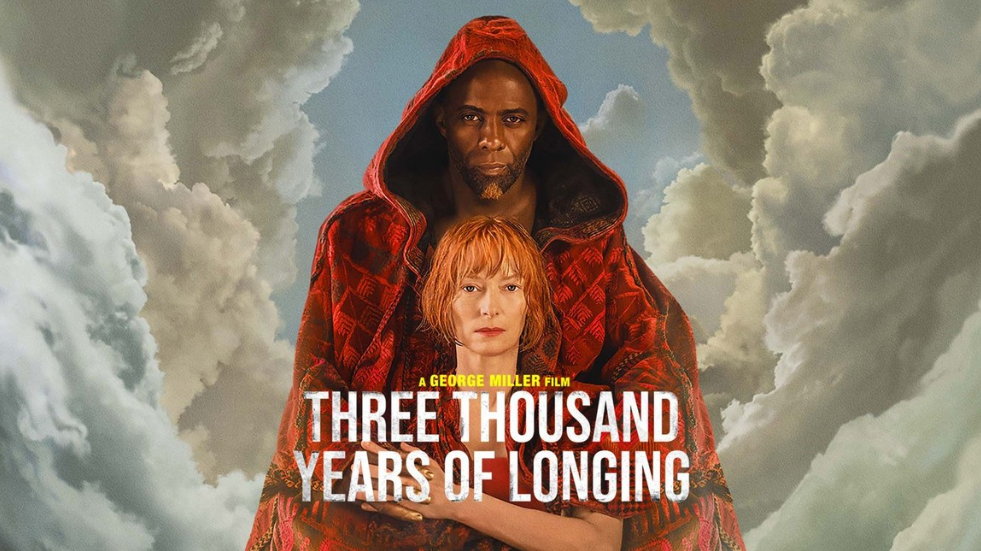
George Miller’s “Three Thousand Years of Longing” is a far cry from his last film “Mad Max: Fury Road” (2015). Instead of violent action, Miller delves into the thought-provoking power of fantasy and storytelling.
“My story is true, (but) you’re more likely to believe it if I tell it as a fairy tale,” declares Alithea Binnie (Tilda Swinton), a middle-aged professor of narratology (the study of stories). She married young and, when her husband left her for another woman, she felt liberated to pursue her research.
At a gift shop in Istanbul’s Grand Bazaar, Alithea buys a decorative glass bottle that she brings to her hotel. While cleaning it, she twists the top, releasing a powerful Djinn (Idris Elba)- a.k.a. genie – who offers her three wishes.
Cautious, she asks him about his life, how he was imprisoned and what people have wished for in the past. As the Djinn answers, there are various flashbacks, including interludes with the Queen of Sheba (Aamito Lagum), King Solomon (Nicolas Mouawad) and Zefi (Burcu Golgedar), a genius inventor.
Eventually, Alithea realizes that love and companionship have been missing in her life, so she brings Djinn back to her London flat, where they enjoy a domestic partnership for several months. But – without granting wishes – the Djinn’s mystical essence begins dissipating in the modern world.
“If you make no wish at all,” the Djinn warns Alithea. “I will be caught between worlds, invisible and alone for all time.”
“Love is a gift of one’s self, given freely,” she acknowledges. “It’s not something one should ever ask for.”
Adapted from A.S. Byatt’s novella “The Djinn and the Nightingale’s Eye,” it’s scripted as a cautionary tale by director George Miller and his daughter, Augusta Gore, with exquisite vignettes, exploring themes of fate, loneliness and the universal desire for connection. With superb comedic timing, Tilda Swinton and Idris Elba play off each other perfectly.
On the Granger Gauge, “Three Thousand Years of Longing” is an idiosyncratic, whimsical, supernatural 7, an avant-garde fable aimed at an older audience and playing in theaters.
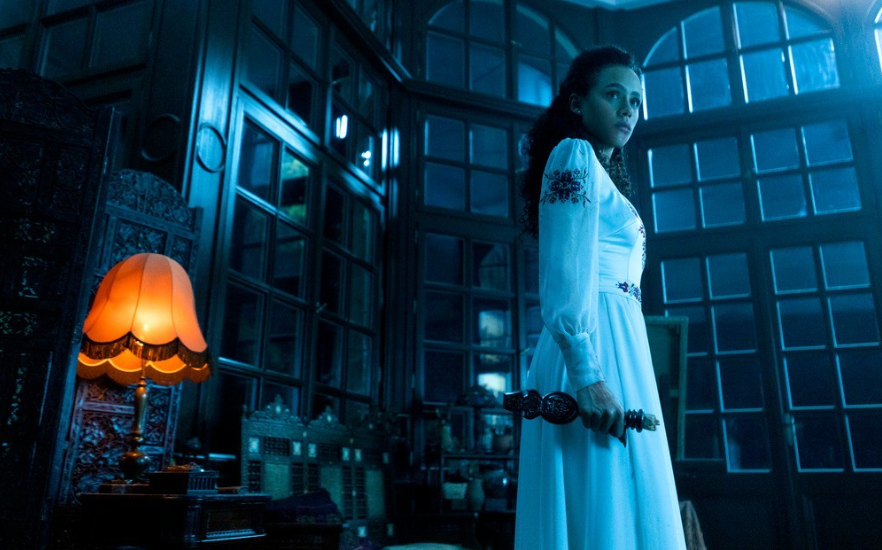
Originally titled “The Bride,” “The Invitation” is an excursion into Gothic horror that pivots around issues of race and class.
After an all-too revelatory prologue, the story begins in New York, where twentysomething Evie (Nathalie Emmanuel), a struggling artist, works as a catering waitress to pay the bills. At an event promoting a DNA testing company, Evie swipes a swag bag and takes the saliva test at home.
Feeling abandoned since the death of her mother, Evie is obviously seeking a sense of identity. Then, quite unexpectedly, she receives a message from an enthusiastic second cousin, a visiting realtor, Oliver Alexander (Hugh Skinner). As it turns out, she has a number of relatives who are all British – and white.
Oliver invites her to a three-day wedding celebration at an English country estate known as New Carfax, hosted by Walter De Ville (Thomas Doherty), for a huge family reunion. It’s an all-expense-paid trip that offers her an opportunity to meet other relatives. Although her outspoken best friend Grace (Courtney Taylor) is skeptical, Evie is obviously intrigued.
Reminiscent of Jordan Peele’s “Get Out,” naïve Evie is immediately subjected to racist innuendos since she’s the only guest of color. Mr. Fields, the condescending head butler (Sean Pertwee), mistakes her for a member of the staff, while a bitchy bridesmaid, Victoria (Stephanie Corneliussen), wants to touch her hair.
A Spa day for the women proves a distraction, but the masked dinner party is decidedly ominous, as is Walter’s locked library that’s definitely off-limits. Vampirism is afoot, as Evie gradually realizes she’s being positioned to be the new bride of Dracula.
Written by Blair Butler and director Jessica M. Thompson, the PG-13-rated script reveals its secrets too early and the action relies far too much on freaky jump scares.
FYI: Nathalie Emmanuel was Missandei on HBO’s “Game of Thrones.” And if you wait for the DVD and/or streaming, there will be more gore, violence and nudity.
On the Granger Gauge, “The Invitation” is a creaky, creepy 4, playing in theaters but I’d advise not RSVPing.





Recent Comments