
By Susan Granger
Today’s political and social forces could create a seismic change in the movie industry–with a dramatic product revamp rivalling the major changes in Hollywood’s 100-year history.
With the election of Donald Trump to a second Presidential term and a right-leaning electorate, traditionally liberal Hollywood will – inevitably – feel the heat.
A ticket-buying public that feels increasingly isolated could also make Hollywood dramatically change its product mix.
After many years of embracing progressive values – like empowering women in “Barbie” and promoting female superheroes, the diversity and inclusion in the MCU and “Star Wars” storylines and in animated children’s fare – the tide may turn.
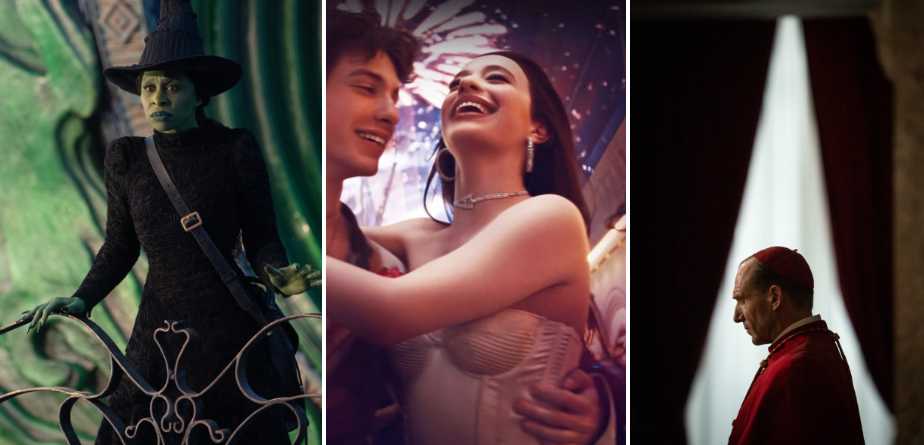
Fear of being out of touch with the mainstream is rampant and – historically – Hollywood tends to follow, not lead. It’s not going to affect big action pictures that are out or in the can, like the new “Mission Impossible” and this year’s Oscar contenders, including “Conclave,” “Anora” and “Wicked.”
With anti-Semitism making headlines on college campuses, we should not forget that Hollywood has produced Oscar winners like “Gentleman’s Agreement,” “Diary of Anne Frank,” “Schindler’s List” and “The Pianist.”
Among this year’s Oscar contenders, there’s Brady Corbet’s “The Brutalist,” starring Adrien Brody as a Holocaust-surviving Hungarian architect who finds sanctuary in Pennsylvania – until there’s a brutal wake-up call from a capitalist benefactor who plans to exploit him as just another plaything in his toy chest of wealth.
“The Brutalist” is a sobering and remarkably timely testament to the contradictions between American immigrant promise and the inequalities that keep it unfulfilled for so many.
Also in the running are “A Real Pain” with Jesse Eisenberg & Kieran Culkin as Jewish cousins who travel to Poland to visit their Holocaust- surviving grandmother’s childhood home.
And “September 5,” revisiting the hostage crisis at the 1972 Summer Olympic Games. Steven Spielberg’s “Munich” and Kevin McDonald’s “One Day in September” did too, but the ongoing Israel/Hamas conflict makes this picture regrettably timely.
As part of his political strategy, or, judging from the soft tone he took in the recent Time magazine interview, his political showboating, the president-elect has repeatedly pushed back on “woke culture,” threatening to defund Public Radio and PBS and potentially to restrict the awarding and renewal of FCC broadcast licenses.
Diversity programming in Hollywood was turbocharged by the #MeToo era, with the public revelations of serial sexual predation by one of Hollywood’s most accomplished and revered producers–Harvey Weinstein. “Wait,” Hollywood said, “He’s not us!”
In fact, according to the USC Annenberg Inclusion Institute, by 2022, 31 of the top films featured an individual from an under-represented racial or ethnic group in a lead or co-leading role. But only 15% of 2022’s top grossing films featured a cast that was “gender balanced” – which they define as featuring girls/women in 45-55% of speaking roles.
In the wake of Black Lives Matter, many major corporations – including tech titans Amazon, Google, Netflix and Apple – became more willing to wade into heated local and national debates over increased diversity, equity and inclusion. Now – with the GOP majority – I think you’ll see those efforts fall off or simply disappear.
Which is a shame. Marvel scored BIG with “Black Panther” and even Brie Larson’s female “Captain Marvel” did well. In their wake, there was “Shang-Chi,” featuring an all-Asian cast, and filmmaker Chloe Zhao made “The Eternals.”
But Marvel’s upcoming projects are less diverse. The upcoming “Fantastic Four” has only one major person of color and in the “Thunderbolts,” four of those six are white.
It’s not just Marvel. “Batgirl,” starring Dominican actress Leslie Grace, has already been dumped by Warner Bros., and Disney has not renewed ”The Acolyte,” which focuses on the relationship between two Black female leads and their non-white mentors.
Of course, the political climate in the US may not influence content in 2025 as much as it may have in the past. Hollywood is far more global today and, possibly, less vulnerable to tacit or explicit pressure from domestic politicians and the right-leaning zeitgeist.
On the other hand, electorates across the globe are turning to hard-right politicians, who are promising to turn back the clock on the progressive agenda.
Another trend that some in Hollywood are tracking is loneliness. One study concludes that Generation Z is lonelier than previous generations, which presents a great opportunity for Hollywood.
Another study says young people – ages 10 to 24 – wanted to see more friendships, platonic relationships, buddy comedies – and were less interested in sex and romantic entanglements. When asked to name their favorite TV shows from the last three years, many cited “Stranger Things,” and the nostalgia of “The Big Bang Theory” and “Friends.”
Hollywood has already picked up on this. This year’s crop of buddy movies include Will Ferrell’s documentary “Will & Harper,” a cross-country road trip with Ferrell’s long time friend Will, who transitioned into a woman – along with “Nickel Boys,” “A Real Pain,” “Challengers” and the animated “Memoirs of a Snail.”
I do not know exactly what Hollywood will produce in this next era, where patriarchy and Christian values are ascending and where ticket buyers are looking for stories about friendship. I do know that Hollywood has met other challenges and I know the American movie business will continue to produce movies that will excite, energize and enthrall viewers here and around the world.





Recent Comments