
By Gretchen Webster
The Historic District Commission was told last month that a second public hearing must be held on a plan to designate six town-owned bridges as local historic properties. But when a second public hearing was held by the HDC on Tuesday – not a single member of the public spoke.
The commission then approved the bridge study unanimously, without additional public comment, so the historic designation of the bridges could become a town ordinance and come before the Representative Town Meeting for approval.
Owner’s request

The Historic District Commission considers designating local historic properties often, but a property owner must file a request with the commission for the designation, HDC Chair Grayson Braun said after Tuesday s meeting.
“Anybody can come to the HDC and ask for their property to be designated,” she said. “But bridges are a little more complicated.” First of all, they are town owned, which means any resident a can ask for the historic designation, but there are wider concerns with public property, especially a bridge, she said.
Safety first
“There is a point where it bumps into public safety,” Braun said. “We can’t approve something that would disrespect public safety.” Safety is even more of a concern, she said, when the historic bridges are in disrepair.
Just as with any property designated to be a local historic property, any alteration to the bridges would require a certificate of appropriateness from the Historic District Commission, she said.
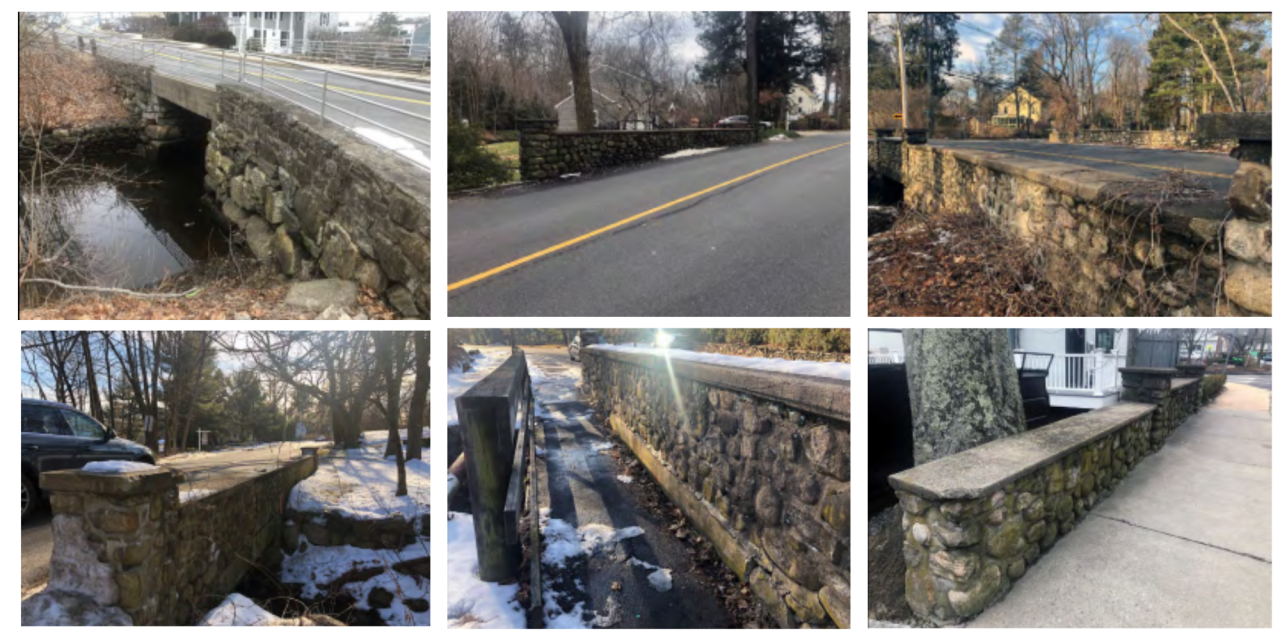
The six bridges proposed for the historic designation are:
- Evergreen Avenue Bridge over Deadman Brook
- Jesup Road Bridge over Deadman Brook
- Greens Farms Road Bridge over Muddy Brook
- Cross Highway Bridge over Muddy Brook
- Long Lots Road Bridge over Muddy Brook
- Myrtle Avenue Bridge over Deadman Brook
The history and significance of each of the six bridges was presented in an 88-page report completed last October by HDC member Benjamin Levites, and William Ryan. “These bridges contribute to our distinctive character and help remind us how Westport evolved through time,” the report said.
Designer Merrick Cooley
All of the bridges, except the Jesup Road Bridge over Deadman Brook, were designed and constructed by engineer Merrick H. Cooley, according to the report. Cooley was a selectman and the town’s Collector of Revenue.
Built from 1915 to 1950
The Evergreen Avenue Bridge, (circa 1920), is within the Evergreen Avenue Local Historic District, and the Jesup Avenue Bridge (circa 1950), and Myrtle Avenue Bridge (circa 1915) are part of the Westport Center National Register District. Both were originally wooden bridges, according to the report.
The Greens Farms Road, Cross Highway, and Long Lots Road bridges were all built around 1920, and all in the Arts & Crafts style “of cobblestone and reinforced concrete,” according to the report.
Review of the bridge report is not yet scheduled on an RTM agenda.






You know something has truly gone awry when the chair of the Historic District Commission takes to the podium to publicly sabotage the Commission’s own preservation initiative – using DOT’s favorite straw man that preservation and safety are somehow mutually exclusive.