
By John Schwing
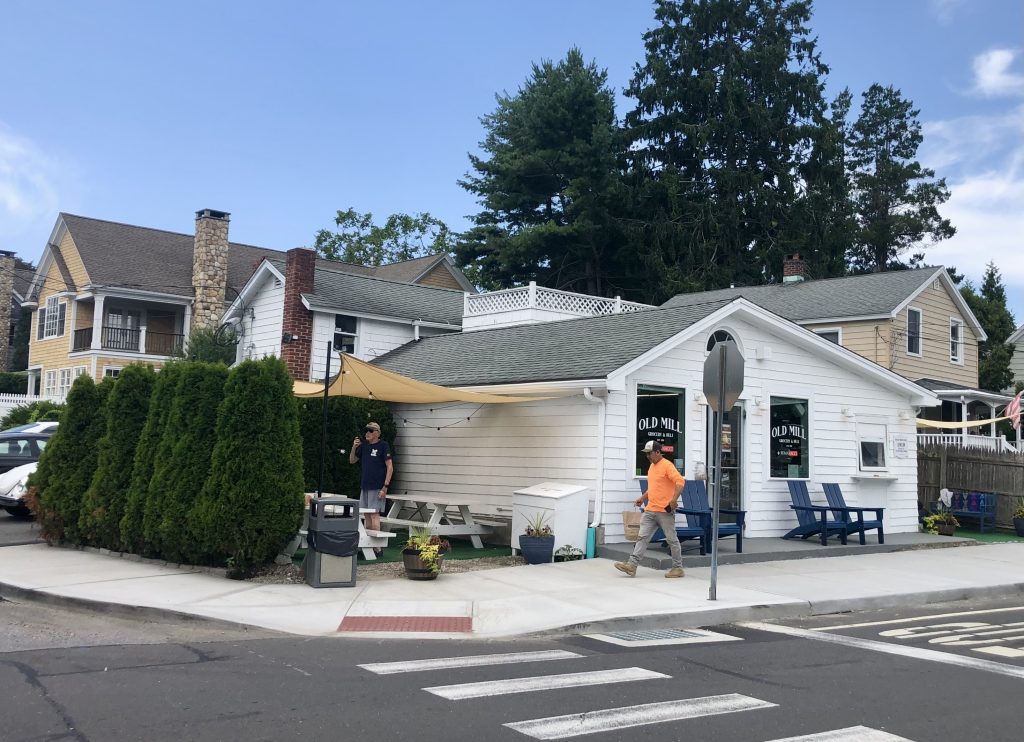
WESTPORT — Another round of debate over whether to allow alcohol sales at a longtime market on Hillspoint Road was on tap at Monday’s Planning and Zoning Commission meeting, but final resolution of the issue was set back when questions arose over how to define property setbacks.
The P&Z appeared poised to approve text amendment 846 — a new proposal that would define standards for outdoor dining and liquor service for Old Mill Grocery & Deli, as well as two other food establishments in residential zones — when a long, sometimes confused, discussion ensued among commission members over issues that Michael Calise raised over the measure’s language on property line setbacks.
The amendment will return for further P&Z review, pending legal guidance on questions about how to address differences among the three business’s property setbacks without providing ammunition for another potential lawsuit.

The amendment under review is essentially a third version of the hotly debated plan to allow alcohol sales at the Old Mill Grocery & Deli, currently leased by Romanacci restaurant from the property’s owner, Soundview Empowerment Alliance, Inc.
The first proposed amendment, reviewed by the commission in May, would have allowed liquor sales by retail food establishments in residential zones. It identified the Old Mill market at 222 Hillspoint Road, a Residence B zone, and The Porch at Christie’s, 161 Cross Highway, an AA Residence zone, as the only two properties affected by the proposal. But questions were raised about whether its scope actually was broader than those two entities.
The proposal was subsequently revised, and approved by the P&Z in June, to apply only to food businesses in a Residence B zone, effectively limiting its impact to the Old Mill Grocery.
That, in turn, prompted several neighbors to file suit against the P&Z and challenge the amendment in Superior Court, and also to appeal to the town’s Zoning Board of Appeals to overturn then-Planning and Zoning Director Mary Young’s decision to sign a liquor license for the business. There has been no decision on either challenge.
The latest amendment, the topic of Monday’s P&Z hearing, again changes the parameters on retail food establishments allowed to sell alcohol, which now would include those located in any of the town’s residential zones — pre-dating Sept. 1, 2024. That, in addition to the Old Mill market and Christie’s, also applies to the Country Store at 332 Wilton Road, also in an AA zone.
The measure would set standards for these establishments to allow outdoor seating and food service from carts, as well as the size of outdoor dining areas; limits on parking, signs, music and lighting, and set hours of operation from 7 a.m. to 9 p.m. Sundays through Thursdays and 7 a.m. to 10 p.m. Fridays and Saturdays.
The businesses also could have no more than 10 indoor seats. Alcohol sales would not be allowed after 9 p.m. and could comprise no more than 50 percent of the establishment’s annual gross sales. That figure would have to be verified yearly by the operator by filing an affidavit with the P&Z Department, according to the proposal.
Before questions arose over the food businesses’ setbacks from abutting properties, arguments over the new amendment largely mirrored those from the several P&Z hearings last spring.
Eric Bernheim, the lawyer presenting the proposal to the commission, said the goal is to change the “non-conforming” status of the three businesses to “permitted uses” in residential zones.
With one lawsuit filed over liquor sales at the Hillspoint market — which he argued would not prevail — Bernheim said the new amendment is designed to better withstand the same sort of legal challenge, particularly the issue of “spot zoning” since the earlier amendment was deliberately tailored for the single 222 Hillspoint property.
He dismissed neighbors’ concerns about the store, noting that there has been a business operating at the site for more than a century and that people knew “full well what was happening across the street” when they purchased their homes in the area.
The measure also sets forth a series of regulations for outdoor dining heretofore unaddressed for the three enterprises, and preserves the “charm” of various commercial styles embedded in the town’s neighborhoods, he said.
Jim Hood, a board member of building owner Soundview Empowerment Alliance, told the panel the group had circulated a letter signed by more 600 people in support of the Old Mill Grocery & Deli. The business also provides job training for people with disabilities, he noted.
While the tenant, Romanacci, runs the 105-year-old market in a “diligent and professional” manner to serve the community, Hood said, the operation “must be profitable” to continue.
P&Z Chairman Paul Lebowitz, before opening the meeting for public comments, acknowledged the commission had already spent “a tremendous amount of time” on the issue and took extensive steps, as “protectors of the town,” to make sure that designating the properties as permitted uses “fit in the community.” The commission’s work, he added, represents an effort to “make the model work” in a way Positano’s, a restaurant that previously operated nearby, could not.
Stacie Curran, who lives across Hillspoint Road from the store, endorsed that view, saying although her property is directly affected by the market, she is “exponentially” in favor of the amendment and cannot say enough positive things about the business. The detriment to the neighborhood, she added, was the closure of restaurants like Positano’s and Allen’s Clam House, a fate she hopes the market will not suffer.

Several members of the Representative Town Meeting also rallied in support of the market, including Chris Tait, Andrew Colabella, Matthew Mandell and Jimmy Izzo. They all described the business as a well-liked community institution, which under various changes of management, has been operated the same way for decades.
Joel Green, the lawyer representing neighbors who filed the lawsuit against the earlier amendment, unsurprisingly saw things very differently.
He said there has been a lot of “misinformation” about neighborhood opponents and their concerns. He said they do not oppose the continued operation of the business as a grocery store, its traditional role in the community, which they feel should be “preserved” and not changed.
Contrary to Bernheim’s view that the lawsuit will fail, Green said the pending court appeal “is a very good one,” adding that the new amendment also is “vulnerable” to a legal challenge.
That proposal poses “unintended consequences” for the town, he said, and should not be approved as the result of “a popularity contest.” The campaign in support of the market is “meaningless” in regard to the P&Z’s responsibility to make decisions as required by its regulations, he said.
The prior amendment has permitted “scaling up” disallowed non-conforming uses, he argued.
Green cited a list of what he considers a “lack of information” that has flawed the new amendment, with no analysis provided about its impact on the three targeted properties. He ticked off issues such as no traffic studies, no analysis of outdoor patron floor areas and seating capacities, no noise analysis, no review of the six weeks during which the Old Mill store has been allowed to sell alcohol.
And, he added, there has been no economic analysis, asking, “Does [the Old Mill Grocery] really need this to survive?”
Gloria Gouveia, longtime land-use consultant, said the application “is not about ice cream — don’t be ridiculous” and called the application “woefully deficient” since it lacks demonstration models for the only three properties affected by it.
Instead, she said, the proposal appears to be an attempt to ensure a business’s profitability, which if that were an appropriate role for the P&Z, “the queue would be miles, ringing around Town Hall, of people having business difficulties that would benefit from more generous zoning regulations.”
Neighbor Ellen van Dorsten, one of the parties who brought the lawsuit, also spoke in opposition, noting that she lives on Hillspoint Road about 100 feet away from the store.
The store has traditionally operated only as a “grocer/deli,” she said, and previously has never had more than one picnic table outdoors. Other issues concerning prior zoning violations and alcohol sales at the site need to be explored by the commission before a decision is made on the new amendment, she added.
Hood responded to the critics, saying he finds their arguments “are getting preposterous.”
In essence, he said, the Soundview Empowerment Alliance is seeking only to formalize what the business has offered customers for decades.
Other than what he said are the only “two neighbors” fighting the application, there have been no complaints from other Old Mill neighbors or patrons since his group took ownership of the property.
“Are their values so different?” from the opponents, he asked. “Do they embrace noise, lights, chaos, crime, drunkenness?”
“There are two [opponents] and then there is the real world, and I would encourage the commission to keep that in perspective,” he concluded in urging adoption of the new text amendment.








Good luck enforcing the restrictions on those outdoor eating areas. I could fill a page but my favorite excuse is: “Our [P&Z] staff doesn’t work at night thus we cannot independently verify the conditions you cite in your complaint”. If you’re a nearby resident, better just embrace the suck .
I really appreciate Stacie Curran’s comments here. I imagine if Westport had more folks saying – YIMBY – yes in my back yard – to the beneficial things in town it could be to our benefit. Another oversized house is not needed at this location as the alternative