
Editor’s note: The following commentary was submitted by Clarence Hayes, a District 4 member of the Representative Town Meeting.
____________________________________
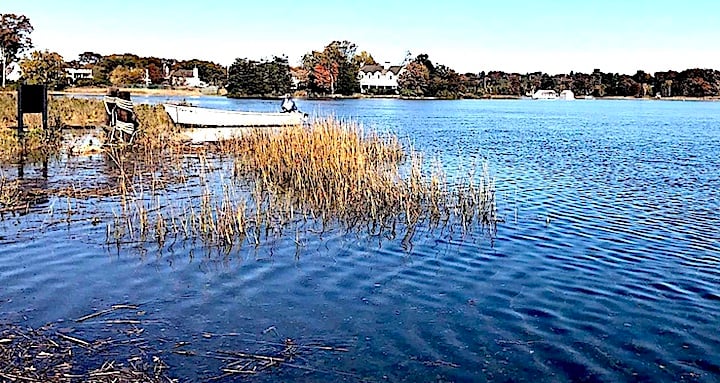
Westport is facing a once-in-a-generation opportunity as it considers the investment required to deal with the deterioration in the tidal dam structure which supports the Sherwood Mill Pond.
The current structure is 30-plus years old, and several elements are rotted out. Something has to be done. This one time decision will determine the fate of this tidal estuary for another 30-plus years. There are several possible futures.
The first, about to be presented to the Board of Finance as a $5.6 million request, is to do what we’ve always done: simply rebuild the structure and continue to maintain an artificial pond.
The second option is to remove the barriers and let the basin revert to a natural tidal estuary, with full twice a day tidal flushing across the whole basin. This option has never been studied.
The only extensive environmental assessment of the basin was done in 1982. Its objective was how to remediate the unhealthy state the pond had fallen into, not to evaluate a fully natural option.
The third option is to utilize the tidal flow from a dammed pond to generate emissions-free electricity. If the town decides against enhancement of the natural habitat (Option 2), then it will have sunk costs of close to $6 million for Option 1. Given that we would already be incurring the main structural cost, the incremental cost would primarily be turbines and interconnection to the grid. A 1-megawatt turbine can support 1,000 homes.
The net additional investment could be as low as $1 million per megawatt, with maintenance costs under $100,000 per year, with a life span comparable to the dam structure, of at least 30 years. That is cheap climate-friendly power.
Option 1 is what I call the “no imagination” option, where we just do what has always been done.
Option 2 takes seriously the town Plan of Conservation and Development, which calls for protection and enhancement of the coastal environment.
Option 3 takes seriously the town’s “Net Zero 2050” objective.
I represent District 4 on the RTM. I live a few minutes walk up the hill from the pond and Old Mill Beach. I walk by this area all the time, and frequently stop at the dam to watch the water and the wildlife.
I also frequently walk by and observe the Grey’s Creek natural estuary between Longshore Park and Hall Island. Twice a day it fills and empties, and provides a fascinating and ever-changing snapshot of local wildlife. And, due to the full and regular tidal flows, it does not smell like “rotten eggs.”
Based on my amateur naturalist readings, I think a natural estuary — Option 2 — would be biologically richer, and form a slightly better storm surge buffer (deeper, less sedimentation). But I would love to engage real experts to evaluate this alternative. Let’s talk to the Connecticut Department of Energy and Environmental Protection (DEEP), and find appropriate experts at UConn and/or Yale to help us.
The same can be said for my conjecture on tidal hydro power. I’m semi-literate in regards to construction costs/challenges, and I’ve done some reading on tidal hydro. But, again, I would love to engage real experts to come up with real costs. Let’s talk to Eversource and DEEP, and find an engineering firm (or interested team at UConn/Yale/MIT) to help us.
This is a generational decision. As of now, only Option 1 has been evaluated.
Why would we not take the time, and spend some relatively minor consulting money, to evaluate other potentially better scenarios, in order to put the best possible information in front of Westport residents and the RTM in order to make Westport as good as it can be?
The first presentation of Option 1 by the administration will be this Wednesday, Oct. 9, at the Board of Finance meeting at the Town Hall auditorium.
I invite anyone who has relevant knowledge or contacts with experts as it relates to Options 2 and 3 to contact me at chayes@westportct.gov.













A chance to move 10% of all Westport residences onto clean tidal power? Of course this needs to be seriously looked at.