
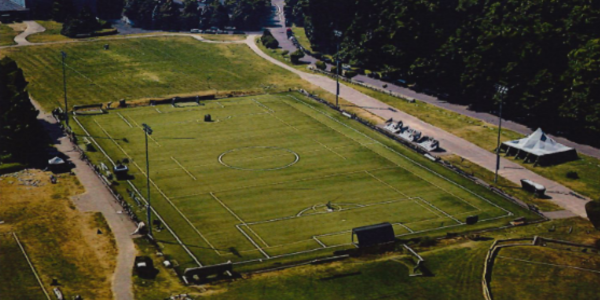
Editor’s note: following is an opinion submitted by Westporters Luc LaFontan and John Sabino.

Who are these lights for? Drive past any lit field on a fall evening and the question answers itself. They’re for the eight-year-old whose soccer practice got pushed to 7 PM because the field ahead of hers ran long. They’re for the travel and rec teams already fighting over impossibly tight windows every week, especially as daylight shrinks from September through March. They’re for the multi-sport athletes whose schedules are chaotic not by choice, but because there isn’t enough field inventory to give every team a predictable, humane slot. Lights don’t create demand for youth sports in Westport — that demand already exists. What doesn’t exist is enough daylight or field space to meet it.
We’re Luc LaFontan (6 Melon Patch Lane) and John Sabino (8 Melon Patch Lane), and, along with many of our neighbors near Wakefield Fields, we’ve spent years of our free time on the fields of Westport and surrounding schools — as parents of kids ranging from a Staples freshman to an 8th grader at Bedford to college athletes who came up through the same programs, and as coaches across multiple sports ourselves.
The disadvantage is already visible — you just have to drive to New Canaan to see it. Spend a Sunday evening at New Canaan High School and it’s immediately clear how far behind Westport already is. Three lit fields, every sport, teams still running at 8 PM. That’s not a hypothetical future scenario — it’s what a town with adequate lit field capacity looks like right now, twenty minutes away.
That context matters when weighing the recent op-ed against these lights. Karl Davis cited a Staples head soccer coach who says he doesn’t want his own varsity athletes on the field past 8 p.m. But that complaint proves the opposite of what it’s used for: teams are on the field at 8 p.m. because there isn’t enough lit field capacity to schedule them earlier. That’s an argument for more lights, not fewer. And it’s worth being direct about the broader picture: in conversations with coaches across football, lacrosse, soccer, rugby, and track, we have yet to find one at the high school level who opposes this project. This isn’t a case of schools resisting lights the town wants to impose on them.
The op-ed’s second move — recasting Erik Barbieri’s comment about “maximizing the investment” as proof the project exists to serve private donors rather than the public — is an ungenerous reading of an ordinary fiscal reality. Public recreation infrastructure in nearly every Connecticut town is funded with a mix of public and philanthropic money, because taxpayers alone rarely cover stadium-grade capital projects. Saying a donor-funded project needs realistic operating hours to justify the investment isn’t a confession of corruption; it’s an acknowledgment that nobody writes a large check for infrastructure that will sit idle. If the real objection is that private fundraising for public fields creates bad incentives, that’s a legitimate town-wide conversation about capital funding policy. It’s a much weaker basis for killing one specific, years-in-the-making field improvement.
The claim that Westport doesn’t actually have a field shortage — that the real problem is “poor resource management,” pointing to underused fields like Loeffler and the loss of Long Lots — is the least convincing part of that argument. Given how sports scheduling works, some fields sit underused at some hours; that’s the exception, not the rule. The real pattern is a scramble for field time at the start of every season and through most of it. No parent whose child’s practice keeps getting bumped to a worse, more distant field is going to feel reassured that better spreadsheet management was the fix all along.
None of this means the review process should be waved through. Davis is on firmer ground raising questions about renderings, sound management, and safety policy — those are legitimate, specific asks, and P&Z is right to demand them before final approval. But that’s an argument for a rigorous process, not for treating the entire project as a giveaway to “connected officials and private interests.” Westport residents deserve a thorough review. They also deserve a Parks Department that isn’t held to an unfalsifiable standard, where no evidence of need is ever enough and every dollar of private funding is treated as suspicious rather than as the normal way towns everywhere build shared infrastructure.
The honest version of this debate isn’t “lights for elite travel clinics” versus “no lights at all.” It’s a town with a real, visible field shortage during the darkest months of the youth sports calendar, weighing a capital investment that would let existing school and rec teams get the practice time they’re already fighting over. P&Z should require the missing renderings, a real balloon test, and a usage schedule Parks is held to. What it shouldn’t do is mistake legitimate process questions for proof that Westport’s kids don’t need the field time in the first place.
Luc LaFontan
Melon Patch Lane
Westport
John Sabino
Melon Patch Lane
Westport







Thank you for this article, Luc and John. As a parent to three kids all of whom are in sports, I whole-heartedly agree. Westport is way behind other towns in the athletic infrastructure. We also are in a desperate need of an indoor facility which would operate year-round.
Driving kids to other towns on a daily basis is not fun and is very time and energy-consuming. Needless to mention the money we spend outside of Westport paying for various sport clinics and the traffic to which we greatly contribute only because we do not have a choice of staying local.
Thank you Katerina. We agree with you.
Sadly, with how much opposition we have received to something as simple as putting lights on an existing field, I can not imaging how certain interests would oppose a permanent new indoor facility. That said, lets hope we can get these lights installed without too many crazy restrictions that make the project unviable and unable to meet its intended use. Thank you for standing up and vocally supporting our kids and growth of our community.
Luc and John make a compelling case for the fall daylight crunch, but no one is arguing about the time the sun sets. They have miscast opposition to Parks’ plan as opposition to any lighting, while mistaking the lack of vocal pushback from coaches as endorsement of its specifics. As the Staples coach’s testimony proved, Parks’ plan was developed without direct user input and remains out of scale with the Wakeman site.
We all want our kids to have access to high-quality facilities, and when the authors write that P&Z should “require the missing renderings, a real balloon test, and a usage schedule Parks is held to,” I couldn’t agree more. But by the authors’ own standard, the application before the commission is legally incomplete and cannot be approved.
In fact, during the recent P&Z work session, Chairman Lebowitz suggested requesting this missing scheduling data from Parks — only to be reminded by the P&Z Director that the evidentiary record is officially closed (by his own vote). In that same session, Vice Chair Cammeyer argued that Westport is behind other FCIAC towns who all have lit soccer fields, as Luc and John do in referencing New Canaan. But that assertion is not supported by the record and sidesteps basic context: How many of those towns chose to light two non-soccer fields first? How many allow non-school rentals? Commissioners cannot set aside due diligence just to remedy past municipal planning choices.
Most critically, P&Z cannot outsource its regulatory oversight role to Parks through vague draft conditions like limiting lights to “Parks/Town-sponsored events.” Parks leadership is already on record claiming the authority to rent fields to out-of-town, for-profit commercial entities. So, the Chair and Vice Chair’s words about barring ‘pay to play’ under the lights are meaningless without language that reins them in.
If even the most dedicated advocates for lights concede that critical visual studies and usage schedules are missing, P&Z should not rush through an unvetted approval that relies on unenforceable “trust-us” management.
I was testing an AI-writing detection tool (Pangram) this week and decided to run a few pieces through it. I was surprised to see it return a high confidence that the entirety of this op-ed (with the exception of the second paragraph where the authors introduce themselves) was AI-generated. Much like P&Z is outsourcing its oversight to Parks, and Park is being steered by Musco Lighting and pay-to-play leagues, it seems these gentlemen are letting an LLM do the arguing for them. On an issue that is supposedly very personal, that rings hollow.