
Editor’s note: Following is an opinion submitted by Jennifer Johnson, an RTM member from District 9.
—
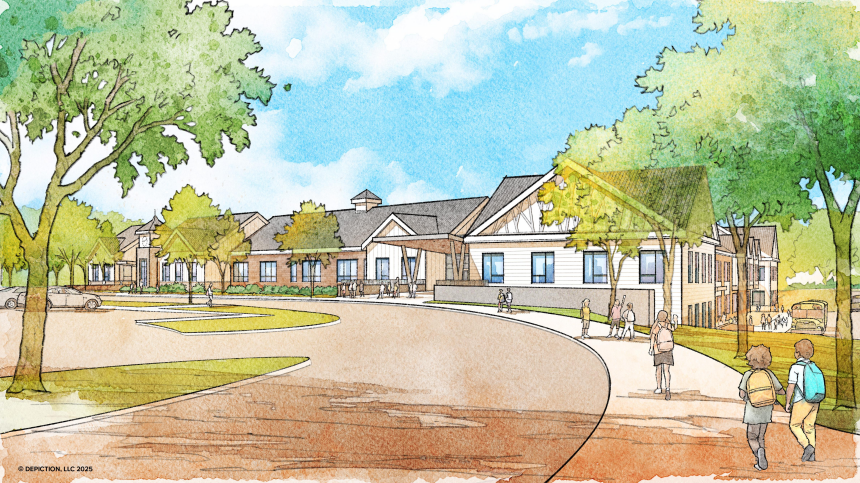
The majority of Westport residents strongly support replacing the existing Long Lots School, with good reason. The proposed building is truly spectacular, and the Long Lots Building Committee (LLBC), a volunteer group, deserves our thanks for its hard work and vision.
The elephant in the room, however, has always been the enormous cost, which is now approaching $110 million and likely to go higher. Were more cost-effective alternatives adequately contemplated? Will there be enough money left over to cover other pressing capital projects like renovations to Coleytown Elementary or a new Fire and Police HQ? Can the average Westporter really afford to pay 4% more in taxes for just one school when so many other large projects are coming down the road?
The public never had a real chance to have that dialogue because RTM leadership pushed the final Long Lots approvals through at record speed with minimal input or transparency. Why? Leaders claimed they made a mistake in calendaring a state grant deadline; in order to avoid additional interest expenses, they argued, the final project approvals had to be rammed through by mid-June.
The result scrambled the normal review process, impeding the public from having a robust debate around the costs or tax consequences before the looming self-imposed deadline. For that reason it is not surprising that a member of the electorate has now decided to launch a petition for a referendum on the issue, as provided for under our Town Charter, asking to cap the expenditure at $90 million.
Here are some of the facts and issues that led us to this place:

- After years of LLBC meetings focused mostly on design specs and engineering, five different town boards and commissions were forced to fast track the required approvals in the space of about a week in June.
- In that short time, the appropriation request changed three times before the final $103,190,124 RTM vote on June 12th. This amount is in addition to a prior $6.8 million design appropriation, bringing the total to $109,909,124.
- If past experience is any guide, the current total is likely to rise with inflation and tariffs driving up the cost of construction.
- Contrary to the way other prior town school construction projects were handled, and in violation of Connecticut’s Freedom of Information Law, RTM leadership insisted on reviewing the LLBC budget in executive (closed) session. This deprived the public of its ability to meaningfully review and question costs in this massive disbursement.
- Because of the fast tracking process, roughly 1/3 of RTM members never even had the opportunity to review a cost breakdown before they voted to approve the appropriation.
- The expedited Long Lots review process ended up overlapping with a slew of public hearings by many of the same town bodies in connection with another massively complex and expensive project, the Hamlet in Saugatuck. As a consequence of this poor planning, which could have been avoided, the last minute crisis mode was intensified.
- No specific information was provided to the public ahead of the vote on the tax implications of the proposed expenditure.
- This project appears to include significant funding for a controversial turf field and lighting under Parks & Recreation. But those funds are ineligible for reimbursement by the State. Why are ineligible turf field costs included in a “school appropriation”? Surreptitiously slipping those funds in now without explicit discussion denies the public the opportunity for debate around this highly controversial topic.
Haste makes waste. That saying certainly applies to the rushed and chaotic Long Lots final approval process. Given the historic magnitude of this important project, the public deserved a more transparent and thoughtful deliberation. Perhaps a citizen’s petition seeking a referendum will serve as a useful positive step towards ensuring more fiscal accountability.
Jennifer Johnson
RTM District 9 Representative








Profile in Courage. Brava.
For the many of us who have been attending and participating in countless meetings over the past several years happily sacrificing our time in the interest of our children’s education, health, safety and well being, to hear this process described as “expedited” is an insulting slap in the face. Over and over again we have been asked to placate a handful of selfish saboteurs. It’s bad enough that one or two narcissistic citizens are willing and able to mount delay campaign after delay campaign for their own self interest. But the fact that an elected representative is now spouting this false narrative is irresponsible and reprehensible. I hope those in her district (obv not Long Lots) will take note.
First, Toni wanted to pursue a referendum strictly because of the cost, and somehow came up with a reduced budget of $90 million, without really explaining how to obtain those cost savings. It appears it would require leaving Stepping Stones at CES, which is very unfortunate.
Now, we’re told that we need a referendum because the process wasn’t open enough. More delays will definitely lead to greater costs though with inflation and tariffs, and it’s again not clear what changes to the project are being proposed, other than the turf fields.
Sure, haste makes waste, but if the town had tackled this problem ten years ago, it wouldn’t be nearly as expensive as it will be now. I sincerely doubt more delays are going to help.
It has been strange that a project that has been presumably a need for ten years ended up with two weeks of rushed meetings with no detailed budget for the public to review. A cynic might say that the last minute push was by design, to prevent informed public input.
In any case, the logic I’ve seen (not from Mr O’Hara – just trying to save writing multiple comments) is peculiar. “Any delay could increase costs by $1 million or more” when some might suggest that the roughly $110 million is wildly high for a project serving 600 students. What is the more serious concern, $1 million or $110 million?
The memory gets fuzzy here, but isn’t another procedural possibility for review for two members of RTM who voted for the expenditure to ask to reopen the matter because they are reversing their votes? It would lead to a re-vote (which would require many more people to reverse the decision to impact the project in any meaningful way) but would at least give the RTM members an opportunity for a discussion of the cost details of the project? I think they can do that in the next RTM meeting after the vote though, again, my recollection is a wee bit fuzzy.
Finally, the actual “saboteurs” were the sports daddies who have wanted (with the assistance of the FSW) a ball field that far exceeded the needs of the school, inserted into the project (and embedded in the budget), even though it wasn’t part of the Ed specs. These people were too clever by half and have put a timely school building process at risk with their selfishness and their attempts to vilify innocent bystanders.
While we can all agree that we need a news school, Ms. Johnson is correct: the public’s ability to obtain and analyze the financial impact of this project has been limited by the extremely rushed timeline and the committee’s and the RTM’s unwillingness to make info publicly available. The taxpayers deserve better–esp. given the fact that we have another school that will probably need to be redone in the not-too-distant future and a slew of other projects in the pipeline. And let’s not forget how the neighbors were treated. How many times were they told that the new plan would improve the drainage situation–only to find out at the very last Flood & Erosion Control/Conservation Commission joint hearing that the plan won’t address the real problem AT ALL–because 85% of the water is coming from across the street. To really address the problem, the consultant admitted, they would have use the area for the ballfields as a drainage basin, which he later labeled an “absurd” idea. Since when is it absurd to give residents what they were promised?
Ms. Johnson has been making the same exact claims since a year ago.
https://westportjournal.com/opinion/jennifer-johnson-on-lls-budget-haste-makes-waste/
“The rushed decision to devote $100 million to a single project was made in
isolation and without context, without any attempt to take into consideration
whether there will be enough money to meet the demands of many looming
capital projects including other school renovation and upgrades we face in
the near future.”
and a later further, she continues:
“I was elected to represent RTM District 9. Voters in my District very much
support the new school. But many are concerned about the huge size and
whether enough will be leftover when Saugatuck needs upgrades.”
Ms. Johnson is advocating to reduce the Long Lots project by $13M through a petition, even if that means a delay in constructing the much needed school building. I wonder if Ms. Johnson would do the same thing had the project been for Saugatuck school. Is this what she calls good governance? Each RTM fights for their own district?
Keep in mind that Long Lots new school building will also host the Stepping Stones preschool in a much better way than it currently does. And this preschool will serve all of Westport, including Ms. Johnson’s district.
If the RTM had enlisted the participation of the Public Site and Building Commission, a body of experienced design and construction professionals set up by Town charter, to participate in the LLBC process years ago when this project came to light the RTM would have had reliable, non-biased, non-political, vetted information that they could have acted upon calmly rather than in this rushed process. I find the RTM’s oversight in not soliciting the PSBC input, an oversight that is not in the best interests of the Westport citizens that voted the RTM into office to be responsible stewards of our Town and its financial resources.
For those of you unfamiliar with the work of the PSBC, our commission has contributed to the successful completion of the library, the Levitt Pavillion, the Senior Center, and the Gillespie Center renovation just to name a few.
Thank you.
Joseph Strickland, Jr., AIA
Chairman-Public Site and Building Commission
This article claims that the executive sessions were made in violation of the Freedom of Information Act.
That claim is incorrect since FOIA does provide specific cases when executive sessions are permitted, and one of the reasons is discussion of purchase of real estate when publicity regarding such construction would adversely impact the price of such site (see Sec. 1-200 6-D below).
https://portal.ct.gov/foi/regulations/the-foi-act/section-1200-formerly-sec-118a–definitions
Sec. 1-200.
(6) “Executive sessions” means a meeting of a public agency at which the public is excluded for one or more of the following purposes:
(A) Discussion concerning the appointment, employment, performance, evaluation, health or dismissal of a public officer or employee, provided that such individual may require that discussion be held at an open meeting;
(B) strategy and negotiations with respect to pending claims or pending litigation to which the public agency or a member thereof, because of the member’s conduct as a member of such agency, is a party until such litigation or claim has been finally adjudicated or otherwise settled;
(C) matters concerning security strategy or the deployment of security personnel, or devices affecting public security;
(D) discussion of the selection of a site or the lease, sale or purchase of real estate by the state or a political subdivision of the state when publicity regarding such site, lease, sale, purchase or construction would adversely impact the price of such site, lease, sale, purchase or construction until such time as all of the property has been acquired or all proceedings or transactions concerning same have been terminated or abandoned; and
(E) discussion of any matter which would result in the disclosure of public records or the information contained therein described in subsection (b) of section 1-210.
Jennifer, You wrote a courageous article. You had the courage to criticize the RTM leadership for insisting on an Executive Session to exclude the public and voters who voted them into office. An executive session with the taxpayers left out who will then pay increased taxes for an elementary school? Is this a school or a royal palace? I am fortunate you are in my district and as far as I’m concerned you and Sal are the only two members I would vote for.