
By Kerri Williams
WESTPORT — Turning aside a town attorney’s opinion, the Zoning Board of Appeals on Tuesday unanimously denied an Old Hill Road homeowner’s appeal of officials’ refusal to approve his plans for a private pickleball court.
“I don’t believe I have ever disagreed with a town attorney before,” said board member Josh Newman. “But in this case, I do.”
The decision came after a long exchange over interpreting the zoning regulations for property setbacks.
Both Jim Coyne, owner of 63 Old Hill Road, and his lawyer parried with zoning officials over whether the private court for the popular paddleball sport should be allowed despite the earlier denial.
“I’m scratching my head over this,” said Coyne. “I have given hundreds of hours to this town and so has my wife. I don’t see any ambiguity.”
Coyne said that he was told by Assistant Town Attorney Peter Gelderman that merging two parcels of his property would bring the property’s setback into conformance with zoning regulations. “I did what they said to do,” he said.
“I’m scratching my head over this … I don’t see any ambiguity … I did what they said to do.”
Jim Coyne, pickleball court applicant
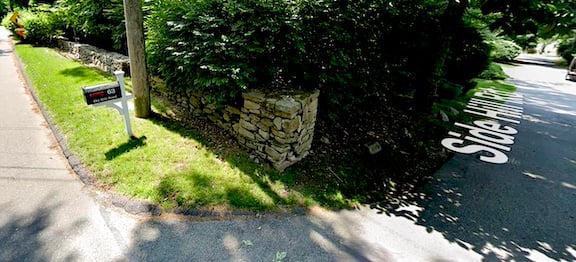
The question at play is whether the setback boundary lies at the pavement edge of Side Hill Road, at the side of Coyne’s property and extending into the street, or whether it should be measured from the southern side of the wider right-of-way as town officials contend.
Last year, Coyne initially sought variances to build a pickleball court in a setback, but the ZBA turned it down Oct. 10, ruling that no hardship was proven. After that, an undeveloped parcel on Coyne’s property was merged with the main, developed parcel in an attempt to conform with setback requirements.
Michelle Perillie, deputy planning and zoning director, said there is ultimately no difference between the two proposals. She said the town has a 30-year history of using the edge of a right-of-way to determine property setbacks.
Using that standard, she said, shows the setback boundary would go “right through the pickleball court” proposed by Coyne.
The zoning ordinances are in place to make properties look “aesthetically pleasing” from the road as well as to allow for emergency access, Perillie said.
However, Eric Bernheim, Coyne’s lawyer, said that in cases where there is more than one interpretation of an ordinance, that Connecticut case law states the property owner’s interpretation trumps that of the board. Based on the opinion of the town attorney and others, there are “clearly multiple interpretations” of the regulations, which Bernheim told the board means, “you have to find in favor of the homeowner.”
“In my view, this is not ambiguous at all, and I am an attorney.”
Joseph Scordato, ZBA member
ZBA members disagreed with Bernheim’s assertion, arguing that the setback should be measured from the edge of the right-of-way.
“In my view, this is not ambiguous at all,” said member Joseph Scordato, “and I am an attorney.” Scordato went on to say the decision on Coyne’s appeal should be made in the context of the entirety of town zoning regulations
“I am also an attorney,” said board member Sheri Gordon. “And attorneys can be wrong from time to time. The right thing here is to side with the interpretation of the zoning officials.”
Jim Ezzes, the board chairman, recused himself from Tuesday’s hearing and vote on the appeal.
Kerri Williams is a freelance writer.










Recent Comments