
By John Schwing
WESTPORT — A tax rate increase of 1.29 percent to finance the town’s $252 million budget package for 2025-26 was green-lighted Wednesday by the Board of Finance, but yellow caution lights were flashing over issues that could pressure future spending plans.
The board’s unanimous vote in Town Hall culminated the months-long budgetary process that saw the Representative Town Meeting earlier this month overwhelmingly approve the budget for the fiscal year starting July 1, with a 3.86 percent increase over current spending of roughly $243 million.
That spending package includes $150.4 million for Westport public schools, $87.5 million on the town side of the fiscal ledger, plus funds allocated for the Westport Library, Aspetuck Health District and debt service.
What town spends and how that’s paid for
To pay for that budget, the Board of Finance approved a new tax rate of 18.86 mills, or 1.29 percent higher than the current 18.62, supplemented by money from the town’s general fund to offset a larger increase. New tax bills will reflect $18.86 per $1,000 of a property’s assessed value (properties are assessed at 70 percent of market value).
Last year, the mill rate approved for the current fiscal year increased 1.47 percent.
Approximate tax bills, using the new mill rate, for properties assessed at the following levels will be:
$500,000, increasing from $9,310 to $9,423.
$1 million, increasing from $18,620 to $18,856.
$1.75 million, increasing from $32,585 to $33,050.
$2.5 million, increasing from $46,550 to $47,150.
$5 million, increasing from $93,100 to $94,300.
Board members on Wednesday expressed general satisfaction with the tax-rate increase proposed by the Tooker administration, mirroring the broad support they gave the budget numbers in March — with the exception of the annual tug-of-war over funding for the Wheels2U on-demand shuttle service.
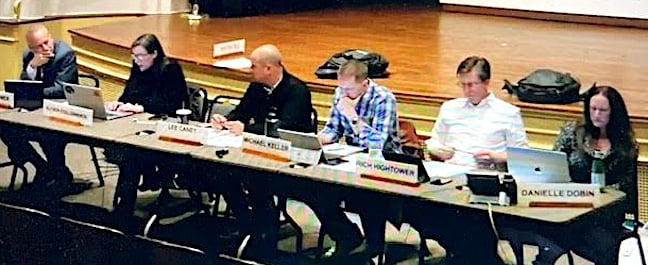
Chair Lee Caney summed up the sentiments, saying the board’s goal in setting the new mill rate is to achieve a balance. “Obviously, we want to keep the mill rate as low as possible … we don’t want to charge too much in taxes every year.”
But being too “aggressive” keeping the mill rate low one year could boomerang the next if expenditures rise significantly, he added, requiring the town to adopt a much higher tax rate to cover the growth.
Reasons for caution: Capital projects, state requirements

Complicating that tax-and-spending balance, Caney said, are “big things coming up” that will be financed outside the town’s yearly operating budget. These include major capital expenditures, he said, citing the most immediate one as the new Long Lots Elementary School with a price tag of about $100 million, the costliest project in town history.
Board member Danielle Dobin, urging caution in terms of future fiscal planning, talked about the potential impact of omnibus zoning/affordable housing legislation now before the state General Assembly.
If the bill is adopted by the legislature and signed by the governor, she said, it could have repercussions on local budgets in communities across the state, including Westport.
Among those effects, according to Dobin, a former Planning and Zoning Commission chair, are:
- Loss of state infrastructure grants to towns that don’t create zones for multi-family housing near transit hubs.
- Requiring towns to cover legal fees for affordable housing developers who successfully challenge a project’s denial in court.
- Imposing housing mandates that could require Westport to create as many as 2,500 new “affordable” and “deeply affordable” units, posing costly implications for municipal services like public safety and schools.
Controlling the controllables
Adopting a “defensive crouch” toward future financial headwinds is the best path forward, suggested board member Jeff Hammer.
Both he and board member Rich Hightower suggested the finance panel should focus primarily on controlling the “controllable” costs that fall under its purview to guard against annual “budget creep.”
But no serious objections were raised to the mill rate proposed for 2025-26.
Throughout board members’ discussion, there was broad consensus that the 18.86-mill figure struck a good balance between the competing dynamics of keeping taxes in check and preserving a robust general fund vs. raising the amount of money needed for the municipal services Westporters expect.
Breaking Caney’s streak
So there was little doubt the tax rate would win final approval, but before the board voted, Caney called for public comments even though Town Hall’s auditorium was virtually empty.
The board chairman, who is not seeking re-election to this year, noted ruefully that he could not recall anyone coming forward to speak during the public-comment portion of the annual mill-rate meeting during his 12 years on the panel.
That streak was broken Wednesday when Nancy Kail, a Representative Town Meeting member from District 9, came to the podium.
Kail said she had not planned to speak, but felt “compelled” to make the meeting memorable for Caney. And since she was at the podium, Kail supported an idea suggested by several board members of conducting summertime budget workshops — which she hoped would include other town officials — to help chart the town’s fiscal future.
John Schwing, consulting editor of Westport Journal, has held senior editorial and writing posts at southwestern Connecticut media outlets for four decades. Learn more about us here.






Capital expenditures indeed. Lack of public comments indeed.
The June 4 Board of Finance meeting will have a $98 million “discussion only” Capital expenditure item. That it is discussion only speaks to why the public generally does not waste time going to BOF meetings. No public comment is allowed when these agenda items are designated as discussion only. Why is that? Mo remote public comment is ever allowed.
I’m sure the chair will say “there will be another bump.” He also is the one who could allow public comment at every opportunity when an important topic is in the agenda.
I attended the BOF budget hearing this year and was discouraged or otherwise cut off from comments by the chair. Not the first time, I might add. I don’t recall ever having gotten a response from the chair on my many emails to him.
The $98 million item is for Long Lots School. There is no project budget posted with the BOF agenda, to-date, nor is it on the Long Lots committee’s website page.
I want to see a complete breakdown, including every optional item and upgrade. I want to see a separate budget for any expenditure not directly related to building a school. I want to see the expected cost of environmental remediation and the plan to achieve it. I want to see the town’s application to the state for reimbursements.
And I will request that those who are predisposed or otherwise biased on this project in particular recuse themselves from voting.
And I will come to those BOF meetings with questions — not about the need to build a school, but the desire to spend extravagantly and to include add-on projects under the cover of a much needed school.
Buckle up.
Lee Caney will want to shove this through as fast as he can. As he said at one of the BOE meetings, “we need that ball field.” Good riddance.
Thankfully the general public will be able to petition the expenditure to a town-wide referendum.
Unless you are writing a check using mills as the currency this is a false narrative. We pay our taxes in dollars, the budget is set in dollars and the taxes match the spending. If the budget increases 3.86% then that is the rate. Westport is the highest taxing/spending town in Connecticut per capita. We choose that because we want better schools and services, sure it should be less but many folks are working to dampen our costs but let’s be honest: we tax a LOT and it’s getting worse. Just because our grand list is very big (and getting bigger) for the reason that folks over pay to be over taxed (!) does not mean the mill rate is relevant. Do better.
It isn’t irrelevant, either. If the mill rate goes up and your property has not been re-val’d, your taxes will increase. The increasing grand list is used to calculate the mill rate. (People get overly-excited about an increasing grand list, too.)
I think the troubling trend is that the BOE budget becomes a larger and larger percentage of total Town expenditures. The BOE tends to be granted a blank check, which isn’t sustainable and eats into Town’s ability to pay for anything else. If you look at a goal of seeing the Ed budget stay flat, factoring in increases for enrollment increases and inflation, they tend to violate that benchmark.
Maybe RTM should cap the Ed budget as a percentage of the Town total budget? (I know, some will say that will only motivate the Town side to spend more.) But I don’t think the average person pays much attention to where there local taxes go.
Business as usual for Westport, and most of CT, where taxes just keep going up and up regardless of economics, the economy or, God forbid, negotiations with the BOE. Fact is we spend too much. Period. But it’s easier to increase taxes versus confront the cost centers and unions.
Not a huge increase.
It probably should be larger.
As for BOE, I think the long lots school should be costing 50,000,00 50 million less..
an outrageous sum of money.
Just incredibly annoying.
Not sure why Nancy Kail who has zero interest in her own district goes to these meetings.
Interesting.. if not comical.
She was useless on Parker Harding !!!
and that has not changed..
we don’t need puppets.
We need action.
Thoughtful action..
not drivel.