

By Gretchen Webster
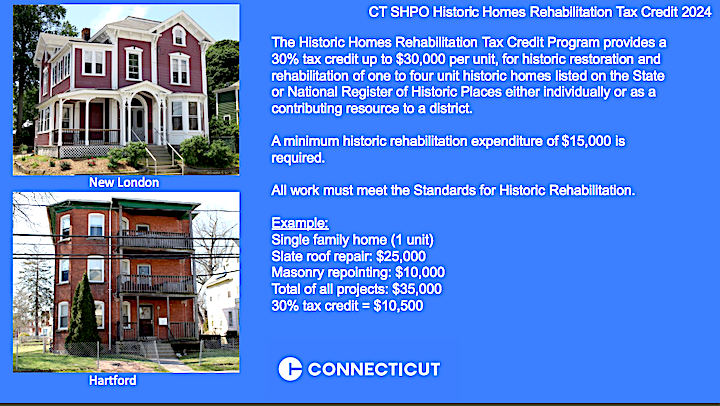
WESTPORT — A state program that provides a 30 percent tax credit to help cover costs, up to $30,000, of preserving or rehabilitating historic homes was discussed at Tuesday’s meeting of the Historic District Commission.
Several commissioners say they had taken advantage of the program for tax credits on their own homes, and they encouraged a couple interested in establishing a new historic district on Compo Road South to consider the program as well as other incentives for creating the district.
The tax credit program was described by Mary Dunne of the Connecticut State Historic Preservation Office, who outlined some of its requirements:
These include:
- The homeowner must be a Connecticut taxpayer.
- The house must be the homeowner’s primary residence, not a vacation or rental property.
- The building must be a residence only, not commercial use.
- The home must have a historical designation, which could be state, national and, in some cases a local designation.
- A minimum $15,000 expenditure is required for the preservation or rehabilitation project.
Homeowners who apply for the program, meet the eligibility requirements and perform the work on satisfactorily within five years, are granted the tax credit on their income taxes.
A second option is for the homeowner to be issued a check for the amount of their tax-credit voucher by a “C corporation,” such as Eversource, which works with the state preservation office to connect the homeowners and companies.
The state program helps not only the homeowner but the entire community, Dunne said, because historic houses add to a neighborhood’s property values, and encourage home ownership and sustainability. A theme of the program is “the greenest building is the one already built,” she said.
The program can also bolster the local economy by hiring workers and purchasing materials locally. Other goals of the program are to encourage restoration of historic homes instead of replacing them and to preserve the features of historic buildings.
Certain improvements covered by the tax credit help a homeowner preserve a home rather than tear it down, although they may not directly be considered historic. These include repairs or replacement of HVAC, plumbing or sewer systems, Dunne said.
Work that does not qualify for the tax credits, she added, includes outside site work, new construction, interior gutting and “soft” fees for architects and other consultants.
Commission member Elayne Landau asked if a homeowner could use the tax credit for a rehabilitation project, then sell the home. Dunne said the owner must live in the rehabilitated home for five years or sell it to an owner who will live in the dwelling five years.
Dunne, responding to a question from member Scott Springer, said that developers are allowed to use the credit for projects of four units or more.
“The key is we want these buildings not torn down, and to be owner occupied,” Dunne said.
Grayson Braun, the commission chair, said information from Dunne’s presentation would be posted on the Historic District Commission’s website. A resource to check if a particular property has a historic designation is ConnCRIS.ct.gov
New historic district on Compo Road South?
The HDC also held a public information session Tuesday on possible designation of a Compo Road South Local Historic District, which has been identified by the commission as a possible historic site.
“There are not many areas in town like this … one of the few areas in Westport where there are small houses,” Springer noted.
Landau, who lives within the proposed historic district, said that her house was built in 1800. “One thing that we really like is the small size of the homes — it seems like a little village. It’s a special part of town,” she said.
Braun cited the state tax-credit program as one of the benefits of setting up a new historic district.
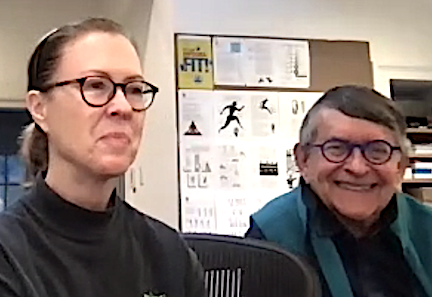
There were only two Compo Road South homeowners present at the meeting to discuss the possibility of establishing a historic district there, Erin McKenna and her husband Nigel Holmes. The couple was interested in the possibility that their home could be included in a historic district both before and after Braun explained details of the designation process.
“An advantage to this is that you are helping preserve Westport architectural history … for generations to come,” Braun told them.
The idea of establishing a historic district on Compo Road South will be discussed again at a future meeting, Braun said.
Freelance writer Gretchen Webster, a Fairfield County journalist for many years, was editor of the Fairfield Minuteman and has taught journalism at New York and Southern Connecticut State universities.








Thank you to the HDC for publicizing the new State tax credits.
As eligibility for tax credits is contingent upon conformance with Standards for Historic Rehabilitation, this program provides safeguards for historic dwellings not located in a local historic district or otherwise governed by the Town’s HDC Regulations.
Good to see another incentive added to the historic preservation tool box.