
By John Schwing
WESTPORT — One size does not fit all — whether a towering stanchion or a mobile cluster — when it comes to scenarios to provide more nighttime lighting for the town’s athletic fields.
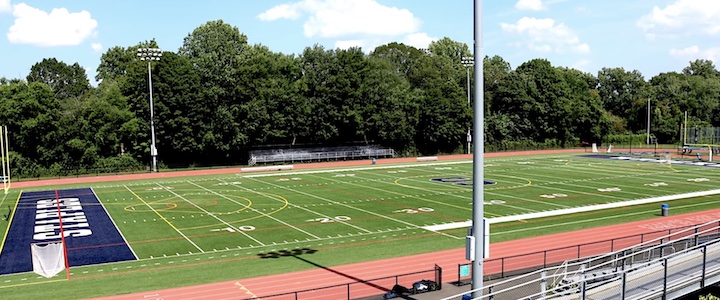
The Planning and Zoning Commission’s Recreation Subcommittee, which met online last Thursday afternoon, continued exploring options for field lights, an initiative that began last year after expiration of a 2011 court-stipulated judgment settling a lawsuit filed by neighbors trying to block installation of permanent lighting at the Staples High School stadium.
Danielle Dobin, the P&Z’s chair at the time, said the pact’s expiration was an opportune time to explore zoning issues related to townwide field use, with a goal of providing more practice and game times for both school and youth leagues.
Michael Cammeyer, the Recreation Subcommittee chair, told the group that in preparing a text amendment for full P&Z review — possibly in September — there should be sufficient flexibility to allow lighting plans to be considered on a site-specific basis since “not all fields are created equal.”
Factors such as the hours and type of use, permanent vs. temporary lighting fixtures, noise levels and proximity of residential neighbors should be evaluated so a lighting plan could be customized for a specific field, he said.
“We need to consider different fields differently,” he said, noting that while new technology limits earlier concerns about field lighting “spillage” into nearby properties, privacy, security and noise issues remain priorities for neighbors, particularly those who live near smaller fields on elementary school campuses.
He suggested the group’s planning focus, at least initially, on the Wakeman/Staples/Bedford complex off North Avenue and Cross Highway, and the P.J. Romano/Doubleday complex between Saugatuck and Kings Highway Elementary schools.
The amendment, he said, initially could be written to restrict new lights to those two sites by specifying the property be at least a certain size or be located next to an arterial road.
Other conditions could be tailored to a specific field and spelled out in a special permit requiring P&Z approval, according to Amanda Trianovich, a P&Z Department planner.
One reason to consider adding more field lighting, Cammeyer said, is feedback about the idea from coaches for Westport’s school and youth leagues. Under lights, coaches favor expanding field use until 9 p.m., which could be divided into two slots of 6 to 7:30 p.m. and 7:30 to 9 p.m.
Westport coaches, he added, feel their teams are at a competitive “disadvantage” with teams in many other Fairfield County communities, where nighttime lighting allows more time for practices and home games.
Dobin, now a Board of Finance member, joined Thursday’s meeting to reiterate her support for the initiative, particularly as it could help remedy the issue of unequal field time available for girls’ sports, such as field hockey and lacrosse.
She said her initial goal in suggesting updates to rules on use of the town’s fields was “to address the disparity with regard to access by gender.” An “unintended consequence” of the stipulated settlement on permanent lighting at Staples, she said, often relegated girls’ teams to fields without lights, restricting their practice and playing times.
For instance, she said, failing to consider lighting for Ginny Parker Field, within the Staples complex, where field hockey and girls lacrosse teams play, would perpetuate that inequality.
Neighbors’ concerns: Noise, privacy and maintenance
A neighbor of Ginny Parker Field told the subcommittee that with greater use of that field, her primary concerns are privacy and noise, and not light spillage, although she favors temporary fixtures rather than permanent stanchions that are not needed year-round.
A neighbor of Long Lots Elementary School raised several concerns about the field lighting initiative, suggesting better maintenance of the town’s athletic fields would be a better way to provide more playing opportunities than installing lights.
As an example, she cited the poor conditions of Loeffler Field, which is no longer used by the Staples boys and girls varsity soccer teams.
She said planning to add more field lighting seems misplaced at this time when some existing fields are underutilized because of neglect and poor maintenance, citing as another example a field on the Long Lots campus that she said is often “empty and unused.”
“That does not feel like productive, responsible fiduciary management to me,” she said. People who complain that local teams “have nowhere to play,” she said, need to realize that “you have nowhere to play because the fields are not maintained.”
Plans to build a new Long Lots Elementary School, expected to get underway later this year, call for adding a larger, multi-purpose athletic field on the property — likely to built on the site of the Westport Community Gardens, which for two decades has been a quiet buffer between the school and neighboring homes.
The Long Lots neighbor, noting several other neighbors had joined the meeting call, asked that whatever zoning framework might be adopted to allow more field lighting specifically exclude the Long Lots property.
The anticipated two years of school construction on the Hyde Lane property, with increased traffic and no guarantee of buffers, she said, will bring “drastic changes” for the neighborhood that from a “property value perspective and lifestyle perspective” are “untenable.”
“We can’t swallow any more,” she said, asking that officials not consider adding any lights to whatever new field is built at Long Lots, particularly tiers one and two of the property.
Cammeyer, in response, reiterated that the field lighting text amendment initially would be applied only to the Staples and Saugatuck athletic complexes.
He said the subcommittee also would endeavor to gather input from a broader range of field neighbors and parents of youth athletes as the planning process moves forward.
The group also considered ways to address problems or questions that could arise with installation of more field lighting. That includes expanding the number of officials who could digitally control field lights from apps on their phones; require that field users set up a hotline for neighbors to report issues, and banning amplified music at all fields.
John Schwing, the Westport Journal consulting editor, has held senior editorial and writing posts at southwestern Connecticut media outlets for four decades. Learn more about us here.







Recent Comments