
By John Schwing
WESTPORT — Item No. 5 on Wednesday’s Board of Finance agenda was a $222,000 request to prepare a schematic design for a new maintenance building at Longshore Club Park.
Instead, there was a lot of talk about Ferraris and Fords and Cadillacs.
The automotive analogies peppered what became a lengthy discussion Wednesday as board members kicked the tires on the appropriation for the first of several projects included in the estimated $40 million Longshore Capital Improvement Plan.
But as questions mounted about land-use and location issues and, particularly, the projected $7 million cost for the new, relocated building for parks maintenance equipment and employees, Public Works Director Pete Ratkiewich pumped the brakes on the design funding request.
Instead, Ratkiewich agreed to schedule a pre-application meeting with the Planning and Zoning Commission for non-binding feedback on the Longshore site for the relocated facility before seeking P&Z approval of an “8-24” report, which is required for all municipal land-use projects. He also agreed to lead board members on a Jan. 24 tour of the site where officials want to build the new maintenance facility, as well as other town-owned properties that were considered, and later ruled out, as locations for the building.
The idea of seeking a pre-application P&Z review of the proposed site was suggested by finance member Danielle Dobin, a former P&Z chair.
She said it would be “irresponsible” to spend any money on the site-specific project before securing an 8-24 approval from the P&Z. If the commission were to reject the proposed location, the $222,000 design money would be completely wasted, she said.
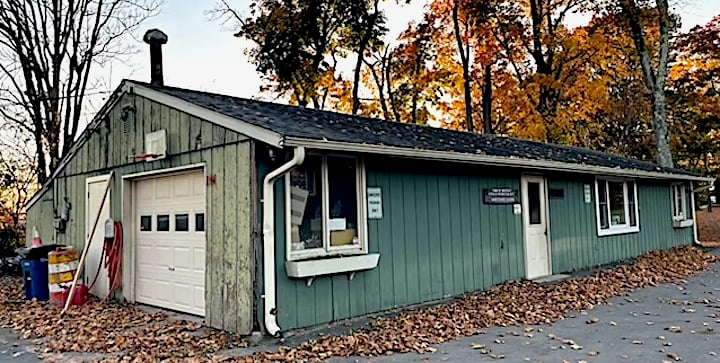
Dobin — displaying a photo of the existing Longshore “shed” that the new, larger building would replace — also took aim at the $6-7 million projected price tag.
Calling that cost “absurd,” she said the facility’s planners need to “take another look” at the proposal, and metaphorically, recommended “shopping at the Ford dealership instead of going for the Ferrari to begin with.”
Moving the existing building to make way for construction of new paddle courts, as called for in the Longshore master plan, would result in a net gain of only two new courts, which Dobin said “doesn’t seem like a great tradeoff” for the money.
She also questioned the “sequencing” of the projects envisioned in the master plan by prioritizing the new maintenance building over other features such as a new golf clubhouse and renovation of the pool area. “It does not make a lot of sense,” she added, to start acting on the master plan with a $7 million maintenance building that would consume such a large share of the overall projected $40 million budget.
Ratkiewich defended the site proposed for the new building, saying it would relocate the facilities from a central area in the park and redirect maintenance traffic away from the main park entrance. He also said the larger building is being designed to achieve “economies of scale” by consolidating uses not possible in the existing structure.
And he, Deputy Public Works Director John Broadbin and First Selectwoman Jennifer Tooker resisted the “Ferrari” description of the new facilities.
All took pains to emphasize the $7 million figure is only a “placeholder” figure taken from the master plan prepared by Stantec, the consulting firm hired to guide the project. The final cost will be determined only after the schematic and final designs are completed, they said.
The figure could be “quite a bit less” than the consultant’s $7 million estimate, Ratkiewich said, “if we go to the Ford dealer rather than the Cadillac dealer.”
David Floyd, the Parks and Recreation chair, also defended the plans, describing the existing maintenance building as “a shambles” and “eyesore.” Its proposed relocation, he said, would reclaim a “prime” site in the park for recreational use.
Lee Caney, the Board of Finance chair, told Ratkiewich that he and fellow board members appear to broadly agree the project should “not be the Cadillac or Ferrari of maintenance sheds,” absorbing a significant share of the overall Longshore master plan budget.
“ … When you design this,” Caney added, “if it’s a Cadillac or Ferrari, we’re probably going to have some real pushback” against the requested funding. He suggested instead that planners settle on a “workable” facility that more modestly meets parks maintenance needs. That suggestion prompted one board member to interject the building’s final design be comparable to a “VW bug.”
Tooker came to the podium to say that she heard finance board members’ message “loud and clear” — they do not want to spend $7 million on a parks maintenance building.
She explained, however, that the maintenance building cost estimate and others on the town’s capital forecast are “aspirational” — in fact, even “guess-timates” — to help guide future spending plans.
A capital spending request becomes “real,” and is submitted to the Board of Finance, only after it is “ready operationally, ready financially, ready from a priority standpoint …,” Tooker said, with details for the board to review and act on.
“That’s when the rubber hits the road,” she added.
John Schwing, interim editor of the Westport Journal, has held senior editorial and writing posts at southwestern Connecticut media outlets for four decades. Learn more about us here.








Recent Comments