
By Gretchen Webster
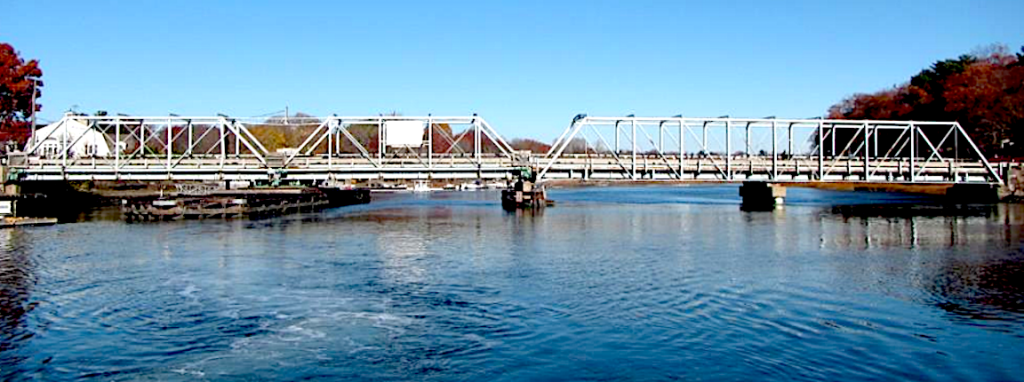
WESTPORT — Six years after the last meeting of stakeholders convened to advise the state on the future of the William F. Cribari Memorial Bridge, Department of Transportation officials Thursday revealed their plan for the historic span: Replace it.
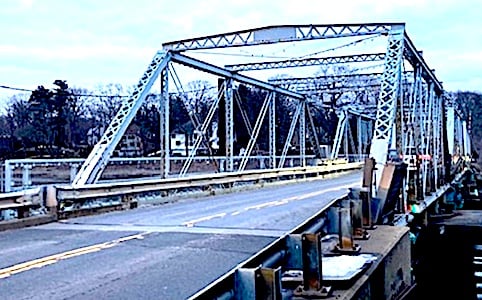
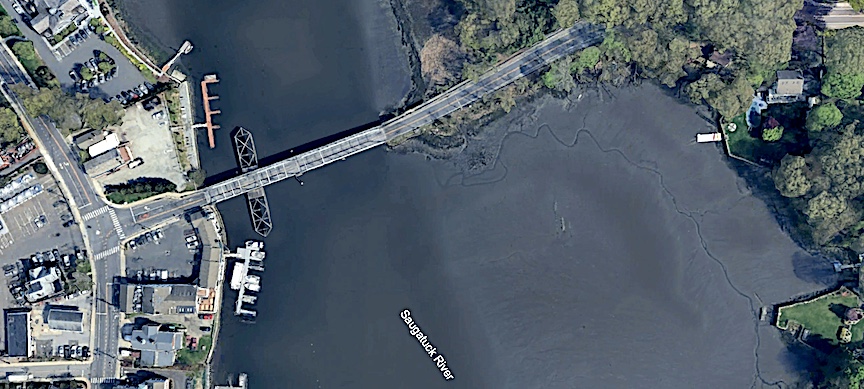
A new bridge to replace the 141-year-old metal span over the Saugatuck River, as outlined by the DOT to a meeting of Cribari Project Advisory Committee in Town Hall, would be built in the same location at a cost of between $78-$86 million.
The new structure carrying state Route 136, also known as Bridge Street, over the river would be wider and taller than the existing bridge.
In 2015, the bridge was classified as “severely deficient” by the state.
State plan draws fire from residents
Most of the 50 people at the PAC meeting were unhappy with the proposal, primarily because they fear more traffic, especially large trucks, would use the span to travel through Saugatuck. The proposed structure would have the capacity to accommodate bigger trucks, allowing some vehicles that currently can’t use the bridge to cross.
Opponents listed a series of problems they say more truck traffic will worsen. These include:
Safety of children who already have trouble crossing Bridge Street to catch a school bus; mailboxes knocked down, and trucks traveling onto sidewalks because roads leading to the bridge are narrow.
Some residents were also concerned about maintaining the historic appearance of the bridge, the oldest metal swing bridge in the state and listed on the National Register of Historic Places.
Impact of “Hamlet” questioned
Others worried that the impact of traffic generated by the proposed “Hamlet at Saugatuck” project — a large mix of residential, commercial and recreational buildings in Saugatuck — was not considered in the option the DOT favors for the new bridge.
The DOT team, led by Project Manager James Barrows, fielded questions, but said the plan is still preliminary and additional traffic and environmental studies will be done. Questions and comments raised at the meeting, he said, will be studied and addressed by DOT planners.
DOT officials have said that a local public hearing on the evolving plans will be conducted in late summer or this fall.
Critics focus on larger bridge, more truck traffic
The audience, however, did not seem convinced by DOT officials’ assurances.
“It looks like their minds are pretty much made up,” Dick Lowenstein, a Representative Town Meeting member from District 5, said after the meeting.
He also didn’t like the state’s response to several residents’ suggestion that the bridge’s height not be raised. If structure is lower, the DOT team said, some trucks would strike and damage it despite posted height limits.
Barrows also said that just because larger trucks might be able to travel across the new bridge, that wouldn’t necessarily mean more trucks would use it.
Many in the audience disagreed.
“If you build it, they will come,” said Matthew Mandell, executive director of the Westport-Weston Chamber of Commerce and District 1 RTM member. “It’s important to this community to have a block to stop trucks. … This community does not want trucks,” he said.
“There is no good that can come of having trucks cross the bridge,” agreed Karen Kramer, a District 5 RTM member.
Several attendees said a more comprehensive study of the project’s impact on Westport should be made. Traffic studies should be done on Greens Farms Road, Compo Road South and other roads leading to and from the bridge that could be affected by more traffic. Local officials could prohibit trucks from traveling on nearby town roads, even though its control over state roads — including Route136 crossing the bridge — is limited, several residents said.
Alternate plans considered
The DOT has studied alternative plans to address the aging Cribari Bridge, Barrows said, and several of those options were presented at the meeting.
The bridge must accommodate bicycles, pedestrian and marine crossings, and be resilient to changing climate, shoreline and environmental factors, he said. Emergency vehicles also must be able to cross the bridge safely, he added.
Other options considered for the bridge include a “No-Build Alternative,” which does not address deficiencies in the existing structure and would include only minor repairs and last only 15 to 20 years.
Another option would include some structural repairs, but would reduce navigation in the channel and last about 25 to 40 years.
Two plans to replace the bridge were considered, both of which would have a life span of 75 to 100 years.
One was the plan favored by the DOT, making the structure wider and taller. A second replacement plan would cost less at $66-$73 million, but it would be constructed north of the existing bridge, affecting some driveways and businesses.
Plans being fine-tuned
Research and planning for the bridge project will continue, Kimberly Lesay, DOT bureau chief of policy and planning, told the crowd.
The bridge option chosen “is not adding lanes and not going to allow for more capacity,” she said.
There will be additional discussions and studies of the impact the Hamlet project may have on “potential increase in traffic,” she said.
Additional review will include studies of train schedules at the Saugatuck Railroad Station, as well as environmental and safety issues brought up at Thursday’s meeting.
Freelance writer Gretchen Webster, a Fairfield County journalist for many years, was editor of the Fairfield Minuteman and has taught journalism at New York and Southern Connecticut State universities.






I attended the meeting reported on here.
The competent and polite engineers of CTDOT and assisting personnel were knowledgeable about the bridge but completely flummoxed by the plethora of questions and comments from the attendees. Old and retired Westporters (like me) were outnumbered by young Westporters who have chosen Westport to raise their young families and engage in the Westport community that has nurtured, and educated its young for decades. There were no “obstructionists” there, no one was pining for lost glories… just residents voicing their heartfelt concerns about safety, pollution, overwhelming and dangerous traffic problems… all of which jeopardize their well-being and deserve to be addressed by elected officials.
Curiously, none of the municipal employees—head of Public Works, Police Chief, Fire Chief, etc., members of the CTDOT PAC, who were all invited—were there.
In reactivating the $4,100,00 funding for replacing the Willian F Cribari Bridge in January 2024 when she also offered a brownfields remediation remedy of properties in The Hamlet worth $12,000,000 to Roan, the First Selectwoman unleashed the genie from the bottle. And it showed up in the Westport Town Hall auditorium on May 15, 2025.
The message from CTDOT was clear and straightforward. Westport authorized us to replace the William F Cribari Bridge. Period.
As the chief engineer emphasized at the close of the meeting, the State cannot and will not restrict any vehicle including 18 wheelers use of the bridge.
RESTRICTING TRUCKS IS WESTPORT’S PROBLEM.
The State of Connecticut has confirmed that the safety of Westport children whose busses stop 18 times a day on Bridge Street, the pollution of diesel truck exiting I-95 and idling on Greens Farms Road and Bridge Street, the potentially massive increase of WAZE traffic due to the lifting of weight and height restrictions are all completely and decisively in the Board of Selectwomen’s court. The Select Women’s Board is in charge of traffic—that’s the town charter.
With the Selectwomens’ advocacy of passage of the Hamlet’s P&Z application, the construction of the Hiawatha Project, the apparent attempt to leave Westporters with the biggest possible traffic conunbrum, and who knows what the hell else we can expect (sorry I got agitated), how can Westport honestly welcome new families, insure them that a rational government is in charge of their safety and health, and pass on the sometimes wonderful, sometimes problematic experience of raising a family in Westport?
I agree with Werner’s observations.
Certainly the meeting was one of respect. And the DOT team was friendly and polite.
I think the latter genuinely believed its assertion that greatly expanding the bridge’s geometry would not have a material traffic impact.
I also feel it’s fair to say that the audience understood what increasing the bridge’s carrying capacity – and thus the velocity of traffic – would really mean for local residents.
In any event, this marks the sixth time the Cribari Bridge – documented to now be the nation’s oldest active pin-connected swing truss highway bridge – has been targeted for replacement by DOT. It won’t be the last.
Things that matter require constant vigilance.
Werner, for the record, my associate Gretchen Webster, who attended and reported on the DOT meeting, notes that First Selectwoman Jennifer Tooker, incoming Police Chief David Farrell and Public Works Director Peter Ratkiewich attended the meeting.
As an architect, I am always troubled by witnessing the razing of any structure listed on the National Register of Historic Places. In my arena, this is a major violation. Most of the structures I have seen demolished were privately owned with little recourse available to public citizens. Think about the magnificent Beaux-Arts, Penn Station in NYC, demolished in 1963 with the only bright light from that travesty being the establishment of NYC Landmarks Preservation Commission. First Lady Jacqueline Kennedy championed preservation, saving many historic structures from the wrecking ball, most notably our beloved Grand Central Terminal.
The Cribari Bridge is publicly owned, it belongs to the people and is Westport’s own little historic gem.
Where is our leadership? We have a First Selectwoman who is eyeing a run for the governorship, yet where has she been over the last four years with respect to major issues our community has faced?
This is New England, we respect our history, our famous Revolutionary War battle sites, we honor our past by keeping memories of the people and contributions they created alive. New Englanders demonstrate humility by honoring the paths traveled by those who came before us.
Westport is one of the most affluent communities in Connecticut, the Cribari Bridge should be historically rehabilitated for what it is; a 140 year old bridge on a small town, two lane road serving as a gateway into Saugatuck.
While I have not researched the ability to generate Federal Historic Tax Credits (as I use them to rehabilitate historic buildings) for the restoration of the bridge, the community deserves to see this bridge rehabilitated, paid for with funds secured anyway possible. I believe money is not the issue here.
The French completely rebuilt Notre Dame after a major fire, why isn’t Westport leadership insisting this bridge be subjected to an historic rehabilitation?
Our leadership, specifically, our First Selectwoman has remained silent on this issue, as she has the Hamlet, despite its massive opposition. I believe these issues are linked. Why would any right minded person vote for her to be governor when she is completely out of her league in Westport? I’m sure her small minded minions keep telling her she is doing a great job at all those ribbon cutting photo ops she attends. If she is not already the poster child for the Peter Principle, no one is.
The scale of the existing Cribari Bridge is appropriate for the neighborhood.
A view to the south while crossing the bridge is of an egregiously out of scale, flatbed bridge carrying I-95. Although, in all fairness, its out of scale and hideous intrusion into the community is in perfect alignment with the proposed Hamlet design solution.
No doubt, this is a win for the Hamlet folks, a new wide bridge to support their “alternate facts” about their project not having a negative impact on Saugatuck traffic.
Communities are evolutionary, not revolutionary, we keep what is good, we improve upon what is working and we discard new concepts that are inappropriate or ill conceived. The decision making from our leadership has been at the lowest level I’ve witnessed in 35 years. We need leaders who bring respect for the works of people long gone, who contributed to make this community what it is today.
My suggestion; use Mitch McConnell’s playbook and kick this can down the road until we have new legitimate leadership, who represent the will of the people, hopefully in November.
Joseph V. Vallone, A.I.A.
Bravo Joseph Vallone, you must be reading my thoughts. I couldn’t have said it better. Thank you. I hope the people in charge who truly don’t care about all you have said will take note of this. Saugatuck does not need a new bridge, more traffic, trucks and whatever else they want to run through it. There is already enough going on there besides the historical certification of the bridge. The town has complained about this bridge for years, had the proper repairs and maintenance been done over the years maybe we wouldn’t be sitting here today.
I’m of two minds about Cribari Bridge. While I agree that it is an historic gem, I can also see the need for it to be – at the very least – widened, as well as made more structurally sound. If that can be done while preserving it in the main, that would be my vote.
But under no circumstances – no matter who “wins” – should the bridge be taller. Under no circumstances should trucks be allowed to cross it.
We don’t allow trucks on the Merritt because of the bridges – let’s make certain the same applies to the Cribari Bridge.
I agree with Mr. Vallone that the issue should be kicked down the road until the current First Selectwoman is out of office in November.
Her desire to see Westport as “a destination” has done harm to our community, and we continue to deal with the problems. It feels like the governorship was her goal all along and we were just a stepping stone in order to curry the favor of big business and make statewide contacts.