
By John Schwing
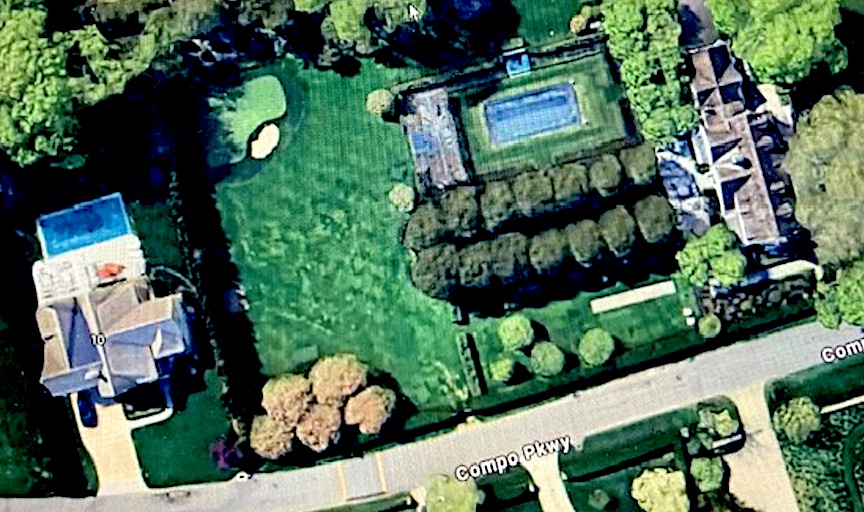
WESTPORT — A homeowner seeking to sink birdies on a private putting green in his own yard hit a bogey instead with the Zoning Board of Appeals on Tuesday.
Andrew Jones had filed an appeal with the ZBA, asking the panel to overrule the zoning staff’s refusal to issue a letter of zoning compliance for a putting green he installed in his 4 Compo Parkway yard.
The board, however, found the appeal to be subpar and upheld the penalty meted out to Jones by the zoning enforcement officer.

In a letter arguing for the ZBA’s approval of the appeal, Jones’s lawyer, Christopher Russo, had written the putting green complies with AA residential district regulations, and even though the green is within the property’s setback, it is not the “principal” use, which is Jones’s home, so it therefore does not violate the rules.
The green’s artificial turf, Russo wrote, also appears to have been a factor in denial of the letter of compliance. That interpretation, he contended, would also be incorrect since the fake grass is considered neither an “improvement” nor a “structure” under the regulations.
But Michelle Perillie, the town’s planning and zoning director, essentially said Russo’s arguments were wide of the mark.
“The subject of the NOV [notice of violation] is not the artificial grass but instead the putting green use within the setback,” Perillie wrote. And, she added, recreational uses are not permitted within a setback, which extends 30 feet from a street line and 25 feet from a side or rear property line.
Several neighbors also teed off on Jones’s appeal, arguing in letters filed with the board the installation more accurately is a “chipping” green, with tee boxes, raised surfaces and flagged holes.
Misfired golf balls pose a safety threat to neighbors and bypassers, they said.
“I also have a police report from 2 golf balls landing in my backyard,” wrote neighbor Leslie Casey, who joined Tuesday night’s Zoom hearing to reinforce her objections. She does not “feel safe in my backyard,” she told the board.
Others also wrote they fear toxic runoff from the green’s artificial turf, contaminating their land and water resources, as well as general drainage problems.
Russo, in a circumlocutious presentation to the board — that tested the patience of Chairman Jim Ezzes — continued to contend the green does not constitute a “structure” and is not a change of “use” so it should be allowed to stay where it is. Otherwise, he argued, even simple recreational uses, such as a child playing hopscotch within a property’s setback, would require a zoning permit.
“There’s no difference between the two — hopscotch and the putting/chipping green,” Russo told the board.
Perillie reiterated the staff’s position that the green, artificial turf or not, is a recreational use that is not allowed in the setback.
Russo, asked why Jones chose to place the green within the setback rather than elsewhere on his property, reiterated his interpretation of the regulations that the green is not a structure or the principal use of the property, so is not a violation.
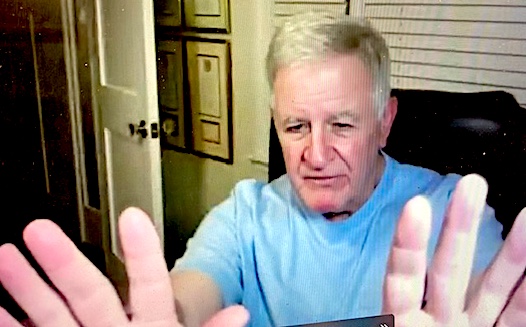
“Stop, stop, stop!” Ezzes interjected, his hands raised in frustration toward his computer camera. “Please, let’s get this a little more succinct,” he implored Russo.
Ezzes, a ZBA member for nearly three decades, said he finds the regulation governing “use” of a property to be clear. The rule was misinterpreted by Russo, the chairman said, and he dismissed Russo’s suggestion that activities like playing hopscotch would require a zoning permit as the lawyer contended,
Ezzes suggested if Russo feels the regulation is ambiguous then he should seek clarification from the Planning and Zoning Commission.
Several skeptical board members also pressed Russo to justify his interpretation of “structure” and “use” provisos in the regulations.
Russo protested, however, saying that he failed to understand why Jones’s recreational use of his property was “being called out” while others are allowed.
It was a losing argument.
With little discussion, the board rejected Jones’s appeal, voting it down 5-0.
John Schwing, interim editor of the Westport Journal, has held senior editorial and writing posts at southwestern Connecticut media outlets for four decades. Learn more about us here.





That’s rough. Sounds to me like he got the shaft. Perhaps he put the cart in front of the horse.
Despite any comments from the ZBA, the dude could have saved himself some trouble by not using artificial turf and then just calling it landscaping. Now, whatever he does will be heavily scrutinized.