


By Gretchen Webster
WESTPORT — Several hundred sky watchers descended on the Westport Library parking lot Monday afternoon for a stellar event: a nearly total eclipse of the sun.
For two hours along the Saugatuck River’s edge, from the lawn of the Levitt Pavilion or in the library parking lot, people of all ages gazed skyward.
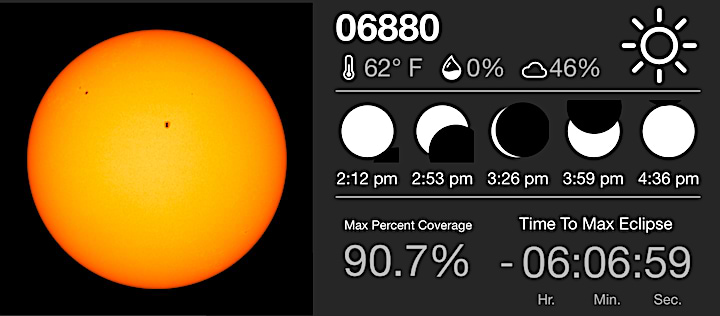
And as the light dimmed and the air grew colder, the crowd donned safety glasses to view the rare celestial phenomenon as the bright orb of the sun was reduced to a sliver while the moon moved in front of it. It wasn’t a total solar eclipse — locally, the eclipse was about 91 percent at peak — but dramatic nonetheless. It also was a rare occurrence — the next total solar eclipse is not expected to be visible from the Westport area until May 1, 2079.


“The sensation is amazing, especially when it gets darker and cold,” said Eli Mizrachi, who traveled to Westport from California and recently earned a Ph.D. degree in physics.
The eclipse-viewing event was organized by the Westport Library in conjunction with the Westport Astronomical Society. The library staff handed out information about how to safely observe the sun and scientific data about eclipses.
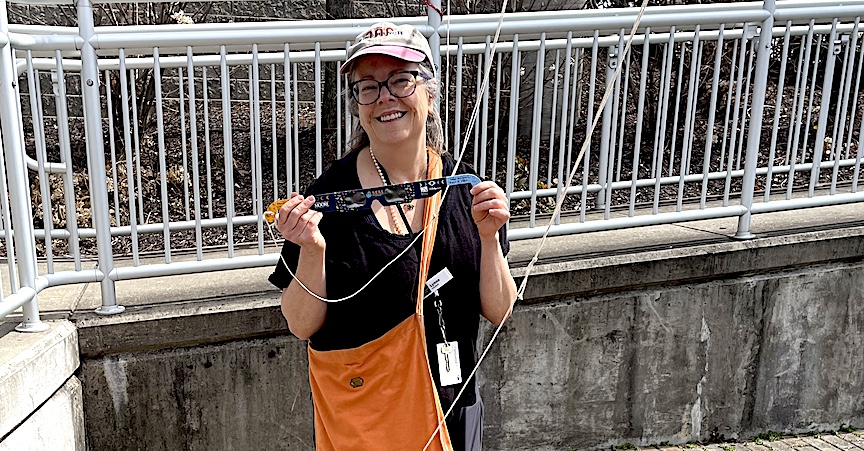
The staff also distributed one pair of safety glasses to each family or individual. Children’s librarian Lynne Perrigo set up a clothesline with dangling pairs of safety glasses for spectators to share if the supply of glasses ran out for every individual.
Westport Astronomical Society members set up telescopes and long lines of people waited for the chance to observe the eclipse through the sophisticated instruments.
But some, like society member Steve Dick, made their own viewing devices. His solar telescope cost him $12 to put together, he said.
Jim Harman also fashioned his own viewing device using lenses from a pair of reading glasses. “I’ve been interested in astronomy for a long time,” he said. “I have a telescope at home, but it doesn’t have a sun filter.”


Brothers Stuart and Sean Smith each brought a telescope to the event, showing scores of people a view of the eclipse, which from start to finish lasted just over one hour. Their father is a member of the astronomical society but couldn’t attend the watch event because of a work commitment. So his sons and his wife, Julie, came instead to help out with the crowd.
Marlowe Harrington, 8, had a simple explanation for what she saw through a telescope. “I’m seeing the moon covering the sun,” she said.
And Westporter Jason Goldberg had one thing to say about the view he saw using one of the safety glasses on the clothesline strung by the library: “It’s cool!”


The Westport Astronomical Society, which has an observatory at 182 Bayberry Lane, was awarded a grant from NASA to fly a high-altitude balloon during the eclipse, according to Dan Wright, a society board member. The society partnered with the University of Bridgeport and the University of New Haven on the project, he said.
The balloon, which was to be flown at 80,000 feet in Texas where the solar eclipse was total, is part of the Nationwide Eclipse Ballooning Project, capturing a perspective of the phenomenon to help researchers study the sun’s outside edge, or corona, and Earth’s atmosphere.
“Eclipses really do generate a lot of interest. It creates interest in science and being outside … putting the phone down for a minute and being with friends and family,” Wright said.
“People who see a total eclipse — it changes their lives. They chase eclipses for the rest of their lives.”
Freelance writer Gretchen Webster, a Fairfield County journalist for many years, was editor of the Fairfield Minuteman and has taught journalism at New York and Southern Connecticut State universities.








Recent Comments