
By Linda Conner Lambeck
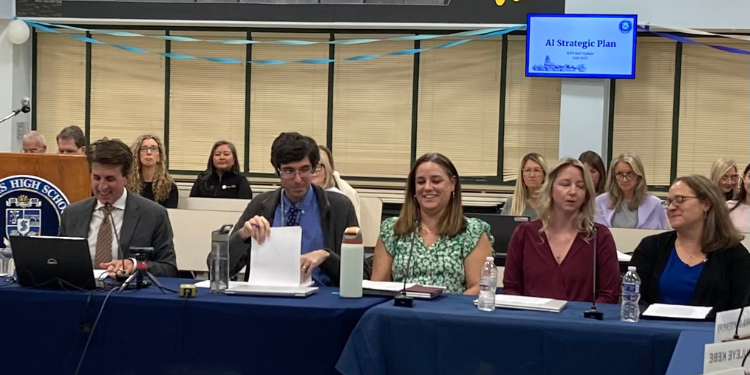
WESTPORT–A three-hour presentation and 80 pages of material on the potential impact of Artificial Intelligence on the district has received an enthusiastic thumbs up from some members of the board and the public.
Others, at a school board meeting last week, admit they are still trying to wrap their heads around what AI will look like in the classroom, but are softening to the notion.
“I still have some reservations, still have questions (but) I feel much more comfortable having reviewed this plan and hearing from you guys,” Board Member Abby Tolan said, facing some of the faculty that have worked on the plan for months.
Schools Superintendent Thomas Scarice, who recommended nearly a year ago that the district change up its strategic plan, switching out collaborative problem solving for AI, is working to win over the skeptics.
“With the right ethics, the right guardrails, and the right leadership, I am not just hopeful, I am wildly optimistic when I think about where we are headed,” Scarice said.
Except for safety and security, Scarice said there is no topic right now more urgent for the district to wrestle with than how it uses AI and prepares students for a world that will be driven by it.
He was flanked by a handful of the 50 teachers who worked on various aspects of the plan to create a “human-centered” vision for AI.
Some, like John Bengston, a Staples Social studies teacher, admits he came into the project a skeptic.
“Specifically, about ethics,” said Bengston, who helped create a draft ethical code to help protect privacy, promote fairness, ensure human oversight and make sure the plan is sustainable even as AI changes daily.
Scarice told the board his only ask of them in the short term is to amend its academic integrity policy to address the use of AI. An AI Code of Ethics is being drafted and Scarice hopes the board will act on it in the next couple of months.
The pitch
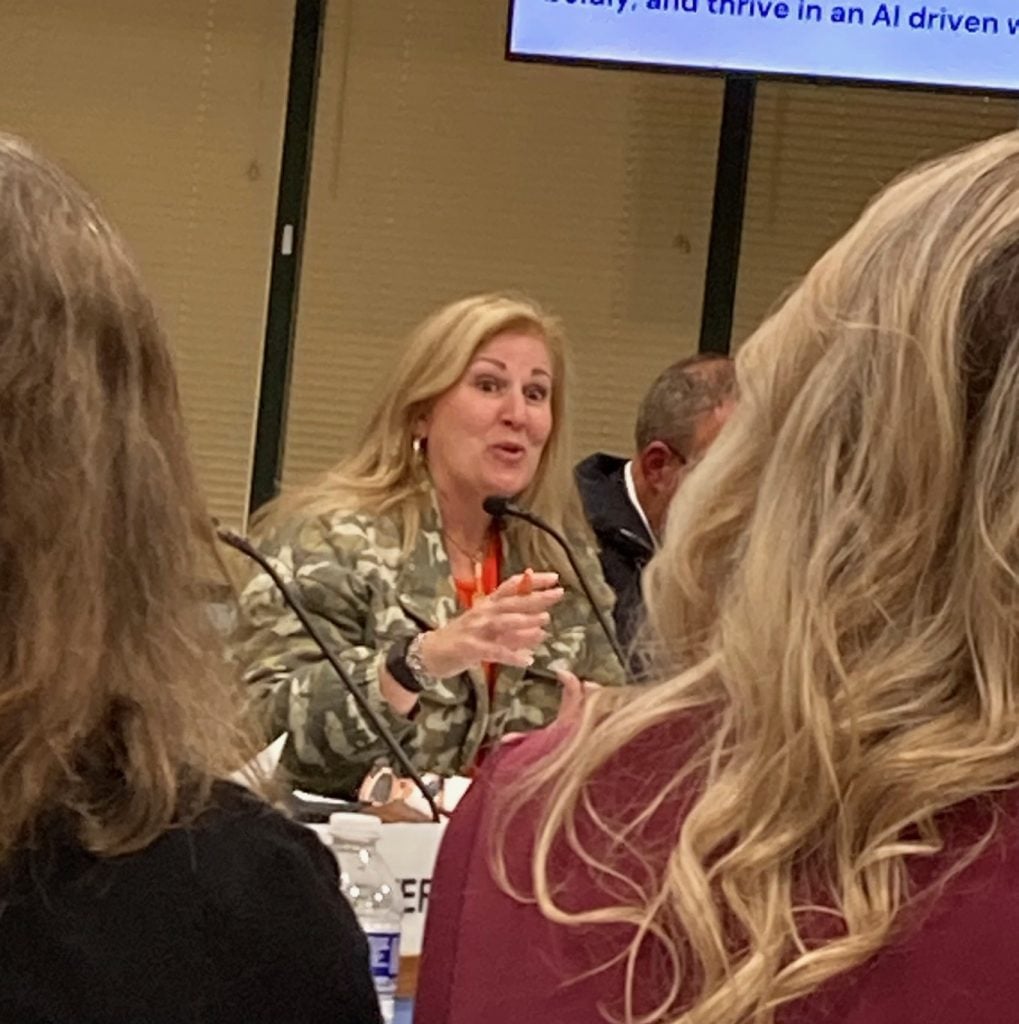
Used intentionally, Scarice told the board that AI can liberate teachers from repetitive work, personalize learning, and strengthen every aspect of the system.
He compared it to the coming of the printing press, electricity and the internet all at once.
Last year, the district took part in a state pilot to try out various AI tools. Several middle and high school classes participated.
Scarice said he was in one sixth-grade social studies class a few months ago where AI was used to teach a topic on the Middle Ages. Instead of poster boards and memorization, students created digital characters – monks, blacksmiths and nobles – that they trained using artificial intelligence. The students then interviewed and debated their characters.
Scarice said it was as if the students were looking through windows rather than computer screens. When some of the answers they got from their characters didn’t sound right, it led to discussion, research and fact-checking. The teacher, Scarice added, floated between groups, asking questions.
To get the most out of AI, Scarice said both teachers and students need training.
“Kids are already way ahead of us with AI,” said Scarice, but they’re basically using it as a glorified search engine or a content generator.
“That’s the lowest possible level of AI’s potential,” Scarice said. He wants to teach students how to think with it.
The plan is to develop a district-wide AI Literacy Framework for both students and teachers.
“What would AI literacy look like for kindergarteners,” asked Board Member Jill Dillon.
Natalie Carrignan, the district’s director of technology suggested at the younger grades it might be as simple as learning mouse skills and basic log in navigation. It is not envisioned that the youngest grades will spend much time in front of the screens.
As for teachers, the intent is to help them recapture time, by spending less on paperwork, and adjust what they teach to individual students’ needs.
It can even be used to help write Individual Education Plans (or IEP) for students with special needs, said Assistant Superintendent Michael Rizzo. An IEP that could take a solid week to work on might be completed in a half hour with proper prompting, Rizzo said.
While some fear AI will dehumanize schools, Scarice said it will do the opposite by freeing up time for more important tasks.
Questions

Board Chair Lee Goldstein asked about cost.
Scarice said any budgetary implications would be presented with the 2026-27 budget recommendation in December. So far, the district has been working with the money it has.
Board Vice Chair Dorie Hordon called the endeavor exciting but hard to wrap her head around.
“It’s new and it’s evolving so fast,” Hordon said. How is the district to keep up.
Scarice agreed that every week AI is leaping forward.
The district committee’s answer is to “future proof” by designing a system that can continuously learn, adapt and evolve with the technology. An AI trends group would be established.
Hordon also asked about teacher buy-in.
Staples Librarian Jennifer Cirino said she has talked to colleagues who at first were against using AI, who became believers training.
Others said there is a healthy sense of nervousness.
Board Member Robert Harrington said he is excited, not nervous. “The framework for learning and how to use it is so important,” said Harrington, describing the 20-somethings he works with having widely different skill sets when it comes to using AI.
Andy Frankel, a Republican candidate for the Board of Education, called what he heard amazing and thoughtful.
There are people in Westport heading up AI initiatives, Frankel said during the public comment portion of the meeting. He urged the district to tap them for help.
Scarice said they already were.
Michelle Hopson, another Republican Board of Ed candidate, suggested as part of its work, the district created a handbook for students that could serve as an AI guide.
Noah Fenn, co-leader of Startup Westport’s Mentorship Program, said AI should become a part of the fabric of the Staples High School student experience.
“Kids are using it,” Fenn said. “Many are using it wrong.”
In November, the AI planning group will return to share objectives related to the humanities, theater, growth mindset, and leadership development.






Recent Comments