
By Linda Conner Lambeck
WESTPORT — A plan to revamp the Staples High School master schedule was sent back for review after the Board of Education’s two student representatives expressed strong opposition to the proposed changes.
Before that, it appeared the plan outlined by Staples Principal Stafford Thomas was set to be put in place next fall.
Thomas told the school board Thursday that the change planned for the 2025-26 school year, two years in the making, would better align with student learning, staff needs and overall school operations.
Supt. of Schools Thomas Scarice characterized the changes as modest.
The plan would have cut the number of class periods each day from six to five. A student’s eight assigned classes would rotate over a two-day period and last longer — an hour to 90 minutes long instead of 50 minutes for most classes now.
“It seems you’re taking minor current problems and replacing with much bigger problems.”
Calum Madigan, Board of Education student representative
There would be four lunch periods instead of three, with the first starting at 10:30 a.m. The number of “Connection” classes — an advisory group all students are required to take — would be reduced to about once a week and offered Wednesdays.
And class rotation would extend throughout the day. Currently, there is a fixed rotation among morning classes and again after lunch among afternoon classes. A full-day rotation would make it less likely that students dismissed early to participate in sports, music or theater would miss the same class day after day.
Thomas said a 12-member committee of teachers and administrators met regularly to devise the new schedule, and relied on student feedback from district climate surveys, as well as parent input.
The proposed schedule “aligns with the school’s mission and optimizes both teaching and learning experiences,” Thomas said in a memorandum to the board.
The changes, he added, will help Staples maintain its reputation for excellence.
Student voices
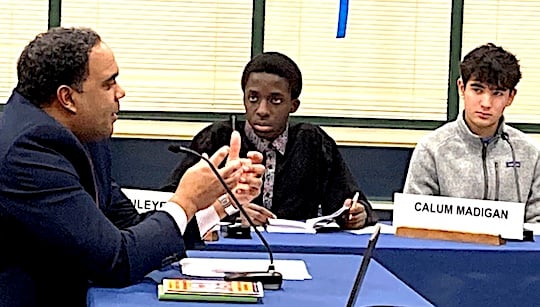
However, the board’s student reps — Staples senior Calum Madigan and junior Souleye Kebe — said that students and teachers they have spoken to felt left out of the decision making.
“It seems you’re taking minor current problems and replacing with much bigger problems,” said Madigan, a senior class president serving his second year as a student representative on the board.
Madigan said most students he has spoken with have a strongly negative opinion of the plan.
Specifically, he dislikes the idea of a 10:30 a.m. lunch shift, thinks longer class periods held less frequently will lead to more homework and that the constantly revolving schedule will be disorienting.
“Students thrive on consistency,” Madigan said.
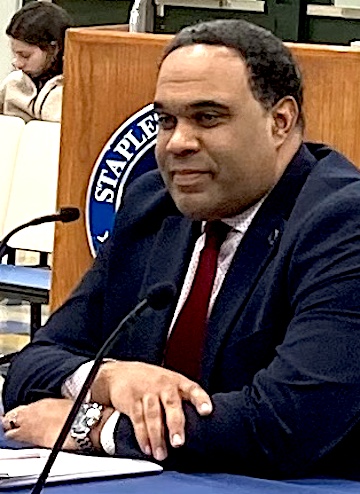
Kebe said he believes there are merits to some of the proposed changes, but questioned how well the plan was vetted among staff and students.
“One teacher described the schedule as a Frankenstein fix,” he said.
Kebe said the first he heard of the proposed change was during a Connections class. “I don’t think student voice has been properly taken into account,” he added.
Board members, most of whom seemed to like the suggested changes, asked Thomas to explain how student voices were solicited.
Thomas said on climate surveys, students complained about lunches tied to lab periods that often meant missing lunch. They also expressed a desire for an open campus, he said.
The proposed new schedule would not allow students to leave campus during lunch, but a five-period schedule that allowed for longer classes would alleviate so-called “lab lunches” and reduce the sometimes crowded cafeteria, the board was told.
The lengthening of class times, Thomas added, should not be a huge adjustment for teachers, although he said some professional development training to pace courses would precede the shift.
The committee also considered a schedule that would give students just four classes each day. It did not get good reviews, Thomas said.
Adult voices
When the plan was presented to the school board’s Teaching and Learning Committee about a month ago, it received good reviews.
Board Chair Lee Goldstein said she liked it.
“I generally like the schedule too,” added Vice Chair Dorie Hordon. “It looks pretty good.”
Her one qualm was about the 10:30 a.m. lunch.
Thomas told her it was not totally out of the norm and that the school cafeteria is open during the day for students who can’t take an assigned lunch period.
Scarice said the lunch change was an operational decision while the extended periods are based on literature that student outcomes benefit when there is more time for critical thinking and problem solving.
The change, the board was assured, would not have an impact on the budget.
“One teacher described the schedule as a Frankenstein fix.”
Souleye Kebe, Board of Education student representative
When the plan was presented to the Staples High PTA, Jodi Harris, a co-president, said the meeting was heavily attended.
Harris said she enthusiastically supports a schedule that would not pull students out of the same math class at the end of the day to play sports.
“It becomes hard to catch up,” she said.
And although she sees a huge plus to the proposed schedule, she wondered how students will keep track of it if the school officials decide to ban student cellphones during the class day.
A phone app most students have allows them to check schedules with one click. Doing it on a computer takes seven steps, she said.
Back to the drawing board
Madiganargued that the existing schedule already allows for long periods for science.
“The overwhelming number of students I spoke with like the schedule now,” he said, adding that students on the climate survey were asked what they want to change, but not what they want in exchange.
“Is this a done deal or a proposal?” Goldstein asked, suggesting there was a disconnect between the committee and some staff and students that needed to be bridged.
Scarice said the board was not being asked to vote, but that he would want a consensus before proceeding. Sometimes, things are done because they are right, not popular, he added.
“You are being heard. This is how it should work. It’s so good.”
Board of Education member Robert Harrington
Hordon wondered if there couldn’t be a trial period, such as when seniors are off for internships in the spring.
Thomas said he didn’t think a trial would offer an authentic experience.
“So how do we manage this now?” asked Hordon, adding she feels the schedule needs to change.
Thomas said the change will clearly not go forward for next year.
“We will create a new committee,” Thomas said.
Board member Jill Dillon congratulated Madigan and Kebe for standing in front of both their principal and superintendent to voice their concerns about the plan.
“I’ve never seen Calum this animated,” Dillon said.
Board member Robert Harrington called the student representatives’ input “awesome.”
Initially opposed to student representation on the board because of how it was proposed, Harrington said he now thinks the idea “fantastic” based on the night’s discussion.
“You are being heard. This is how it should work. It’s so good,” Harrington said.
Freelance writer Linda Conner Lambeck, a reporter for more than four decades at the Connecticut Post and other Hearst publications, is a member of the Education Writers Association.







Recent Comments