
By Linda Conner Lambeck
WESTPORT — Most Westport public school students have shaken off the effects of the pandemic when it comes to scores on state standardized tests administered last spring.
Still, there remains a stubborn dip in scores when students hit the sixth grade — chalked up to a difference between what Westport teaches and the state measures on its Smarter Balanced Assessment test — and a persistent gap between local white, African-American and Hispanic/Latino students across the board.
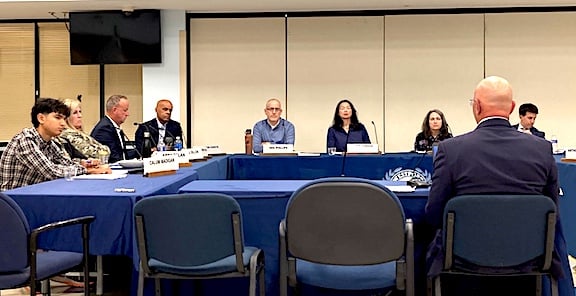
“It is hard to find a school district that doesn’t have performance gaps,” Supt. of Schools Thomas Scarice told the Board of Education when it was presented with an overview of the scores last week.
As a professional educator, however, Scarice called the gap frustrating.
There is little solace, he added, for the most part, minority students in Westport schools outperform minority students statewide.
While 79 percent of students identified as white met or exceeded the language arts proficiency benchmark across the grades taking the test, just 56 percent of Black students and 67 percent of Hispanic or Latino students did.
In math, the Westport gap was even greater with 80 percent of white students, 40 percent of Black and 66 percent of Hispanic/Latino students reaching or exceeding the state proficiency bar.
Statewide, 64 percent of white students, 30 percent of African-American students and 30 percent of Hispanic/Latino students met the benchmark in language arts. In math, 60 percent of white students, 20 percent of African-American students and 24 percent of Hispanic/Latino students met the target.
Better understanding and addressing racial and ethnic gaps remain an ongoing challenge, said Assistant Supt. Anthony Buono.
Headed in the right direction
On a positive note, Buono said most student scores on the test have rebounded to pre-pandemic levels.
The school district’s overall scores remain among the highest in the state.
Across all grades that took the test, between 78 and 79 percent of Westport students met or exceeded the benchmark compared to a statewide average of 49 percent for language arts and 44 percent for math.
The state’s test is given in grades 3 through 8. In 11th grade, a school-administered SAT test is given.
In fifth-grade math in Westport, the percentage at benchmark rose from 79 percent in 2022-23 to 83 percent in 2023-24. That is one point higher than in 2018-19, just before the pandemic.
In eighth grade, 79 percent met or exceeded the benchmark last spring compared to 78 percent the year before and 70 percent in 2021-22.
In English language arts, 88 percent of fifth graders met the benchmark last spring compared to 82 percent the year before while eighth grade again saw 79 percent reaching benchmark last spring, a point higher than the year before.
Buono said other grades show similar growth.
Last year, concern was raised when in third grade — where between 83 to 84 percent of students had been meeting the language arts benchmark — the percentage reaching the target dipped to 73.8 percent. For 2023-24, that grade is back up to 78.4 percent.
“I’m confident the trend will continue,” Buono said. “I am confident that we can have over 90 to 95 percent at or above benchmark on this assessment.”
On the state-administered SAT, given to all high school juniors, Westport’s average score was 1,214, a point lower than the year before but the highest among comparable districts. Wilton was second at 1,204.
On the state science assessment, given in grades 5, 8 and 11, the percentage reaching benchmark rose at all three levels, most notably among juniors where 80 percent met the benchmark last spring compared to 67 percent the year before.
Officials say in the past some juniors didn’t take the science exam seriously. Last spring, they were offered incentives if they did well. It seems to have worked.
The same strategy may be used in eighth grade this year, the board was told.
Local curriculum vs. Common Core
Like last year, the board was told the decline in the percentage of sixth graders has more to do with what is taught than how well students can read, write, speak and listen.
There is an 11-point gap between grade 5 and 6 in language arts. Peer districts have not seen such a sharp drop off.
Less time is spent in middle school on reading: 41 minutes vs. 120 in elementary school.
Buono said a UConn consultant looked at the district’s sixth grade curriculum and suggested the time spent on language arts be increased to 60 minutes.
It is something the district is considering. Time spent on the subject is also focused largely on literature.
The state test, based on its Common Core curriculum, has a heavy emphasis on informational, non-fiction reading, said Buono.
Scarice called it a value judgment. He said he is not sure “gaming the system” by teaching to the test will give students what they need. Literature, he added, is a runway for the curriculum students will encounter at Staples.
The district is also slowly conforming to the state’s Right to Read law, which it initially appealed.
Buono said the district is using three of four state-approved components. The fourth may be a challenge,” he said. “We have a committee looking at it.” The district has until July 1, 2025.
The achievement gap
In some grades, the number of African-American students in Westport is so small that their scores are not broken out because of privacy concerns.
In fifth grade, for instance there are 11 African-American students out of 397, the board was told.
Districtwide among tested grades, there are 1,802 white students, 167 who list two or more races, 183 Hispanic/Latino students, 55 African-American students, 169 Asian and one Hawaiian/Pacific Islander.
The approach of the district, according to the administration, is to look at students as individual, not groups.
Students underperforming get extra support and differentiated instruction regardless of demographics.
Interventions are provided, Buono said, adding the changes have done little to lessen the gap.
“Why not pull those families and ask how we can help you,” asked board member Jill Dillon.
“I’m hearing that’s what they are kind of doing,” said board Vice Chair Dorie Hordon.
The district has several internal assessments that it values more than the state test when it comes to identifying students who need extra help early on.
The board was offered a future presentation on its Response to Intervention program that works with students who need extra support.
The district also casts a wider net, giving extra help to students that other districts might consider to be in an acceptable performance range, Assistant Supt. Anthony Rizzo said.
Board member Kevin Christie said that while he appreciates what the district does for individual students, he wants to know how the board can assess whether efforts made for underperforming students is working.
“It sounds like we haven’t really done that in the aggregate,” said Christie.
Buono said the district has by beefing up its intervention process and applying it early.
Results of internal measures will also be shared with the district at a later date.
Freelance writer Linda Conner Lambeck, a reporter for more than four decades at the Connecticut Post and other Hearst publications, is a member of the Education Writers Association.






Recent Comments