
By Linda Conner Lambeck
WESTPORT — Changes made to the district’s early literacy program led to 95 percent of third graders meeting with reading success on assessments this winter, the Board of Education was told last week.
Whether that and other positive results reflected on a new K-3 Literacy Dashboard local school officials developed are enough to satisfy a state reading law that requires districts to start using a state-approved reading curriculum program aligned with the science of reading by July 1 remains unclear.
Conversations with the state are ongoing, Assistant Supt. Anthony Buono told the board Thursday at Staples High School.
Buono said there are new strategies, training and collaborations that have led to improvements in the already high percentage of district students meeting state reading goals.“We have … sent that information to the state as part of our ongoing correspondence,” he said.
Last year, Westport was one of dozens of districts that applied for waivers from the requirements of the state’s “Right to Read” legislation. The waiver was denied.
Since then, Buono said the district has implemented three out of the four programs approved by the state, putting Westport in full compliance for this year. “We continue to work with the state to ensure [Westport] is in full compliance for next year,” he said in an email after the meeting.
State officials did not immediately respond to a request for comment on the district’s compliance efforts.
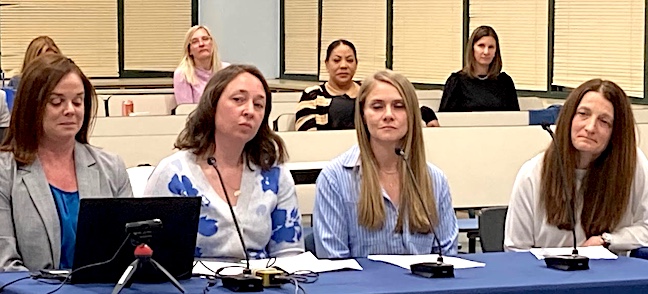
Buono, along with a team of early-literacy educators from the district, say that while the arsenal of effort to make sure all students are successful readers includes phonics, phonemic awareness and decoding skills, they remain reluctant to rely on basal readers or grade-level anthologies favored by the state.
“We value the art of teaching, and it isn’t something that we’re going to [achieve through] turn the page and be the same for every kid,” said Jess Carey, a literacy coach at Saugatuck Elementary School.
Every elementary school student in Westport, regardless of reading level, gets small group instructions, in addition to whole group instruction, multiple times a week, Carey said.
“If we lose our model, we lose that opportunity for that small group instruction,” said Devon Carothers, a literacy interventionist at Coleytown Elementary School.
Supt. of Schools Thomas Scarice said the district’s approach must be protected.
“If we can plant our flag in one place … grade three on track for reading is probably the best indicator that we have,” Scarice told the board.
In 2024. 78.4 percent of third graders in Westport scored at or above the state goal in reading on the Smarter Balanced Assessment test. The state average was 45.9 percent.
In the fifth grade, 87.9 percent of Westport students met or exceeded the state goal compared to 51.4 percent statewide.
Local efforts
The district has collaborated with the Southport CoLab, which specialized in literacy training programs, and has had 100 staff members trained in the Orton-Gillingham approach to reading and writing, according to district officials.
Classroom libraries have been expanded. All five elementary schools have literacy coaches.
Work the district has done has been highlighted at a Cooperative Education Services presentation in Trumbull, at which state representatives were in attendance, said Buono.
The most recent standardized measures of early literacy for K-3 show impressive results.
An AImsweb Literacy Performance test given to Westport students in the fall of 2024 show that most kindergarten students come in with a skill set similar to the national average but soon take off.
In kindergarten, about 14 percent of Westport students tested in the high-risk category in the fall but by the winter, that shrunk to only 5 percent — or 18 students.
Conversely, the percentage of kindergarteners testing at grade level rose from 62 percent in the fall to 80 percent in the winter.
In first grade this school year, 15 percent of Westport students tested in the high risk range in the fall. That percentage dropped to 5 percent in the winter, with 88 percent on track.
In second grade the percentage scoring in the high-risk range fell from 7 in the fall to 3 percent in the winter, with 91 percent on track.
And in third grade, 3 percent of students — 12 out of 440 students — were at high risk by the winter with 95 percent on track.
In all cases, the local performance and growth were greater than the national average, according to the new performance dashboard.
“We are very different,” Buono told the board.
State programs, Buono said, would require the district to use the same text for all students.
“Our kids, the majority, are above grade level,” he said. “They would be reading below where they [are at].”
The Aimsweb test is one of several assessments the district uses to measure growth and weaknesses.
Kelly Michel, coordinator of elementary education for the district, said the assessments help identify relative weaknesses that are addressed on a continual basis.
“We are always looking for ways to improve,” Michel said.
Michel said the ability to best fit the needs of individual students would be loss if the district shifted to a big box program.
“We would lose the engagement,” added Tracey Carbone, principal at Kings Highway Elementary School. “Kids are reading books they are interested in.”
Phonics is important said Carbone, but so too is reading to learn. “We want kids who can think about the text,” she said.
Science visit in the fall
Reading was just one of three academic topics the board heard about at the meeting.
The district is also planning for a fall visit of the Tri-State Consortium, an alliance of public-school districts in New York, New Jersey and Connecticut. The focus will be the district’s science program.
The consortium works to help members improve through peer reviews of programs and practices. Nine districts in Connecticut belong to the consortium.
Westport’s three-day visit from the consortium will be in November.
John DeLuca, science coordinator for the district, said the visitors will be asked to critique the district’s efforts to integrate Next Generation Science and Engineering practices into the curriculum. They will also gauge how effectively the curriculum and instruction provides opportunities for students to engage in meaningful scientific learning.
The visit will include observations, interviews and feedback.
New dashboard
The district is also eyeing a new performance dashboard that looks beyond test scores to inform the public about student achievement.
Scarice said the board discussed the development of such a dashboard at his latest annual review.
The dashboard would collect data the district already has on such things as graduation rates, program evaluations, and climate surveys with other information to give the board and community a pulse of the district.
To aid in the effort, the district is using Hanover Research, a group that has assisted the district in administering its climate survey and conducting research on such topics as cell phones.
James Kornegay, a senior content director for Hanover, told the board the district’s dashboard can be custom built.
“What’s the cost,” asked board Vice Chair Dorie Hordon.
She was told the fee would be part of the annual subscription the district already pays Hanover. District membership costs $40,000.
Board Chair Lee Goldstein said as good as district test scores are, she wants, as best as the district can, to measure qualitative aspects of the school system.
“It is something we have been talking about for years,” Goldstein said,
Board member Kevin Christie said he would like the district to take a look at trends over time.
Hordon said she had a list of possible areas of focus including college outcomes.
Calum Madigan, a Staples senior and student
representative to the board, said he’d like the dashboard to track student grade point averages from freshman to senior year to see if they climb as student start taking more challenging classes.
Board Secretary Neil Phillips said he wants the dashboard to be user friendly so that the public can easily navigate it.
Freelance writer Linda Conner Lambeck, a reporter for more than four decades at the Connecticut Post and other Hearst publications, is a member of the Education Writers Association.






Recent Comments