
By Linda Conner Lambeck
WESTPORT — Offered the chance to change the state’s controversial and cumbersome teacher evaluation system, the school district has seized the opportunity.
In its place, school officials, with the help of the teachers’ union, have developed an updated system that relies on feedback and growth rather than a rubric system and open-to-interpretation labels.
The plan is “tailored specifically for the esteemed educators of the Town of Westport,” according to the report developed by a 21-member committee that spent this past school year working on the plan.
Presented to the Board of Education earlier this month, the plan was approved unanimously last Thursday by the five school board members in attendance.
“The new guidance is sure to have a more powerful impact on improving teaching and learning in our schools,” said Assistant Supt. of Schools John Bayers, who led the development of the local plan.
Prior to the COVID pandemic, Bayers told the board that teacher evaluation plans in the state were driven by the federal Race to the Top regulations that offered incentives to states prescribing teacher evaluation systems that emphasized student performance on standardized tests as well as teacher growth.
There was a lot of paperwork. Many deemed the system ineffective and decried the loss of local control over how teachers are judged.
New guidelines, approved by the state Board of Education nearly a year ago, give local districts more flexibility to design a system that works for them and which gives teachers a voice in their evaluation and professional development.
State law requires the plan relate directly to the school district’s strategic plan.
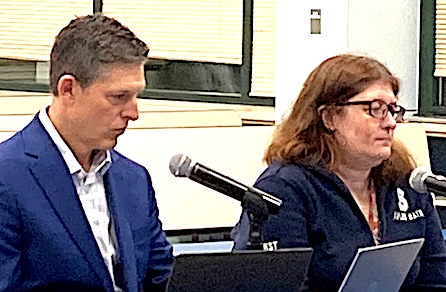
“We are trying to get back to that idea of professional growth,” said Stacey Delmhorst, a math teacher and co-president of the Westport Education Association.
Delmhorst, along with John DeLuca, science coordinator for the district, co-led the committee that developed the plan which will roll out in September.
The plan “focuses on the spirit of what we think is good teaching in the classroom,” said DeLuca.
It won’t get bogged down in the difference between “exemplary” and “proficient,” two labels assigned under the former evaluation system.
Under the old system, teachers would want to know, “What do I need to do to get to a 5,” Delmhorst said.
Now there will be discussions about growth, not getting from one arbitrary benchmark to another.
Under the revised plan, the evaluation timeline will differ for tenured and non-tenured teachers.
There still will be goal setting, data collection and classroom observations for the 500-plus educators in Westport’s public schools, but also feedback is to be ongoing and goals veteran teachers set for themselves can span over multiple years and involve multiple disciplines.
“We are now really looking at the whole child as a goal as opposed to the grade they got on some test,” Delmhorst said. Growth demonstrated in other ways would count toward goal accomplishment.
New teachers still will be subject to at least four observations a year. Evaluators will be looking to see the teacher understands what they are teaching, offers challenging and engaging lessons and can address the needs of individual learners, among other things.
For tenured teachers, the focus will shift toward a concentrated number of observations in some years, but not all, and on a specific unit they are teaching.
The emphasis is on personal growth.
Bayers said the approach will encourage feedback between evaluator and teacher throughout a unit that can be much more powerful than one-and-done observations of the past.
It should help when teachers have off days, Delmhorst said.
As for struggling teachers, Delmhorst said the plan is meant to offer clearly communicated plans of improvement for what she called a small subset of the staff.
“We’ve always had an intensive support plan for teachers who are struggling,” Delmhorst said. “We have more of a tiered process now.”
The support would not start with union involvement or a full-on formal corrective plan.
“They are a lot of work,” Delmhorst said of corrective action plans. “On both sides.”
Based on recent state feedback, Delmhorst said that part of the plan may need to be tweaked.
“I really think we did a great job,” the union rep said of balancing the wants and needs of the state and the district.
Bayers said the plan will make teacher evaluations more meaningful.
Policies changed on K enrollment, HS graduation
In other action, the board Thursday adopted new policies to comply with the state’s new cutoff age for kindergarten enrollment — age 5 by Sept. 1 — and also revised high school graduation requirements.
One change adds a half-credit financial literacy requirement for graduation starting with the Class of 2027 that the district plans to satisfy through existing courses. Another requires the district to describe proficiency skills students need to graduate.
A third state change makes a mastery-based assessment an optional requirement to graduate, but the school board will keep the policy as part of local requirements at the urging of Staples Principal Stafford Thomas.
Thomas told the board in May the relatively new requirement is something the high school’s accrediting agency wants to see continue.
Freelance writer Linda Conner Lambeck, a reporter for more than four decades at the Connecticut Post and other Hearst publications, is a member of the Education Writers Association.











Recent Comments