
By Linda Conner Lambeck
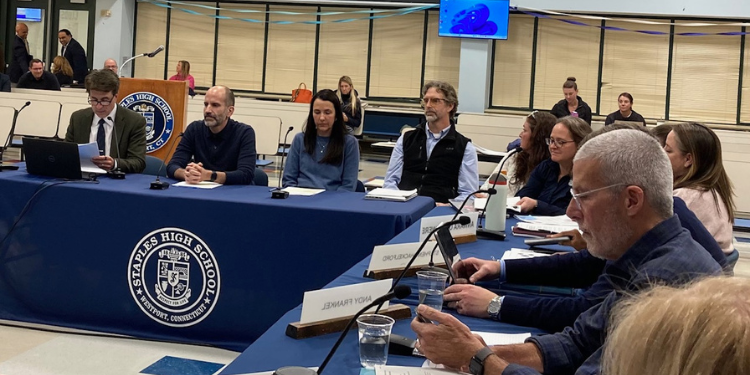
WESTPORT–Artificial Intelligence may help make the school system more efficient, but will it take the soul out of learning?
Schools Superintendent Thomas Scarice argues “no” and laid out a plan to incorporate AI into liberal arts, district efforts to cultivate student intelligence and even help students become better public speakers.
“If part one of our plan was about intelligence, part two is about integrity,” Scarice told the board during a presentation that came two hours into a meeting filled with discussions about enrollment, the budget and the cultural climate of secondary schools.
Plan goals
The goal of the district’s AI plan, said Scarice, is not to simply make Westport schools keep up with the technological times but to make its students use it to their advantage and become more extraordinary.
Flanked again by staff members who have worked on the initiative, Scarice laid out a plan to leverage AI so that teachers and students have more time to think, compose and create.
“Our students must remain brilliantly human,” Scarice said.
Humanities
For that, Scarice is looking to the humanities–English, Social Studies, Theatre courses and district Growth Mindset efforts–to help students continue to find meaning and be able to express it.
The plan calls for an inventory of best practices, partnering them with technology, developing interdisciplinary courses and rethinking master schedules.
Michael Mezzo, a Staples English teacher, said AI can be used to elevate student thinking. He has already been doing some of it as students read “The Odyssey” and “Fahrenheit 451.”
“If we are mindful about using AI deliberately we are really going to let these kids fly,” Mezzo said.
Bedford Language Arts Teacher Alison Antunovich said the idea is to use AI but prevent students from becoming so reliant on it that fundamental skills like writing and forming arguments suffer.
Bedford Social Studies Teacher Jeremy Royster, who participated in last year’s state-funded AI pilot, said students can also be taught to discern what is true and false using AI and determine when AI is reliable.
Board Chair Lee Goldstein said she loved the idea of elevating the humanities and called taking an inventory of current practices crucial. She wants that inventory to include how much screen time is currently demanded of students in school and how much homework is done on computers.
No more time
Goldstein questioned the idea of interdisciplinary courses on top of curriculum currently offered.
“We keep asking for more money (from the town) and we are lucky and we get it. But there is no more time,” Goldstein said. “I think when looking at what we can and want to do there has to be a really fair evaluation of what is possible within a day.”
Board Member Abby Tolan said what is most exciting to her about the plan is the idea of rethinking the master schedule. She said she likes the thought that some learning would become project based.
Board Secretary Neil Phillips said he loved the plan but questioned the planned rollout, with some action steps reaching into 2027.
With technology changing so fast, how will we keep up, Phillips asked.
Already happening
Scarice said the district is not holding back waiting for a plan. Some work is already happening across the system, Scarice said. Faculty training is taking place and teachers are using AI in various ways.
More will happen, he said, once the board district establishes an AI ethics policy. A draft was presented to the board last month. Scarice is hoping for approval in a couple of months.
Board Member Andy Frankel urged Scarice to get more outside expertise as he advances the work.
“This is very ambitious,” Frankel said. “I think it might be much more efficient and save time to get that guidance.”
“I would not gravitate toward that,” said Goldstein. “We have a history here of ground up curriculum development.”
The district, she added, doesn’t bring in volunteers to tell it how to teach biology. Technology, she added, is no different.
Scarice said his strategic plan does call for the district to engage colleagues and professionals as it moves forward.
Board Member Stephen Shackelford said he liked that the plan doesn’t just chase the next best thing but seeks to use AI as a tool to enhance learning. Shackelford said his biggest fear is that AI would stop kids from learning to think.
Looping in parents
Board Member Jill Dillon asked how parents will be kept in the loop.
Scarice said there will be meetings and communication with parents once plans become more concrete.
Goldstein said part of that should be teaching parents what is acceptable and what is considered cheating when using AI to help with schoolwork.
She also questioned Scarice’s idea to make performance arts part of the AI initiative.
To ensure students learn to think on their feet, and can collaborate and communicate well with others, the plan calls for more opportunities for students to learn and practice public speaking in front of others.
“It’s exploratory … I have an idea the ways it could work,” Scarice told the board.
“I think all these skills should be in our program and students should learn them,” Goldstein said. “I don’t see it as part of this strategic plan. Build these skills into classes.”
Board Vice Chair Dorie Hordon agreed.
“Leadership presentation skills should feel more organic,” Hordon said. “Not like an AI thing.”
Phillips said he saw the initiative as a counterbalance to AI. To help students feel comfortable in their own skin.






Recent Comments