
By John Schwing
WESTPORT — A budget to fund Westport public schools for 2025-26, with a 4.7 percent increase over current spending, won unanimous Representative Town Meeting approval Monday night.
The $150.4 million operating budget, which also won unanimous backing from the Board of Finance in March, is actually about $15,000 more than initially proposed to the Board of Education in January by Supt. of Schools Thomas Scarice.
And that’s despite the school board trimming roughly $770,000 from Scarice’s proposal in February, primarily by eliminating plans to add two assistant principal positions for the town’s elementary schools and a facilities coordinator job.
But those savings were counter-balanced by a 10.9 percent projected rise in the school district’s health insurance costs, an expenditure that has risen significantly over the last several fiscal years. The increased cost was built into the new budget even as the district switched health insurance coverage to the State Partnership Plan.
The hike in health insurance coverage accounts for roughly 1 percent of the overall 4.7 percent 2025-26 budget increase, according to Elio Longo, the school district’s chief financial officer.
The new education budget will comprise roughly 63 percent of all Westport’s public expenditures in the new fiscal year starting July 1. In addition to the operating budget, the RTM unanimously backed nearly $7.7 million to service the school district’s long-term debt.
The rest of the 2025-26 budget — primarily $85.7 million for the town side of the fiscal ledger — awaits final action by the RTM when it convenes at 7:30 p.m. Tuesday in Town Hall’s auditorium.
“Shared values” in support of education
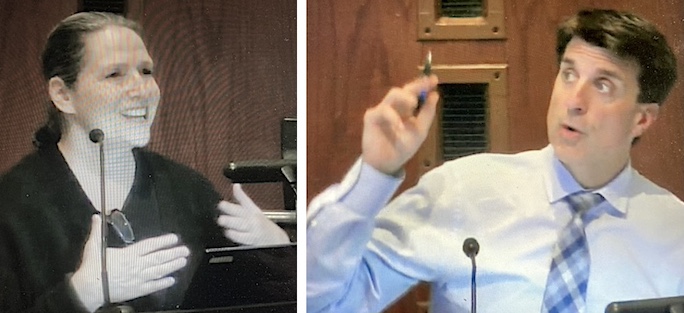
Board of Education Chair Lee Goldstein and Scarice led Monday’s presentative to the legislative body’s meeting in Town Hall.
Goldstein said she was grateful to live in a town where support for education is “a shared value,” describing the roughly $6.8 million increase in operational expenditures over current spending as “essentially maintaining what we have” now.
She recounted the “difficult, controversial, painful, robust discussions” that school board members had over the course of several meetings before deciding not to hire the equivalent of two assistant elementary principals, which would have given each of the town’s five elementary schools two full-time assistants.
And, in addition to cutting the superintendent’s recommendation to add a new facilities project coordinator, she noted the board also trimmed two school buses from the current fleet — an estimated savings of about $230,000 — with the prospect of reducing more in the future.
A redistricting plan set to take effect with the new academic year — reassigning about 60 students from the Long Lots Elementary School district to Saugatuck Elementary — won’t provide immediate operational savings, Goldstein said. But it will have an impact on capital expenditures for the new Long Lots, she added, since the footprint being planned for the school will be smaller.
“Cost avoidance” priorities
Scarice called Westport’s public schools a “premier” district, “one of the best in the country.”
In terms of the new budget, the superintendent underscored what he called “cost avoidance” totaling millions of dollars in special education expenses by adopting in-house programs that circumvent the need to enroll special education students in more expensive out-of-district programs. Currently, 36 students are placed in programs outside Westport.
He also said that changing health insurance coverage for school district employees — proving “inconvenient at times” — over the last several years has been another major cost avoidance, estimating it saved more than $4 million.
The Long Lots redistricting plan, he added, helped to “right-size” the design for the new school, allowing for smaller common areas and lower capital expenditures.
Salaries for school district employees are the largest share of the $150.4 million education budget. Under contractual agreements for 2025-26, the amount paid certified staff will be $79.1 million, or 4.6 percent higher than this year, comprising 47.8 percent of the total budget, while pay for non-certified staff will total $19.5 million, rising 4.9 percent, or 13 percent of overall spending.
Scarice’s lieutenants also provided more background on school budget ingredients, such as enrollment, special education and staffing.
When RTM Moderator Jeff Wieser opened the floor to comments or questions, the only person who opted to speak was Melissa Levy, a District 2 RTM member. She asked several questions about the district’s special education programs and out-of-district placements.
Wieser then called for a vote on the budget, which was approved by a unanimous show of hands.
John Schwing, consulting editor of the Westport Journal, has held senior editorial and writing posts at southwestern Connecticut media outlets for four decades. Learn more about us here.








Recent Comments