
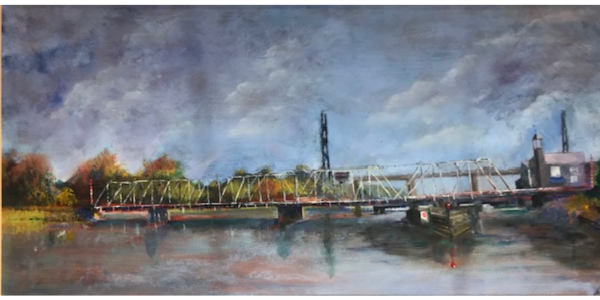
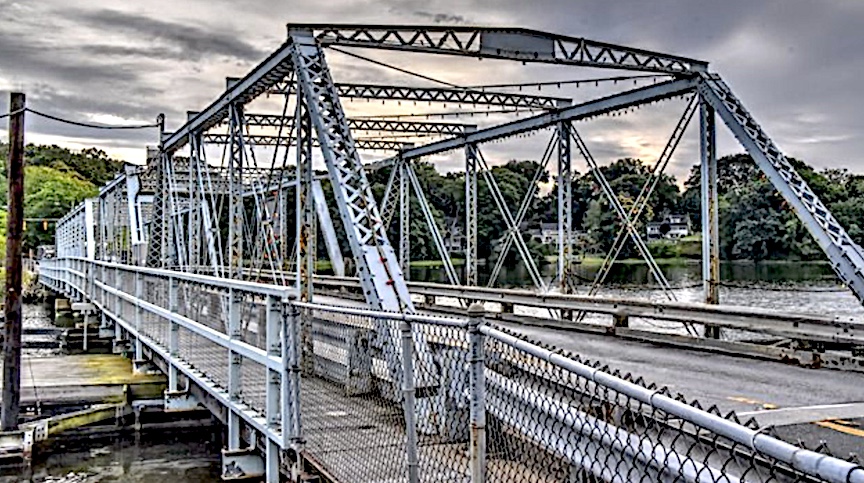
WESTPORT–The Representative Town Meeting (RTM) will continue to work toward a community position on what should be done with the William F. Cribari Bridge tonight.
At the 7:30 p.m. meeting in Town Hall, the full RTM is scheduled to continue a discussion that began in a Feb. 24 virtual meeting to address the Connecticut Department of Transportation’s (DOT) plans to replace or rehabilitate the 142-year-old span.
The agency has deemed the span structurally and functionally deficient.
A perfect consensus on the future of the historic swing bridge may be unrealistic among the 36 RTM members, said RTM Moderator Jeff Wieser. But some elements of the discussion seemed to garner strong support – including that 18-wheelers continue to be barred from the bridge and that pedestrian and bicycle lanes be included – he said.
“We have to pick what it is that’s really important to us and provide that input to the negotiators,” he said.
The aim is to adopt a “sense of the meeting resolution” – a statement of the RTM’s collective position – on the future of the span, which carries Connecticut Route 136 – Bridge Street – over the Saugatuck River.
The DOT is accepting public comment through April 17 on its recently released environmental assessment of potential solutions. Many people in town oppose the agency’s preferred option – to replace the bridge with a new one on the same spot – but the agency says that no decision has been made.
As part of its efforts to gather input, the DOT has scheduled a public hearing for 6 p.m. March 19 in Westport Town Hall.
One topic discussed in the February session held by three RTM districts was the formation of a Cribari Bridge committee to engage with the DOT on the issue. During the meeting, however, Wieser and Selectman Don O’Day said such a panel would need to be appointed by First Selectman Kevin Christie.
Christie said he saw the benefit, but that he would need to consult with others before making a decision. Yesterday, he said his immediate priority “is ensuring strong participation in the March 19 DOT public hearing and formal comment period, which is the appropriate forum to hear directly from DOT about the proposed project and where the process stands, and to provide feedback on the Environmental Assessment and proposed improvements.”
A Change.org petition requesting federal oversight of the project as a means of saving the span has collected more than 1,300 signatures. A second, more recent, petition on the same site has collected more than 50 signatures in support of preserving the bridge.




A brief clarification regarding Mr. Wieser’s and Mr. O’Day’s statements about the creation of a “panel”: pursuant to Section A162-18 of the Town Charter (“Special Committees”), the RTM has sole authority to create Special committees — not the First Selectperson’s Office.
The First Selectperson may offer suggestions or recommendations, as First Selectwoman Tooker did in connection with the Long Lots School Building Committee, but the authority to establish such a committee rests exclusively with the RTM.
The RTM also retains authority to make additions or modifications to any committee it establishes.
Jennifer,
That is why I voted for you. You read the charter and question people in positions of power. You are a hard worker.
It be helpful to clarify the role the RTM can play—from my point of view, at least—in how the Cribari Bridge pProject advances, who is involved, and encourage your effort::
Cribari Bridge – Why RTM Engagement Matters Now
The Cribari Bridge project is advancing with involvement from:
• Connecticut Department of Transportation
• Federal Highway Administration
• Federal historic and environmental review laws
• The Bridge Street Historic District
Because federal review is underway, public input — including from RTM members — becomes part of the formal decision record.
Why this matters for RTM and Westporters in general:
• Issues raised now must be addressed in the final Environmental Assessment
• Long-term traffic, noise, and district character impacts can be formally evaluated
• Consulting party and public participation concerns become documented
• The record created now shapes FHWA’s final determination
The March 19 hearing is not simply informational.
It is part of a federally required process.
RTM engagement helps ensure that:
✔ The town’s concerns are clearly articulated
✔ The federal record reflects present-day conditions
✔ Alternatives and indirect effects are fully examined
✔ The review process is thorough and transparent
Participation does not require the RTM to reach consensus on one outcome.
But participation ensures Westport’s elected representatives are visible in the official record.
And, in my opinion, nothing could be more important to Westport’s citizens.