
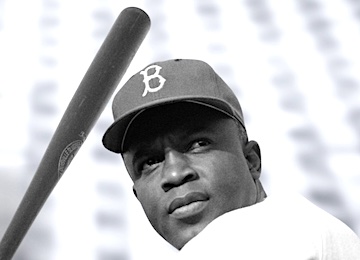
WESTPORT — *42,” the uniform number Jackie Robinson wore when he broke Major League Baseball’s color barrier taking the field for the Brooklyn Dodgers nearly eight decades ago, has the singular distinction of being the only one retired by all teams.
That pays tribute Robinson’s pioneering status in baseball and the civil-rights movement.
And in recognition of his accomplishments, an essay contest asking writers 60 years old and over to explore the lasting impact of Robinson’s legacy on today’s sports and culture was organized in March by Westport Library’s Common Ground Initiative. It was co-sponsored by the Westport Center for Senior Activities and Meryl Moss Media Group.
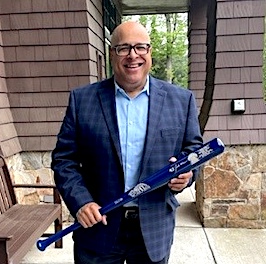
Tony Sanches was announced this week as the first-place winner for his essay “Life Lessons.” He was presented with a Jackie Robinson Baseball Hall of Fame 1962 Induction, limited-edition, full-size bat.
Steve Karp was the runner-up for his essay, “42 and Me,” receiving a prize of a Highland Mint Jackie Robinson Hall of Fame plaque.
Jim Alkon won third place for his submission, “His Courage Taught Baseball to be Color Blind,” and was presented a Highland Mint silver photo coin.
Other essayists selected for recognition were: William Field for “The Meritocracy of the Locker Room: Jackie Robinson’s Halo Looms Large;” Martin Erdheim for “Jackie Was America’s Dream,” and Holly Goss Betts for “Jackie Robinson Moved Boulders.”
Robinson became the first Black player in professional baseball’s modern era when he started playing for the Brooklyn Dodgers on April 15, 1947.
He was inducted into the Baseball Hall of Fame in 1962 for a career highlighted by a .311 batting average, more than 1,500 hits, 137 home runs and 197 stolen bases.
He later became the first African American to hold an officer-level position at a major corporation; served as an advisor to political leaders; promoted economic empowerment by co-founding a bank and housing development company, and worked to advance equality and social justice until his death in 1972, according to information from the Jackie Robinson Museum.
Essays submitted for the inaugural Jackie Robinson Essay Contest “were thoughtful, thought-provoking and routinely excellent. It was a real challenge to narrow it down to just six recipients,” William Harmer, the library’s executive director, said in a statement announcing the winners.


Recent Comments