
By Kerri Williams
Every year, Cathy Gilbertie challenges herself to try something new with her gardens, whether it be to add a new plant, include more native varieties, or even to put in a whole new garden bed. It’s a great way to get out of your comfort zone and perhaps do something to help the environment.
This year, Cathy’s new project is to up her composting game. Cathy, who handles communications for Gilbertie’s Garden Center in Westport, spent last winter reading up on the composting process so that she could create her own compost pile and reap the benefits in her gardens.
Why compost? For one thing, it’s a win for the environment. Instead of adding food scraps to a landfill, you are using them to create nutrient-rich matter that will enrich your garden.
So far, Cathy’s progress has been admittedly on the slow side, but that’s okay. One of the first things she advises for those looking to start their own composting journey is to “start small.”
“It’s a commitment,” Cathy said of the composting process. “…You can’t just pile up leaves and hope for the best.”
In fact, Cathy said the first thing for newbies to consider is whether they want to compost themselves or to bring in compost to enrich their garden soil. For those who decide to purchase compost, she advises using a high-quality brand. Gilbertie’s sells Coast of Maine, which she said is “very well sourced.”
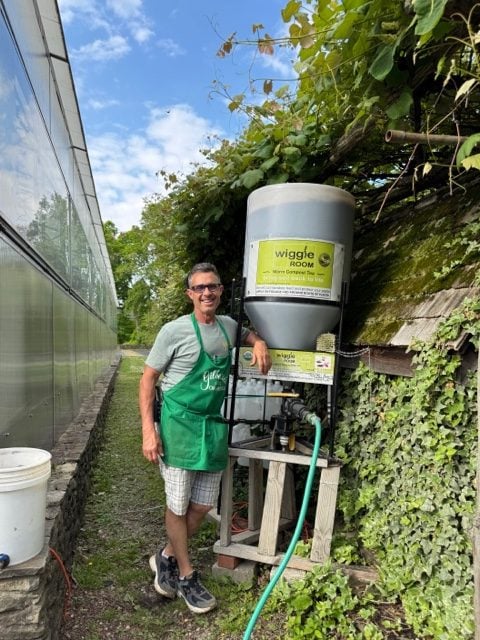
In addition, Gilbertie’s sells compost tea, which they brew on the property. Compost tea is a liquid fertilizer made by steeping compost in water to extract beneficial nutrients. The garden center sells compost tea each Friday during the growing season. It can be used to help houseplants, shrubbery or garden plants, but it must be applied the same day it is purchased, Cathy said. She recommends that customers bring their own gallon jug. After purchasing 10 gallons, the next one is free.
Those who decide to make their own compost must first understand a little bit of the chemistry behind how it works. Nathalie Fonteyne, the president of the Westport Garden Club, got her introduction when she took the master composting class through the University of Connecticut.
Compost is prepared by managing the decomposition of organic materials such as yard debris, grass, leaves, kitchen scraps, paper, straw, hay and wood chips. Microorganisms feed on these, breaking them down and releasing plant nutrients. As this takes place, the temperature of the pile rises, reaching a temperature of 130 degrees or higher during peak decomposition.
To make compost, four basic elements are necessary: water, oxygen, nitrogen and carbon. This is achieved by using nitrogen-rich materials, often referred to as “greens” such as food waste, grass and coffee grinds, with carbon-rich “browns” such as leaves, straw, newspaper and wood chips.
Those greens and browns are layered in the compost pile, which aids in their decomposition. Getting the balance of greens and browns correct is one of the hardest and most important things for composters to get right, Nathalie said. The goal is for a ratio of two to three parts browns to one part green.
Another important factor is to make sure that the debris you are using is chopped up small enough, Cathy advises. One rule of thumb is not adding anything to your pile larger than finger-size.
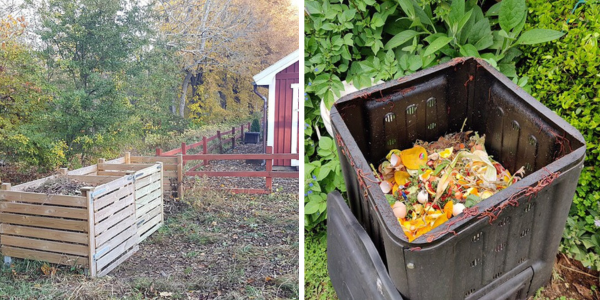
Another consideration is where to locate your compost pile and how to store it. While the most simple compost piles are out in the open, that can lead to odor and sometimes attract animals. So, many people prefer to keep their compost in a bin, which can be either purchased at a gardening store or made. One expert recommends a container size of 3 feet by 3 feet as ideal to help with heat retention.
Finding the right site is also important, Nathalie said. It should be in part shade, where it ideally gets morning or late afternoon sun. The site also needs good drainage, as the pile should not get too soggy.
Turning the pile regularly helps with the decomposition. But one of the most important attributes of the composter is patience, as it takes a year or longer to get the nutrient-rich compost that you can add to your garden.
So, now that you know a little bit more about composting, you can make an informed decision about whether to add it to your gardening journey like Cathy has. It’s an age-old method that helps both the environment and your soil.
What can be composted:
Yes:
- cardboard
- coffee grounds and filters
- eggshells
- fruits and vegetables
- hair and fur
- houseplants
- leaves
- paper
- tea bags
- yard trimmings
- wood chips
No:
- dairy products / eggs (except for the shell)
- diseased plants
- fats or oils
- meat or fish bones
- yard trimmings treated with pesticides
- pet feces.

Kerri Williams
Kerri Williams is an award-winning writer and journalist. She has worked as a reporter at the Norwalk Hour, as Living editor at the Darien News-Review, and managing editor for the Norwalk Citizen-News. For Westport Journal, she is a reporter as well as a gardening columnist, writing ‘Cultivating with Kerri.’ Williams moved from Connecticut to upstate New York in 2021.





Recent Comments