

I’m often asked if I can vote for the Academy Awards. The answer is ‘No,’ there is no “critics” category at the Academy of Motion Picture Arts & Sciences.
Instead, my vote counts as one of the original founding members of the Broadcast Film Critics Association, now known as the Critics’ Choice. This year’s 28th annual Critics’ Choice Awards at the Fairmont Century Plaza in Los Angeles will be broadcast on Sunday, Jan. 15th on the CW network from 7 to 10 p.m. ET with comedian Chelsea Handler as emcee.
Joining a star-studded roster of presenters, Michelle Pfeiffer will honor Jeff Bridges with the Lifetime Achievement Award, while Kate Hudson will present the SeeHer Award to Janelle Monae.
“Everything Everywhere All at Once” leads this year’s film contenders with 14 nominations, followed by “The Fabelmans” with 11 nominations, while “Babylon” and “The Banshees of Inisherin” are tied with nine each. “Abbott Elementary” leads the TV contenders with six nominations, followed by “Better Call Saul” with five nods.
Perhaps what makes this telecast different is its diverse membership, comprising 600 media critics and film journalists, often encouraging under-represented voices to be heard, as evidenced by spinoff events like the Celebration of Black Cinema & Television, Celebration of Latino Cinema & Television and the inaugural Celebration of Asian Pacific Cinema & Television.
Historically, the Critics’ Choice Awards are the most accurate predictor of Academy Awards nominations.
“The gold standard is always going to be the Academy Awards and the Emmys – the people who make film and television deciding what they think is the best of the year,” notes Critics’ Choice CEO Joey Berlin. “But frankly, we have a lot of influence on that. We are the people who are passing judgment all year long. We are the people whose job it is to make these assessments and to help people find what’s really worth their time.”
For more details, visit www.CriticsChoice.com
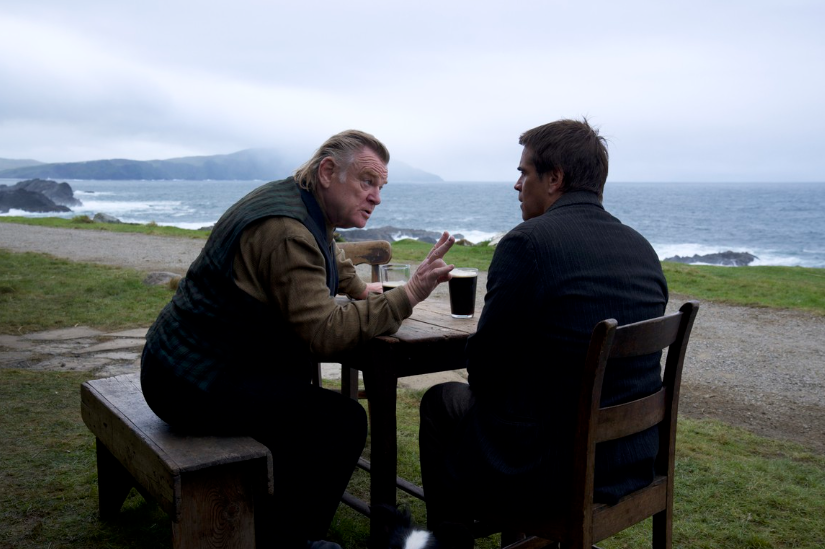
Critics’ Choice nominees Colin Farrell and Brendan Gleeson deliver memorable performances in “The Banshees of Inisherin” but whether you want to spend two hours in their company on an isolated island off the coast of Ireland is purely a matter of choice.
Set in 1923, this tragicomedy follows the fractured friendship of amiable Padraic Suilleabhain (Colin Farrell) and stolid Colm Doherty (Brendan Gleeson). Accustomed to meeting every afternoon for a pint of stout at the local pub, Padraic cannot understand why Colm now refuses to join him there – or even engage in conversation.
“I just don’t like you no more,” grumpy Colm says.
“You do like me,” child-like Padraic insists, refusing to accept Colm’s obstinate rejection.
In this tiny, close-knit community, despairing Colm, who loves composing songs on his fiddle, lives alone with his dog while Padraic, a dim-witted dairy farmer, shares a small cottage with his steadfast, yet exasperated older sister Siobhan (Kerry Condon) and his beloved miniature donkey.
When tortured Colm realizes that badgering Padraic is not amenable to leaving him alone, he ominously threatens to cut off his pudgy fingers with garden shears. As the plot unfolds, stoic Colm makes good on this promise of self-mutilation.
Meanwhile, others get involved – like the puzzled publican (Pat Shortt), ghoulish soothsayer (Sheila Flitton), ineffectual priest (David Pesrse), surly policeman (Gary Lydon) and his vulnerable son (Barry Keoghn).
This existential black comedy, created by writer/director Martin McDonagh (“In Bruges,” “Three Billboards Outside Ebbing, Missouri”), who has a penchant for grisly, blood-soaked imagery, tries to draw some sort of metaphoric parallel between the Padraic /Colm feud and the Irish Civil War that’s occurring on the mainland but the comparison seems pallid.
FYI: “Banshee” is the Anglicized term for the Irish “bean si” which meant “fairy woman,” a spirit who could foretell an impending death. Padraic Sulleabhain is the Gaelic spelling for Patrick Sullivan.
On the Granger Gauge of 1 to 10, “The Banshees of Inisherin” is a caustic, stifling, sorrowful 6 – streaming on Prime Video, HBO Max and Apple TV.
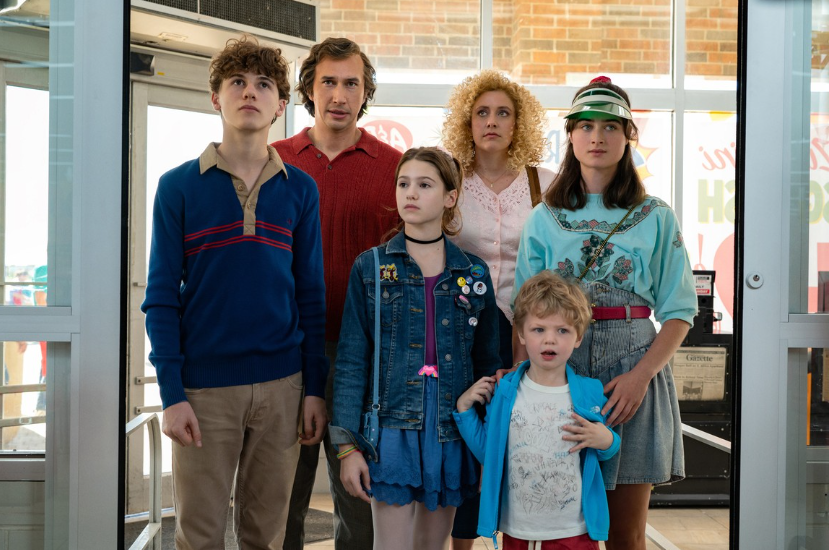
Advertised as an absurdist comedy, Noah Baumbach’s “White Noise” is neither fanciful nor funny.
Adapted by Baumbach from Dom DiLillo’s minimalist satire, it revolves around how a Midwestern family in the 1980s copes with an environmental disaster and their fears of death.
Since each has been married three times before, middle-aged Jack Gladney (Adam Driver) and his wife Babette (Greta Gerwig) do their best to accommodate the various demands of their blended family.
Although he’s unable to speak German, Jack teaches a Hitler Studies course at the (fictional) College-on-the-Hill, while Babette dabbles in self-help and secretly pops pharmaceuticals.
The catastrophe they must endure is caused by a horrific crash in which a distracted truck driver hauling explosive chemicals crashes into a freight train. The result is a huge, black, toxic cloud that ominously hovers above.
When ordered to evacuate their home, Jack, Babette and their kids pile into their huge Chevrolet station wagon. Caught in a steady stream of cars, filled with panicked passengers, they’re headed toward shelter in a Boy Scout camp. There’s an endless stream of idle conversation, prompting Jack to observe that the family is ”the cradle of the world’s misinformation.”
Meanwhile, Jack’s academic colleague Murray Siskind (Don Cheadle), an Elvis Studies scholar, proclaims that supermarkets, particularly the local A&P, have become our nirvana. Actually, a long, concluding wide shot of the brightly lit A&P aisles and check-out counters is the creative highlight of the film.
DiLillo’s highly-acclaimed 1985 novel was remarkably prescient about our consumerist, conspiracy-plagued culture. Often deemed un-filmable because of its abstract ideas, both Barry Sonnenfeld and Michael Almereyda were attached to direct before Baumbach.
Unfortunately, Baumbach’s interpretation is simply self-indulgent, spending far too much time focused on Gerwig’s tearful adultery confession and Driver’s seemingly inevitable reaction.
As advertised by the title, the result is ‘white noise,’ which is defined as an all-encompassing sound, embracing all frequencies, that masks all other sounds and is perceived as ‘static’ by the human ear.
So the question is: Do you really want to sit through two hours of dialogue drivel that’s as annoying as crackling static?
On the Granger Gauge, “White Noise” is a frustrating 4, streaming on Netflix.




Recent Comments