
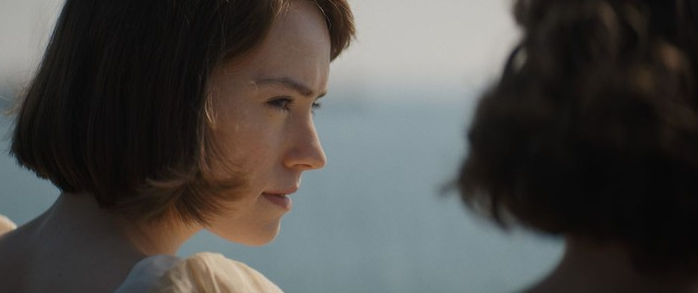
With the rapid rise of interest in women’s sports and to tie in with the 2024 Paris Olympics, “Young Woman and the Sea” is uniquely timely, relating how Gertrude Ederle became the first woman to swim the English Channel back in 1926.
Born in New York City in 1905 to traditional immigrant German parents, Gertrude “Trudy” Ederle was a sickly child, almost succumbing to measles. She was raised in an era when girls were not allowed to swim because it was considered too strenuous.
As teenagers on Coney Island, Trudy (Daisy Ridley) and her older sister Meg (Tilda Cobham-Hervey) defied their dictatorial butcher father (Kim Bodnia) in their desire to learn to swim, aided by their determined mother (Jeanette Hain) who was afraid they might someday drown.
Descending to a tiny, indoor pool in a basement boiler room, they learned the 28-stroke American crawl from no-nonsense coach Lottie Epstein (Sian Clifford). Girls were not allowed to compete in public until an Australian team arrived in Manhattan and Trudy was able to demonstrate her remarkable ability in the water.
“To me, the sea is like a person – like a child I’ve known a long time,” Ederle once said. “I’ve never felt alone when I’m out there.” Her perennial theme song was the 1921 hit “Ain’t We Got Fun.”
Stubbornly defying the rampant sexism that surrounded her, the rest, as they say, is history, culminating in Trudy’s courageous 21-mile crossing from coastal France to Dover, England – beating off thousands of stinging red jellyfish – in 14 hours, 31 minutes, besting the world record previously set by men.
Based on sportswriter Glenn Stout’s biography of the same name, it’s adapted by screenwriter Jeff Nathanson (“Catch Me If You Can”) and deftly directed by Norway’s Joachim Renning (“Kon-Tiki”).
Filmed entirely in Bulgaria on sound stages at Nu Boyuana Studios and on various Black Sea coastline locations, the remarkable cinematography is attributed to Oscar Faura (“The Impossible”).
On the Granger Gauge of 1 to 10, “Young Woman and the Sea” is an uplifting, inspiring 7, streaming on Disney+.
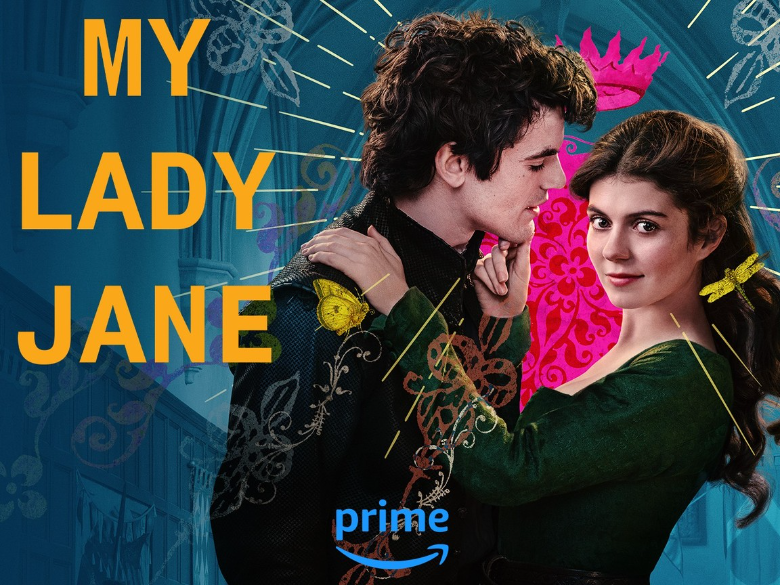
British Royal historians note that 16 year-old Lady Jane Grey was Queen of England and Ireland for just nine days in 1553 before she was incarcerated and executed as a heretic.
As the narrator of “My Lady Jane” notes: “History remembers her as the ultimate damsel in distress….(But) What if history were different?”
In this eight-episode dramedy, created by Gemma Burgess with showrunner Meredith Glynn – adapted from the 2016 YA novel by Cynthia Hand, Brodi Ashton and Jodi Meadows – facts are largely ignored in favor of fanciful, feminist froth.
Lady Jane’s saga begins when her father dies, leaving the family penniless. Teenage Jane (Emily Bader) is told by her imperious mother, Lady Frances Grey (Anna Chancellor), that she must wed rakish Lord Guildford Dudley (Edward Blumel) to secure their status in society.
Well educated and remarkably knowledgeable about medicinal herbs, rebellious Jane refuses and tries to run away, accompanied by her maid/BFF Susannah (Mairead Tyers), but they’re quickly caught.
That’s when she discovers that Susannah is Ethian. Scorned by pureblood humans, who are called Verities, Ethians possess a supernatural power to shapeshift into animals – as Susannah soars off as a hawk.
Ethians have been banished to scavenge on the outskirts of the realm, barely able to survive. It’s obvious in the subtext that the Ethian/Verity bigotry represents the rampant Protestant/Catholic conflict. Jane was Protestant, while her successor, Queen Mary I was a devout Catholic
Credit diverse/colorblind casting as Jane’s lifelong friend/cousin, ailing King Edward VI (Jordan Peters), is introduced, along with his constant canine companion Petunia, who warns him that he’s being poisoned; she turns out to be Ethian too.
Then there’s the King’s shrill half-sister, diabolical Princess Mary (Kate O’Flynn) – who evolves into ‘Bloody Mary’- and her lover/advisor, treacherous Lord Seymour (Dominic Cooper) who seemingly leans toward S&M.
Accompanying all the 16th century Tudor twists, there’s a persistent indie-rock girl pop soundtrack, studded with songs like “Rebel Rebel,” “Kashmir,” and “Come Together.”
On the Granger Gauge, “My Lady Jane” is a silly, slyly snarky 6, streaming on Prime Video.





Recent Comments