
WESTPORT — The Westport Museum for History and Culture announced a new installation Tuesday. A pair of panels are dedicated to providing a better understanding of the diverse communities and families that have made Westport–from before it was founded to what it is today.
Each panel focuses on a separate yet equally important aspect of Westport’s history, aspects which have been misunderstood and ignored.
The panels were dedicated last November, but moved to their final locations this week.
Westport’s early African-Americans
The 18th and 19th century Black experience in Westport is the theme of one panel. For 80 years, the Greens Farm Church noted the names of 241 enslaved and 19 free African-Americans living in Westport.

Westport’s history of slavery, as previously reported in a 2022 Westport Journal article, includes prominent slaveholders whose names are hard to avoid today: Staples, Jennings, Coley, Jesup and Sherwood, to name a few.
“These installations reflect the Museum’s core mission to make history whole by reshaping narratives that have long overlooked or erased Black and Native voices,” said Ramin Ganeshram, Executive Director of the Westport Museum for History & Culture.
The seeds for this panel were planted in 2019, at the time that the Memorial Brick feature was installed.
The Paugusset experience
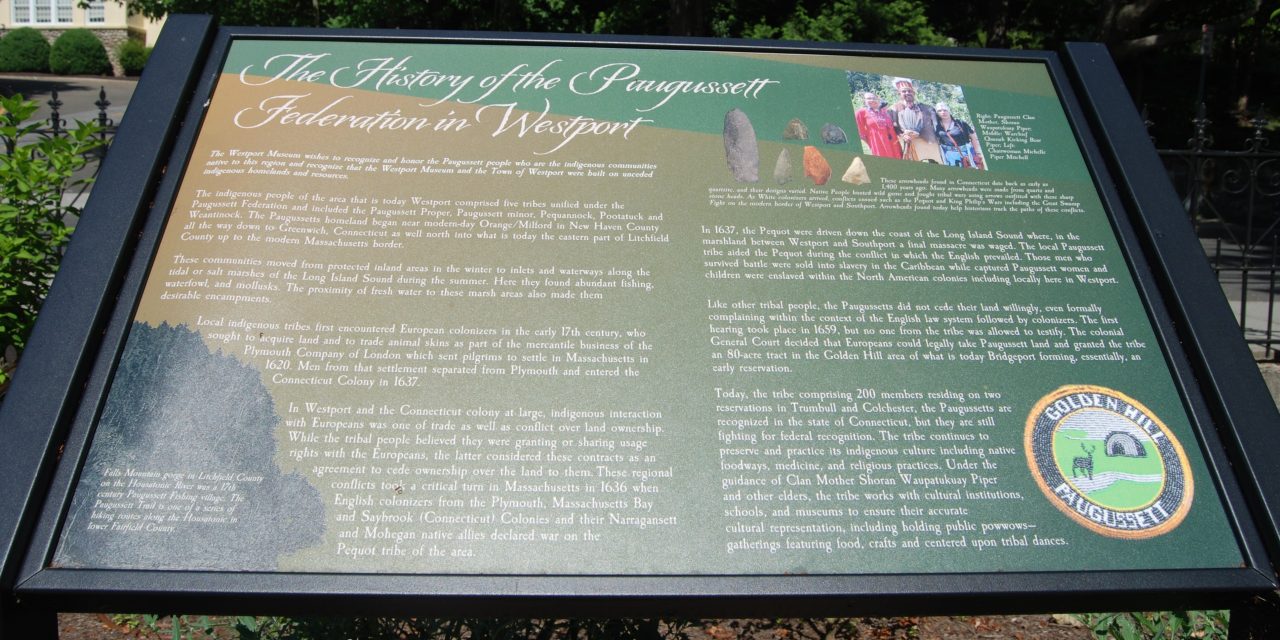
The voices of Native Americans have been silenced for centuries. Another museum panel aims to honor and showcase the Paugusset people, the original Westporters.
This panel highlights the heritage, traditions and the enduring legacy of the Paugusset people. In today’s contentious political climate, Ganeshram says the unveiling and opening of both panels is of the utmost importance.
“At a time when history itself is being contested, it is more important than ever to protect the truth of the past and ensure no one is left out of the story,” Ganeshram said. “Institutions like the Westport Museum play a critical role in preserving and sharing these vital narratives.”
The museum does not receive funding from the Town of Westport and instead has a community of backers – donors, sponsors and friends of the museum. All of these, Ganeshram says, are vital to the continued existence and survival of the museum and with it, the history of how Westport got to where it is today.
“We invite the community to visit, to learn, and to support our ongoing work,” Ganeshram said. “[The community’s] contributions enable us to continue this important effort — to preserve, teach, and illuminate the shared heritage that makes this town and this nation strong.”
The museum’s collection, these two new installations included, is open to the public when the grounds are open – Thursday through Saturday from 11:00 a.m. to 5:00 p.m. Admission is free for members.
Westport Museum for History & Culture
25 Avery Place
Westport, CT 06880
(203) 222-1424






I believe it is important to rewrite those aspects of Westport’s history that have been glaringly lacking over the almost 6 decades that I have been roaming these streets.
Take for instance– The Great Swamp Massacre– I didnt learn about this foundational moment until I was — well lets just say, moved back from Hollywood and I had time to dig into things.
This is a great effort by our own ministry of culture at righting those murderous wrongs comminted by Ludlow so that white folk could luxuriate by the sea here.
However, I would also say, that being raised in the town, attending Saugatuck Nursery School, i was trained to always respect people with concern for anything but that we enjoy freedom.
For me, Westport has always been, since the 60’s, a place of open arms. In fact, socialization founded upon acceptance, was the community glue.
I assume many secrets were long since buried before I became aware. And by bringing these gross historical facts to the daylight, I hope we remember that Westport has not been structured by racism for many years— at least since I have been alive attending all the schools and taking part in the activities about town.
And that for me, that is one of the things that makes Westport so great — its open and caring and truly progressive outlook upon human rights — that is foundational in the Westport I know. I am proud of my hometown for being ahead of the curve. As a toddler we marched around singing Free to be Me and You and it was great to grow up in such a place as thus.