
Editor’s note: This article has been updated to correct Commissioner Neil Cohn’s comments at Monday’s hearing.
By Kerri Williams
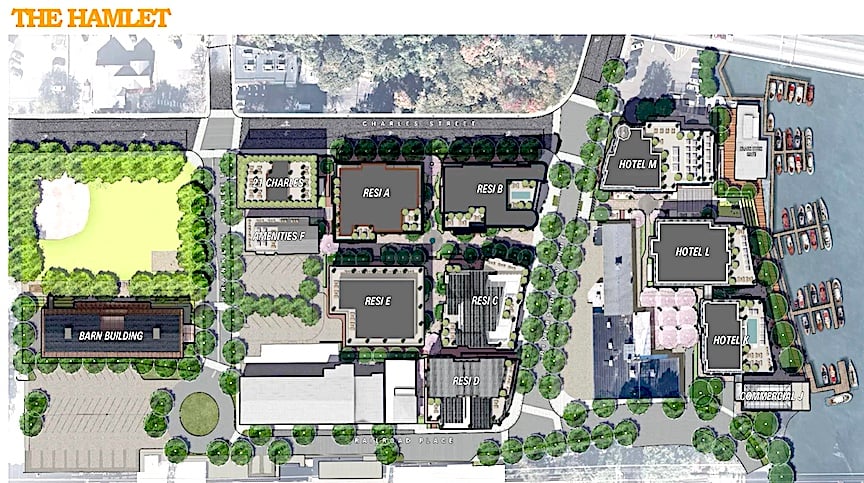
WESTPORT – The transformational “Hamlet at Saugatuck” project was scrutinized from angles ranging from traffic and deliveries to design and scale by Planning and Zoning Commission members at another marathon hearing Monday.
P&Z Chair Paul Lebowitz, addressing the developers during the five-hour session, gave them “check marks” for some aspects of the application, including the waterfront concept, proposed environmental cleanup, adding traffic lanes and bringing more hotel accommodations to Westport.
But he followed up with several concerns centering on the buildings’ design and the density and size of the project. He also questioned plans for parking and signs, and how the design might affect river views from roadways.
Size matters
“To me, this is a project that, if done right, is a positive for the town of Westport,” Lebowitz said. Most people in town “want something,” he added, but “just not that big.”
The chairman added the letters he has received from constituents were filled with concerns about commuter parking and traffic, as well as the size of the development. “Something’s got to give,” he said.
Meanwhile, Hamlet applicants Martin Purcell and Dan Suozzi, of Roan Ventures, defended their proposal, which would likely be the largest development in Westport’s history if approved. They pointed out the proposed buildings are lower in height than zoning regulations for the property allow and also are lower than those originally proposed.
“We have worked with members of the town in good faith to get here where we are today,” Purcell told the commissioners and about 50 members of the public logged in for the Zoom meeting.
“We have done a lot of work. But it’s hard to please everyone,” he added.
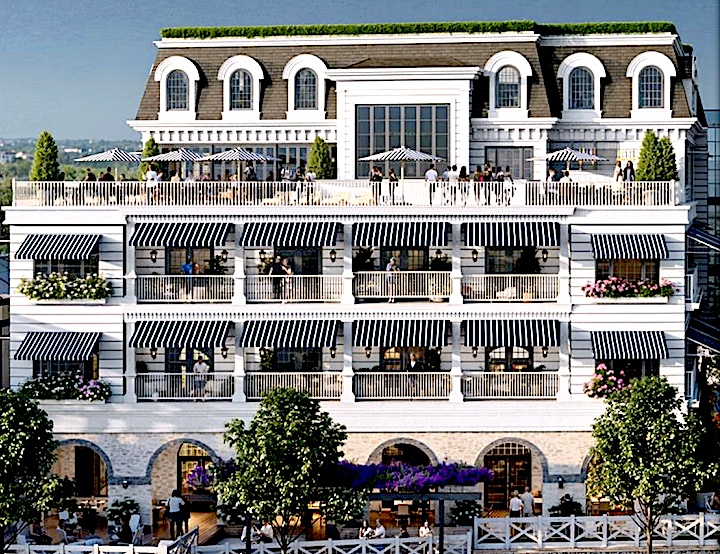
Lebowitz also had questions about the uses and planned amenities for some of the taller structures. The entire fifth floor of one building is dedicated to a four-bedroom, 5,000 square-foot apartment, he said, suggesting that it could be eliminated to produce a shorter building “if that is what it takes.”
An elusive consensus as clock winds down
Suozzi said he would like to hear a consensus from commissioners on what changes they recommend for the plans going forward. “It’s hard to work within a vacuum,” he said.
Eric Bernheim, a lawyer representing the developers, echoed Suozzi’s sentiments, noting the applicants have only two weeks to respond to concerns before the next P&Z meeting.
But five hours into the hearing, Lebowitz suggested that commissioners might be suffering from “Hamlet fatigue” and would be unable to achieve that consensus.
He added that the P&Z’s current timeline for reaching a decision on the complicated application by June or July does not “seem possible” given pending reviews of the project that still must be completed by other town boards before the commission acts.
A “Plan B” timeline may be necessary, the chairman suggested.
Concerns raised by commissioners
Earlier in the meeting, several P&Z commissioners brought up concerns about the loading and deliveries plan for the development, saying the single loading area originally proposed may be inadequate.
The developers’ representatives from SLR Consulting responded that loading zones have been added on Riverside Avenue, Railroad Place and Franklin Street. A new plan focusing on delivery requirements for the development is expected next week, Bernheim added.
Commissioner Amy Wistreich said she had hoped for more of a conversation with the developers rather than hearing mostly from Bernheim about the project. “I really want to feel like the town of Westport has a relationship with these developers,” she said. “I would love to talk to you directly.”
Later in the meeting, Wistreich praised both Purcell and Suozzi for joining the conversation. “This is a big undertaking” for the commission, she said, adding that she feels a plan that would be viable both for constituents and the developers is within reach.
Wistreich, followed by several other commissioners, also brought up the concern that some of the buildings are not within the zoning setback requirements and would require a variance.
In response, Bernheim said the developer has requested a waiver from the commission on the setbacks. In return, the developer would provide 50,000 square feet of public access to the property compared to the 5,000 square feet that is required.
“I appreciate the public access, but not as an exchange for the setbacks,” Wistreich countered.
While Roan representatives pointed out the buildings currently on the properties within the Hamlet footprint have the same frontage as the proposed replacements, commissioners said they still were not satisfied by the failure to conform with setbacks.
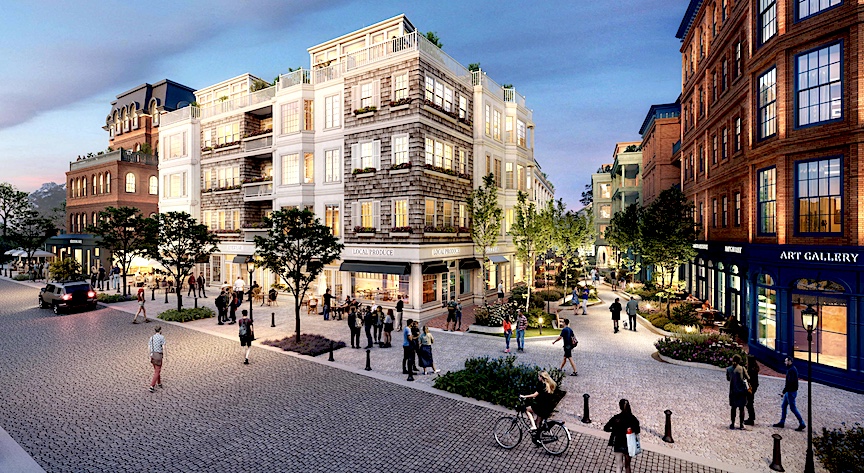
Several commissioners also pushed back on the proposed design of the buildings, saying the current look is not in keeping with the “coastal New England village” promised by Roan.
Roan previously revised the design after receiving feedback, but Lebowitz suggested the earlier version was more representative of what he thinks of a New England village. Then he conceded, “If we have 28,000 people in town, we will get 28,000 opinions on what is a New England coastal village.”
Another concern, brought up by Commissioner Michael Calise, was the long-term plan for a tunnel proposed under Riverside Avenue.
“What happens in 10 years when it starts to crumble and needs interior maintenance?” he questioned.
Bernheim responded that the tunnel, which will be designed to last more than 10 years, will be “fully maintained” by Roan.
Commissioner Neil Cohn said rejection of the Hamlet application raises the prospect that an 8-30g affordable housing project could be proposed in its place. Those projects, under the controversial state law, are not subject to most local zoning regulations.
And if an affordable housing developer were to challenge a P&Z denial in court, and prevail, Cohn said proposed state legislation could make the town liable for the developer’s legal fees.
But Calise said he hopes to never hear that “what if” scenario mentioned again. Commissioners need to make their decisions without thinking of what might happen next, he said. “It’s uncalled for, and it sullies the process.”
Kerri Williams is a freelance writer who has worked in journalism for years, including as a reporter for the Norwalk Hour and managing editor of the Norwalk Citizen-News.













I suggest a Plan B timeline which preferably goes past November and hopefully to a Democrat run administration who I would hope will look at this disaster not on behalf of investors but on behalf of this towns tax payers and electors who have spoken out loud and clear.
The VAST majority DO NOT want this.
But that being said the MAJORITY did not want this 2 years ago either and were duly ignored and got screwed by both PZ and by the RTM.
This plan does NOT work.
Parking.
We were assured whilst being called liars several of us back 2 years ago that railroad parking was not being leaned on to satisfy parking..
this the sneaky FAR !
Unbelievable BS.
How does that work ?
How on gods green earth are 700- 1,000 staff ( which is what it will be) coupled with patrons for more than 10 new restaurants, a food hall and 30 retail stores, 100 cars for the Apts, 52 cars for the hotel(s). In a financially successful scenario for merchants and restaurants there would be 600-1000 staff, and 1500-2000 patrons. Just for the mixed use side of the project.
200 spaces on private commercial property are being lost to the construction, spots many current saugatuck businesses have used for years. Staff and customers.
So this project is negative 200 spaces before it begins.
Who cares about 277 underground stacker parking spaces.
That’s not even 277 proper spaces.
It’s a joke.
So back to my question
Where does PZ think
STAFF – 700-1000
PATRONS – 1500-2000
HOTEL – 52
CONDOS – 100
And no I’m not using their numbers because these are the real numbers which as a business owner I know are grounded in reality.
Let’s count
A minimum of 2352, and a likely maximum( not including the barn building) of 3152.
The train station has 1500 parking spaces. At at least 70% occupancy and counting.
That occupancy doesn’t include or take into account the current 200 spaces which will be lost to this construction. Those 200 cars are then going to also get permits and park at the train station.
The train station will then be 80% occupied.
Greens farms train station is full most days of the week.. I drive there dropping my son to school.. I check it every day. It’s full with the exception of Mondays and Fridays.
In fact I suggest the buses which should NOT be parking there be moved to the saugatuck train station which will then be 90%?occupied.
I mean what is anybody thinking here?
This plan relies on Covid era parking numbers and bogus numbers not correctly depicting the true scenario.
No doubt drone shots of a half empty station can be got if one takes them on a bank holiday or a Friday or weekend. Or rigs the date and time.
But the fact remains if you look at precovid parking with 5 year waitlists to, Covid parking, largely empty, to companies who allowed their workers to work from home post Covid to now, employers have rightly grown tired of “working from home” and are demanding employees return to work.
On a daily basis more commuters are required to return to their office.
In 3 years the railroad lots are going to be full.
Full until 7.30pm.
I passed the lot across from Rico’s last week. 7.30pm it was 70% full !!!!!
So where are 2352-3152 people going to park ? WHERE ?
I’d like PZ to answer this question. I’m not sure why it’s not FRONT AND CENTRE.
I’d also like an explanation for the insane FAR GIVEN WHICH WAS CLEARLY TO MAKE THIS WORK. Because even with a far of 3000 to 1 it does not work.
In which case we were LIED to 2 years ago.
Lied to and misled.
Railroad parking is for commuters not for staff and not for patrons of this development.
These numbers do not take into account the businesses both retail and restaurant that already exist down there, most of whom have no parking lots.
So they already use the railroad parking-WHEN- it’s available.
It is not going to be available as commuter parking is increasing at a rapid clip.
Even the suggestion staff of retail and restaurant tenants will be told under contract to park at other train stations and take the train is beyond a joke. It’s not even funny.
It’s authoritarian and it’s never going to happen.
23 existing restaurants, 15 plus existing retail locations
Let’s see, some are small, some have their own parking.
So let’s be conservative here, let’s call it a total of 1500 staff and patrons needing to find parking.
Ok now we are at 2352/3152 for hamlet, and 1500 for existing businesses which I presume Pz is
not looking to put out of business.
Let’s throw in Haiwatha which will be finished before any hamlet iteration. Haiwatha residents will undoubtedly need to apply for permits and take up another 100 or so.
3952-4752 parking spaces potentially required…
The train station has 1500 I believe.
Add in off street and private parking lots and the hamlet underground “stacker” spaces.
Do we get to 2000
Maybe.
So WHERE are they parking Monday to Friday, 10am-6pm ?
I do want this question answered.
Like it or not the state contract is very clear though attorney Bernheim and attorney bloom seem to have their own interpretation of it. How convenient and self serving.
The state can cancel the contract at will
The states contract if not cancelled as they please ends in 2031.
They could choose not to renew it. Or they could choose to make it commuters using train only parking. And nobody else.
They could choose to sell lots to developers for fully affordable housing, and use the rest of their lots for parking for those units.
That could leave us with a few hundred spots down there.
There is NOTHING to stop the state from doing this.
They own almost all the parking down there.
In fact I would think that such a scenario is less far fetched than this text ammendment which was passed.
I noted the town attorneys “guidance” for want of a better word last week on PZ not having any wiggle room here.
WAIVERS
NOT ONE SHOULD BE GIVEN. N O N E
There is nobody who can force the PZ to give a single one of these waivers. And they should NOT
And since the entire FARM was GIVEN AWAY, 2 years ago I suggest that the waivers should be ignored.
Send this project to ARB, where it belongs- like all the rest of us need to do. That is where variances/waivers are given or not.
Waiver is just a get out of jail free card to not have to go in front of the experts. Our ARB. Elected commissioners just as PZ are elected.
And I believe that was “intentional” because I have no doubt that in variance terms they don’t have a leg to stand on.
I’m getting tired of special treatment for this development which the vast majority of this town HATES.
This is a land and zoning and money grab !
It is being driven by sheer greed and zero sense by a bunch of investors, many of whom are now known and some not, and they could care less about commuters or traffic but just Benjamin’s.
And who knows maybe it’s getting flipped !
Because anyone intimately familiar with all the facts knows that with NO parking it cannot survive.
Please let nobody compare downtown parking with this railroad commuter scene.
FAR in downtown is such because there’s no commuter parking in the downtown.
And lord knows we struggle in the downtown to have enough parking middle of the day.
One last item I hope is being safeguarded.
The ability of the valets in that parking garage underground to be moving cars in and out of the garage into commuter parking early in the morning at peak commuter time and before it( middle of the night)
They have said 24/7 valets.
Undoubtedly in my opinion the intention could be to empty their parking garage into permit or paid parking before commuters arrive to begin their day.
In other words they will potentially empty 277 cars out into paid parking spots leaving their parking garage empty and ready for customers at 10am.
This is a very real probability.
And if you poll commuters and ask how that sits with them, I believe you will get a resounding no !
This MUST not be allowed !
It must be considered, preempted and safeguards put in place.
IF that were to happen it would completely unacceptable.
The developers know the parking situation. They are going into this in full knowledge. Eyes wide open.
There is no excuse for claiming ignorance later. And if any kind of permit is passed for this lunacy PZ must write as a condition and requirement that parking spots will not be commandeered ahead of morning rush hour by moving cars out of the garages and into commuter/metro north users valued parking.
Parking is just one of 20 issues most, the vast majority of westporters have with this project.
I suggest a brand new plan which uses its ground floor for parking instead of cramming in as much retail and restaurant spaces as it can.
Just like the WRIGHT building as pointed out by commissioner Calise.
If I buy land to build a house and I overpay for the land, that does not give me the ability to change zoning regulations to suit my project so it makes financial sense.
I don’t get to circumvent ARB through waivers.
It should be no different for these guys.
That should go without saying.
And I will also add most of these properties were bought for half nothing decades ago. I have zero sympathy for the land owners. There’s no reason for this to be a huge financial coup for them at the expense of 28,000 Westport residents.
Had the text amendment so erroneously written, not happened, those properties just like when they were purchased were cheap, contaminated.
The only thing making them sellable now is that text ammendment.
That landowners can leave their properties to go to rack and ruin should not mean we all get screwed over when the properties owners decide they want ungodly sums of money and then we the residents are expected to suck up a project with 8x FAR deliberately changed in zoning regulations to suit a developer overpaying for these and factoring in their extensive laundry list.
This should have never happened.
It was disgraceful 2 years ago and it came back even worse !
Nobody asked for tall buildings to hide I95. I’d far prefer to see and hear 95 than be shaded by gargantuan hideously un New England buildings.
That was another figment of the developers imagination.
It was nice to see and hear the seven P&Z Commissioners ask thoughtful, detailed, important questions and try to wrap their arms around this attempt to build a small city – not a Hamlet – in an already busy transportation hub / zone in Westport. Our thanks to the Commissioners for taking the time to study up before this meeting.
The Roan developers are to be applauded for their ambition and creativity. But as it stands now, their inexperience as a newly formed development team is clear because they have developed a plan that (1) no one wants,(2) that does not make sense for Westport, (3) that cannot pass muster with a range of local and state agencies, (4) and that shows, they don’t understand this town.
I fully agree with all the Commissioners who believe that the “river view corridor” should include the whole block of Riverside Avenue, even the property that the developers do not yet have under contract. As Commissioner Lebowitz stated, “that was clearly the spirit of the text amendment”. (And by the way, Roan’s attorney essentially wrote the text amendment!)
Commissioner Cohn, you seem so much to want to help the Roan team. You are a smart guy. But if you wanted to help them, why did you not insist 2 years ago, 1 year ago, and last month, that they produce a model, 3D walkthrough or some complete plan rendering with dimension that would actually show the P&Z and the public what the project they are seeking? As has been reported, the reason they gave for not taking this step is “because it was not required”. That lack of common sense is impossible to ignore.
Once again – hopefully for the last time – the Roan team tried to scare us with the threat of 8-30G housing. Well, most of the 8-30G projects that actually get built have density, and an FAR (Floor area ratio) less than what is Roan is planning. And they don’t have highy complex, environmentally dangerous, valet operated underground parking near a river. Most new housing proects- from luxury to affordable – DO NOT ADD much to local traffic. But the Roan plan, – with a hotel, event space, food hall and 20-30 retail stores would. That’s one of the main reasons why Westport hates this project.
Looking ahead, I believe that if Roan cannot pull off this plan, there are many other regionaly based developers sho will come in with a more reasonable plan.
Mary Ciara uses a lot of words in her letter above, but I do agree with most everything she wrote. I do want to amplify this section she added:
“WAIVERS – NOT ONE SHOULD BE GIVEN. N O N E There is nobody who can force the PZ to give a single one of these waivers. And they
should NOT. And since the entire FARM was GIVEN AWAY, 2 years ago I suggest that the waivers should be ignored.
Send this project to ARB, where it belongs- like all the rest of us need to do. That is where variances/waivers are given or not.
Waiver is just a get out of jail free card to not have to go in front of the experts. Our ARB. Elected commissioners just as PZ are elected.
The coming month will be an interesting next chapter in the history of Saugatuck and Westport.
Well said Rick.
I meant ZBA both times I mentioned ARB. ( apologies to ZBA commission) My mistake. I know you also meant ZBA
The abbreviated commissions get confusing sometimes.
My bad.
I know my writing is so long winded, but I find it hard to shorten or look for short cuts, when these hard numbers are so damning. And I just hope they are being absorbed by people.
I agree with everything you said.
As I believe so many do.