
By Linda Conner Lambeck
WESTPORT — The Board of Education on Thursday got its first look at several redistricting scenarios that divides the process into two parts and may relocate between 3 and 5 percent of the district’s 2,400 elementary school students.
Phase 1, to be rolled out in the fall of 2025, would involve Long Lots, Saugatuck and Greens Farms elementary schools, all which feed their student bodies into Bedford Middle School.
Phase 2, involving Coleytown and Kings Highway elementary schools, would coincide with the projected opening of the new Long Lots School, potentially in the 2026-27 academic year. Those students move on to Coleytown Middle School.
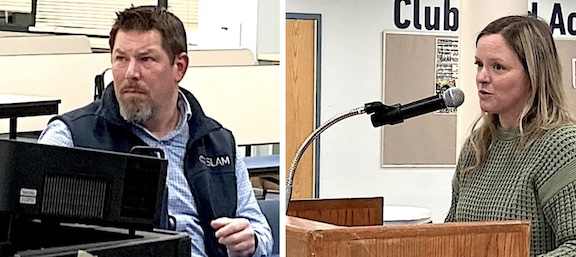
The first brush scenarios at redistricting were presented by Mike Zuba, the demographer consultant from SLAM, the firm hired to do enrollment projections for the district.
The 54-page document seeks to balance enrollment between the district’s five elementary schools by reducing enrollment pressure at some schools and better utilizing space at others.
To read the full report, “Elementary Redistricting Initial Conceptual Scenarios,” click here.
While the aim is to bring parity and efficiency to the school district, the reshuffling would not likely save any money, the board was told.
Only the beginning
“We are at the very beginning of this process,” board Chair Lee Goldstein said.
The seven-member school board has yet to settle on guiding criteria to help shape the plan, but already the district is getting emails and calls from concerned families, according to Assistant Supt. of Schools John Bayers.
One parent at the meeting, Long Lots PTA Co-President Julie Gartin, urged the board not to adopt a scenario that redistricts Long Lots students to Saugatuck after they spend two years attending classes in a construction zone at the existing school as a new one is built.
“That is so unnecessarily detrimental to kids,” said Gartin. “To live through construction and then be redistricted.”
“There will be a lot of discussions into the early fall,” Bayers said of the options.
Information sessions for parents about any redistricting plans were promised.
The goal is to have the school board vote on a plan in November, and then spend then until the fall of 2025 to make the first phase changes.
Timelines have been established and, in a memo to the board, Supt. of Schools Thomas Scarice suggests the panel establish an ad hoc redistricting committee once it sets guiding principles for the process.
In the memo, Scarice said the redistricting plan should have long-term sustainability so that each school is left with flexibility when enrollment bubbles occur.
He wants to keep students from neighborhoods together as much as possible, and not re-assign students more than once.
Zuba’s conceptual scenarios follow that criteria. “My initial take away [is] we do have viable approaches … for enrollment balancing,” he said.
“Nothing is set in stone,” Zuba added.
The school district’s last attempt at redistricting in 2018 was abandoned after consensus could not be reached on more than a dozen possible options. It has been more than 25 years since Westport’s school district boundaries have changed.
Options on the table
Anticipating that the district’s elementary enrollment could grow to 2,500 students before leveling off, Zuba said he started by deciding how many students could be optimally accommodated in each school. He then used geo-coded maps of where students live to start formulating options.
Each option moves small pockets of students using two approaches: one that keeps the district’s self-contained Intensive Resource special education programs where they are and another that shifts some of them to another school.
Scenario A1 would move roughly 39 students in a corner of the Long Lots district, between Roseville Road and the Saugatuck district, to Saugatuck School. Intensive Resource rooms would remain where they are at Greens Farms and Long Lots.
In a second phase of that scenario, some 39 Kings Highway students would shift to Coleytown Elementary. In all, the plan would affect about 3 percent of the elementary students in those districts, Zuba said.
Scenario A2 would affect roughly 4 percent of elementary students.
The first phase would shift fewer students from Long Lots to Saugatuck, while two pockets of Greens Farms students would move to Saugatuck. Part two of that scenario has roughly 55 Kings Highway students north of the Merritt Parkway shifting to Coleytown.
Scenarios B1 and B2, not only shift pockets of students from Long Lots to Greens Farms and Kings Highway students to Coleytown, but also move two Intensive Resource classes from Greens Farms to Saugatuck. Long Lots IR classes would remain at that school.
To provide maximum flexibility, the consultant’s scenarios also count on continuing to use portable classrooms at Coleytown Elementary indefinitely.
Zuba told the board that Scenarios A1 and B2 perform best based strictly on enrollment numbers, but that other factors, such as transportation, have to be considered.
School board members have questions
Goldstein called SLAM’s ideas comprehensive and a good jumping-off point for establishing guiding criteria.
She wondered, however, what happened to the idea of redistricting the middle school boundaries. Bedford is much bigger than Coleytown Middle.
Zuba’s scenarios — and Scarice’s recommendation — would leave the middle schools and their elementary feeder patterns as is.
Zuba said he also did not factor in allowing fifth graders to finish their final year of elementary school where they are despite potential boundary shifts.
“I do want to see fifth graders grandfathered in,” said board Secretary Neil Phillips.
Zuba was asked about the portable classrooms at Long Lots. He did not count them into available space because they are on a short-term lease.
“Should we be renewing them?” Phillips asked.
The idea of moving the Intensive Resource rooms also raised questions. There are adaptive playgrounds and other accessibility accommodations where those classes are now.
“I thought we recommended [not moving] IR rooms,” board Vice Chair Dorie Hordon said.
Bayers said any shift in that program’s classrooms would be done thoughtfully and systematically.
Several board members said busing patterns generated by the scenarios would play into how disruptive the redistricting plans are for families.
Goldstein asked what happens if a new Long Lots is not ready to open by the fall of 2026.
Phase 1 can be implemented regardless of Long Lot construction, the board was told.
“These phases are independent of one another and Phase I for any scenario can be acted upon independently of Phase II,” Zuba’s report states.
Freelance writer Linda Conner Lambeck, a reporter for more than four decades at the Connecticut Post and other Hearst publications, is a member of the Education Writers Association.








Recent Comments