
By Linda Conner Lambeck
WESTPORT — Collegiality between the Board of Education and other town bodies remains evident with the approach of the 2024-25 budget season, even though all sides are bracing for what some say will be unprecedented increases in health insurance costs.
That concern is such that Lauren Karpf, the Representative Town Meeting’s deputy moderator, has suggested putting health-care coverage in a “special box” so any cost increase doesn’t adversely impact student programs.
Karpf wasn’t at the annual discussion last Thursday for town and school officials to lay their budgetary expectations on the table, but forwarded her thoughts to school board Chair Lee Goldstein.
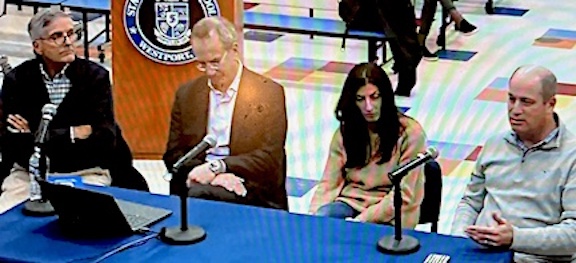
Other Board of Finance and RTM leaders did attend to tell school officials they were not necessarily looking for a specific 2024-25 budget number from school officials.
“In years past, we’d come to you and said we expect there to be a 2 percent increase or a 3 percent increase. I didn’t plan on coming to do that tonight,” said Board of Finance Chair Lee Caney. “With the health care it’s really difficult to predict.”
Like last year, Caney urged the board not to expect the town to whittle down a big increase or dwell on details, but rather focus on the big fiscal picture and come in with its best shot.
“That has some good will with our board if you do it that way,” Caney said. “That is not to say there won’t be some back and forth. There should be back and forth.”
Supt. of Schools Thomas Scarice told him that is the plan and that the school board, along with town officials, will get a list of what staff budget proposals didn’t make the final budget cut before drafting its recommendation.
Insurance costs are wild card
In the current fiscal year, the education budget stands at $135,287,710, a 5.24 increase over the year before.
The 2023-24 budget factored in an 8 percent increase in insurance costs. The increase ended up at a contractual cap of 14 percent, forcing the town to pay some of the gap, and the school district to use a special account to mitigate the rest.
This year, Scarice said, the school district is seeing another unprecedented year of insurance claims. The district covers about 1,000 employees.
As a result, he said the district has issued a Request for Proposals for health insurance coverage, and notified bargaining association presidents and the town.
Bids from insurers are due shortly.
“When there is more information out, we will share it,” Scarice said.
Caney said the finance board expects to be involved in the process.
School board Vice Chair Dorie Hordon liked the idea of separating health-care costs from other education spending.
“We don’t want to cut programs that impact kids,” said Hordon, characterizing the last two budget requests as reasonable.
New fiscal watchdogs
With Caney at last week’s meeting were three new members of the finance board, including Liz Heyer, who until last month was the school board’s vice chair.
Heyer said the annual meeting between the town bodies is different than in past years because the board work so closely together on a more regular basis.
“I think we should optimize costs where we can,” Heyer said. “Find where there are opportunities to do things more efficiently and effectively. We want the Board of Ed to help with that.”
Beyond health-care costs the other big-ticket item in the school board’s operating budget is transportation. This year, the district changed bus bus companies, replacing its longtime vendor Dattco with First Student. The finance panel said they are interested to hear how it is working out and what efficiencies are anticipated.
School board member Robert Harrington, who has pushed the district to find more transportation efficiencies, called spending $7 million a year on busing wasteful.
“I imagine if $7 million in transportation [costs] disappeared from your budget you’d find some really cool programs to add,” said RTM Moderator Jeff Wieser.
Caney said it drives him crazy to see buses riding through town with empty seats.
“I wish it was a cost we didn’t have to incur,” he added.
Capital expenses
Also having an impact on the operating budget are capital costs.
The town is about to commit to an estimated $100 million expense to finance a new Long Lots Elementary School. It will be the town’s largest capital expenditure and part of about $400 million in overall debt the town will owe.
“That is a really big focus,” Caney said. “During this budget season we also want to talk about other capital expenses for the schools.”
After the Long Lots project, Coleytown Elementary School is next in line for an upgrade.
Freelance writer Linda Conner Lambeck, a reporter for more than four decades at the Connecticut Post and other Hearst publications, is a member of the Education Writers Association.







It too “drives me crazy to see empty school buses,” next to the oft-dangerous long lines of school traffic on the roads, with parents dropping off and picking up one or two children at a time. I realize school bus service is mandated; are there better ways to incentivize parents to use them? In addition to a lot of tax-payer-provided dollars for transportation, there is also an environmental cost in fuel consumption and air pollution from doubling up on getting the kids to school.