
By Meghan Muldoon
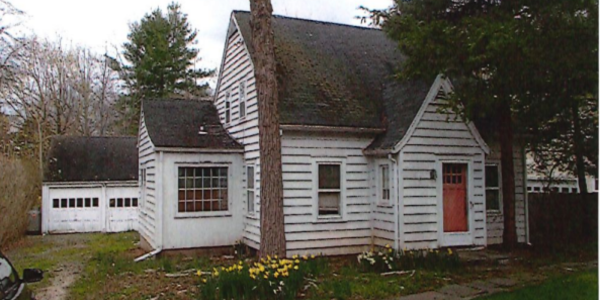
WESTPORT–The Westport Historic District Commission voted last night to rescind its earlier opposition to demolishing 19 Turkey Hill Road North after reviewing new evidence detailing extensive mold contamination and structural damage inside the home.
The 100-year-old Colonial Revival house was recently purchased by Peter Greenberg of Able Construction. Greenberg told commissioners he closed on the property “without even looking at it” and “didn’t think there was anything historical about it.” After taking ownership, he said he discovered severe interior deterioration, including widespread black mold and water damage. Greenberg also submitted photos of the “dilapidated state of the interior” for commissioners to review.
“The house is riddled with mold,” Greenberg said. He added that a pipe burst during last week’s frigid weather, leaving the interior “completely flooded.”
Amy Van Arsdale, the listing agent hired by the homeowners’ children to sell the property, corroborated the severity of the conditions. She described encountering black mold covering clothing, photos, mattresses and the basement walls. After spending about an hour inside the house, she said she developed a “severe allergic reaction” and later returned only while wearing “a respirator mask the entire time.”
“It’s uninhabitable,” Van Arsdale said. “The mold was just very, very serious. It was scary.”
Historic charm vs. structural reality
Commissioners wrestled with the property’s historic value and “cottage charm.” The house is considered one of the few remaining 1920s homes in the area and commissioners asked whether a new design could preserve elements of its original character.
Architectural designer Gary Chase, however, described significant physical and structural limitations. During his on-site assessment, he observed “really tight stairways” that were not code-compliant and second-floor rooms “all kind of under roof,” making meaningful expansion “extremely challenging” without overwhelming the home’s original scale.
“It’s really hard to look past the condition of the house,” Chase said. “It really limits, I think, the potential to make it a viable family home.”
Commission Reverses Course
The Westport Historic District Commission is empowered to protect the town’s historic character by reviewing major exterior changes and demolitions of buildings with historic value. Under town regulations, the commission can impose a 180-day waiting period to allow time to explore alternatives to demolition.
During its Jan. 13 meeting, the commission voted to impose the six-month delay on 19 Turkey Hill Road North after receiving a letter from Westport resident Michael Stone asking the commission to consider the home’s “historic” and “affordable” status.
Under the commission’s rescission policy, property owners must demonstrate a “good faith effort” to explore alternatives to demolition. After reviewing photographic evidence of mold infestation, standing water and structural deterioration, commissioners acknowledged that the “damaged beams and damaged structural components might make it impossible to save.”
Ultimately, the commission determined that preserving the exterior charm of the home did not outweigh the documented environmental hazards, structural damage and the challenges of bringing the property up to modern code. Commissioners voted unanimously to revoke its prior opposition to the demolition permit.
With the rescission approved, demolition of the Turkey Hill Road home may now move forward.

Meghan Muldoon
Meghan Muldoon is a freelance journalist based in Darien, Connecticut. As a television and print journalist, Muldoon has covered state government and politics in Virginia and Connecticut.







WHAT COMES NEXT – on Turkey Hill North and throughout Westport?
What happens when the quaint and/or historic architecture that brought people here in the first place is gone? The developers will leave too. They will have wrung their profit from the community and they will disappear. And, the next generation of buyers will look to other historic communities that have actually kept their architecture intact. Why do people move to Bedford or Bronxville – they move their because those communities are unique. They have architect designed houses, they have buildings that represent a rich cultural history. Their towns do not look like a photocopy of a photocopy of 100 other places.
Perhaps this house is not the hill on which to die, but with a modicum of respect, no one demolishes a house because of mold, a narrow staircase or dormered bedroom ceilings. Houses like this are demolished because the house has less value than the land on which it stands. In this case the 1/4 acre is non-conforming in a 1/2 acre zone. So when this little 1920s cottage is sacrificed to the bulldozer a series of variances will need to be passed in order for a new house – with a wider staircase and higher ceilings – to be built. Hardship will be claimed. Affordability, history, context, cannot be demanded of the developer – but he will claim hardship because the lot is too small to be built upon. And he must know he is going to get it or he wouldn’t gamble on destroying this house with no guarantee of building a more profitable one. What will the town allow? Will he need to maintain set backs, appropriately small FAR or will “hardship” allow him to construct another giant white box with black windows pushing up against its neighbors – now so prevalent in town.
I am not picking a fight with this builder or the seller or the potential buyer. I am asking what is the point of living in a town like Westport if we are so willing to see its charm and history lost to anonymous development. Has the building department sent in an objective engineer to evaluate the structural integrity of the building, or are we relying on the word of the people most likely to benefit from the demolition of the house? What is the point of an architectural review board or of historic building commission if their rulings are so easy to influence or overturn? Incidentally, that 1920s cottage can be found in thousands of towns throughout the country, BUT it represents a time in this town, it is scaled appropriate y to the lot, it has eaves and gables and dormered windows that are appropriately proportioned to its size and have charm. It is not a cottage pretending t be a mansion. There a reasons to encourage saving this kind of building that go beyond aesthetics as well. As the developer will tell you – it isn’t easy to market because it is small. So the price needs to be lower – which means in turn people with slender means will look to buy it. This is affordability create by the free market as opposed to the governement. Tear down all the small houses and the State will come in and build more big anonymous boxes on vacant land or worse they try and buy or commandeer that lot behind your house.
Westport is likely to become a victim of its own success if it hasn’t already. The bell is tolling here – we need to preserve our history – we need to insist on architect designed houses – we need to respect the zoning and setback laws – we need to encourage sympathetic, contextual, and appropriately proportioned buildings – or Westport will resemble Nanuet in a few years (look it up – a soulless suburb of 1970s split levels – so popular in the 70s). Give some thought to the loss of this small house – you may think it doesn’t matter – but it represents so much that is going on in this town.
David Nastasi
50 Turkey Hill Road N
Westport