


By Gretchen Webster
WESTPORT — Can the Historic District Commission demand that instead of demolishing a historic house the owner should try to sell it to someone who will preserve it? And does the commission have a say when exceptions to property setback or subdivision rules are sought from zoning officials that could result in demolishing a historic building?
The answer is “no” to both questions, HDC Chair Grayson Braun said when the commission’s authority to review real estate development and rehabilitation projects became a focus of discussion at Tuesday’s meeting.
At issue was the proposed demolition of a Dutch Colonial-style house at 35 Evergreen Parkway, which was on hold because of an 180-day demolition delay imposed by the commission last month. The commission can prevent for six months the demolition of a structure 50 years old and over with the hope the owner or developer will consider saving it instead. But the HDC can only postpone demolition, not stop it.
Developer Chris Montanaro returned to this week’s meeting again seeking to immediately demolish the Evergreen house, built in 1937.
But two commission members said they thought that putting the property on the market now, instead of demolishing it, might attract a new buyer willing to preserve the house.
“I think that the purpose of the delay is to look at the alternatives. One option is to put it on the market and see if there would be a buyer who would buy it and keep [the house],” said member Wendy Van Wie.
“I have to agree,” said Martha Eidman. “That’s the reason for the regulation … It would be nice to let these houses go to the market and let the market decide.”
However, Elayne Landau, a commission member who is a real estate lawyer and agent, said since the siding and windows on the Evergreen house are not original and other changes have been made to the structure, the historic value may not be enough to entice buyers interested in preserving it.
“We’re not here to second guess the price,” Landau said when Van Wie suggested that if a property owner can get a higher price on the open market than from a developer, the owner might consider preserving the home’s historic value than a developer with plans to demolish it for a new build.
A vote on rescinding the Evergreen demolition delay was taken after commission Vice Chair Scott Springer, an architect, said that although it would be interesting to see what would happen if the property was put on the market, “significant money would need to be spent to get it into a livable condition.” Plus, he added, the home’s structural materials date from a time period when they were “not of the highest quality.”
The panel’s vote was three to one in favor of rescinding the 180-day delay and allowing demolition to go forward. Eidman voted to maintain the delay and Van Wie abstained
Old Hill Road project heads to P&Z
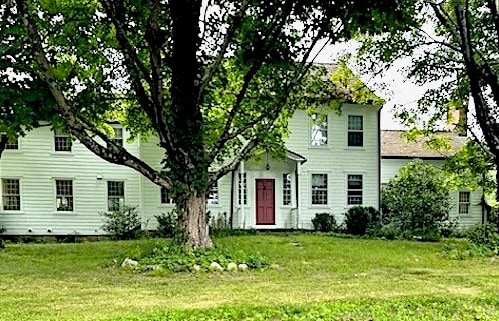
Another discussion of the HDC’s authority arose Tuesday when a plan to subdivide a nearly three-acre property at 70 Old Hill Road was presented by Mark Agnew, the property’s owner.
Agnew wants to create two one-acre lots where new houses would be built and split off a third lot for an existing main house, built in 1795. The third lot, however, would not be large enough to meet the minimum one-acre size required under the town’s residential zoning regulations.
HDC members were asked to decide whether to recommend the plan to the Planning and Zoning Commission for a 32-18 report. That report gives zoning incentives to owners of historic structures, including relief from some regulations on setback requirements, lot size when subdividing and other zoning regulations.
Commission members agreed the house — the Finch Hanford house, listed on the Westport Historic Resource Inventory — is historically significant. “It is unquestionably a historic structure,” said commission member Benjamin Levites.
But when Agnew said, “We want to maximize the value of the property … It doesn’t matter to us if it goes to one buyer or two,” some commission members discussed the financial options the owner would have to preserve the house, if he intended to stay, rather than sell it.
Braun, however, reminded panel members their role is to determine the historic value of the house and send the project along for the Planning and Zoning Commission’s review, and not to discuss financial issues involving its sale.
The commission voted unanimously to recommend the project be considered by the P&Z under a 32-18 report for zoning relief as an incentive to retain the historic structure on a non-conforming lot.
Freelance writer Gretchen Webster, a Fairfield County journalist for many years, was editor of the Fairfield Minuteman and has taught journalism at New York and Southern Connecticut State universities.







Save 70 Old Hill please.
Also the home of William S Hart western silent movie star for one.
What is the point of zoning if regulations are constantly massaged for greater and unnecessary development. Do we really need 2 more multimillion dollar homes, mature trees desiccated for the convenience of developers? Same with the proposed subdivision onSylvan North. Please do not open Pandora’s box. Westport has been sliced and diced enough.
Also, with this type of overdevelopment of single family homes in areas not zoned for it we will never reach the affordable percentages our town has been seeking nor ever be able to manage our traffic situation. The owners knew the zoning regulations when they purchased this home as well as the historic nature of the property just as I know the constrictions on my own property. Freight trains need working brakes and as our trusted engineers our P&Z must utilize them.