
By John Schwing
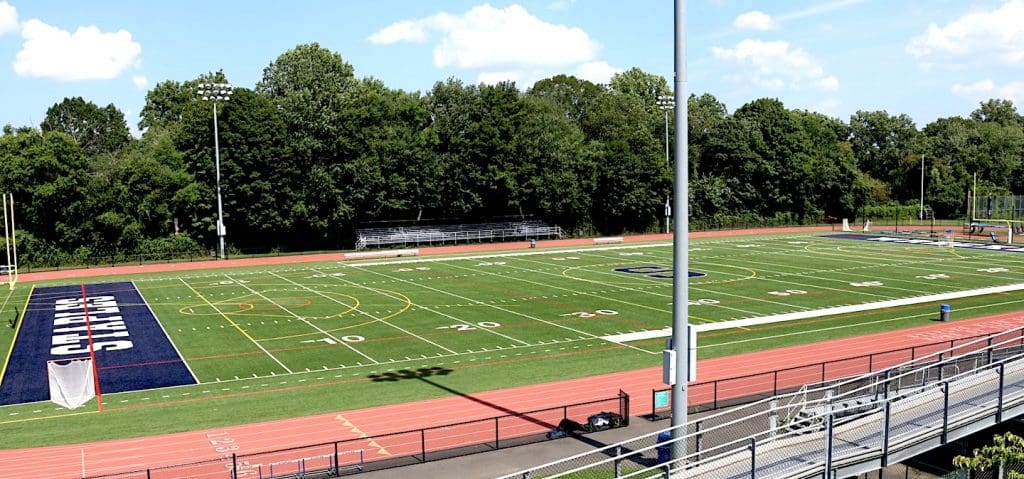
WESTPORT — Risks to health, safety and the environment posed by athletic fields with artificial turf are being tackled by Representative Town Meeting members and concerned citizens who say those playing surfaces endanger young Westport athletes and local water quality.
At a joint meeting of the RTM’s Environment and Health and Human Services committees Monday, growing concerns about artificial turf fields were highlighted as a decision looms on the types of athletic fields that will be built for the new Long Lots Elementary School.
Ellen Lautenberg and Wendy Batteau, chairs of the Environment and HHS panels, respectively, opened the wide-ranging discussion by noting the session was planned to promote public awareness of artificial turf issues, as well as to provide input for the Long Lots School Building Committee before it makes a final recommendation for the project. The seven-decade-old Long Lots is scheduled to be replaced by a new building, now projected to completed in mid-2027 with an estimated price tag of about $100 million.
Lautenberg and Batteau took turns listing a litany of problems linked to artificial turf fields (Westport currently has four), highlighting emerging data concerning PFAS embedded in the synthetic playing surfaces.
PFAS — per- and polyfluoroalkyl substances — are manufactured chemicals that have been widely used for a variety of purposes over the last several decades, ranging from firefighting to household and consumer goods.
PFAS are often referred to as “forever chemicals,” Lautenberg said, because they break down slowly and, over time, exposure to PFAS builds up in a person’s body with the potential to cause a range of serious illnesses.
Concerns cited by the RTM chairs, as well as supplementary materials, include:
- No level of PFAS is considered devoid of risk to human health, as well as to water and soil quality. The federal Environmental Protection Agency earlier this year classified them as “hazardous substances.”
- PFAS can be found in every blade of artificial turf.
- Carcinogenic materials and other harmful substances, such as lead, have been found in detailed studies of materials used for artificial turf.
- Health risks, to which children and pregnant women are particularly vulnerable, include reduced fertility, cancers (particularly prostate, kidney and testicular), high blood pressure, delayed development, behavioral problems and hormonal and immune deficiencies.
- More injuries, particularly concussions and ACL damage, have been recorded among athletes playing on firmer artificial surfaces.
- The turf also is a source of microplastics, which are implicated in respiratory and cardiovascular health problems.
- Artificial turf, although generally requiring less maintenance, is not as absorbent as grass and therefore causes more water runoff, which in turn spreads PFAS contamination more widely, leaching into ground water and soil.
- Surfaces covered by artificial turf can generate considerable heat, burning athletes. The fields also need to be doused with significant amounts of water to mitigate the high temperatures.
- When the turf heats up, it generates greenhouse gas emissions, which contribute to air pollution and global warming.
- Artificial turf, which needs to be replaced periodically, is no longer accepted as recyclable material.
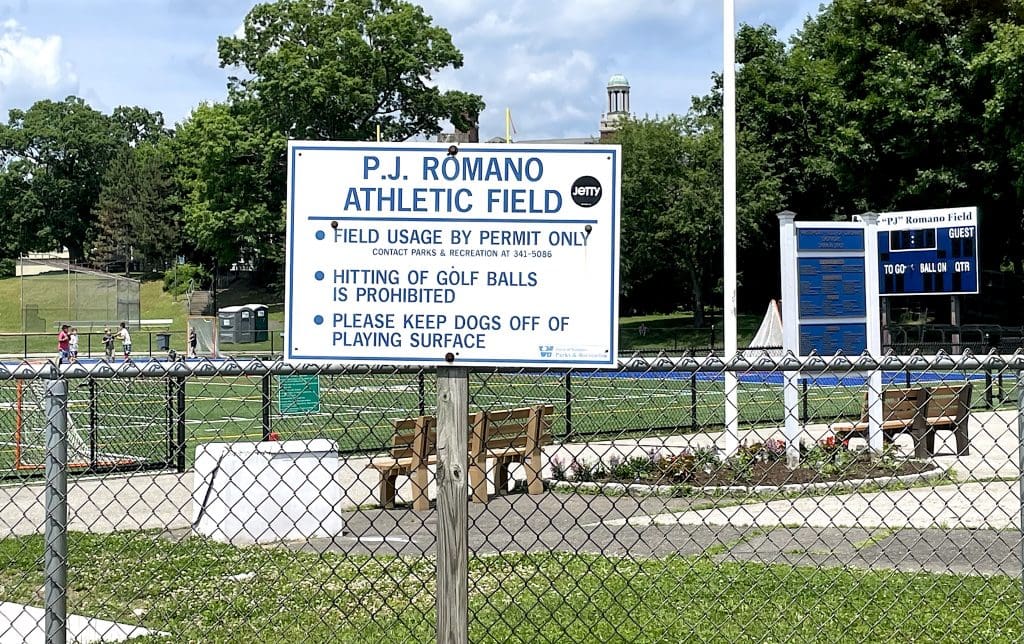
Both RTM chairs took pains to emphasize they are highlighting concerns about artificial turf not as a way to delay the Long Lots construction project, but to refer information to the building committee before it decides what kinds of fields will be installed.
That decision, they added, appears imminent since as the schematic design for the new school takes shape, a drainage plan for the entire Hyde Lane property needs to be settled before designs for the building and other amenities above ground are finalized. Drainage plans would differ, depending on the type of fields.
Kristin Schneeman, a District 9 RTM member, framed several questions about the field issues as they pertain to the Long Lots project, which other speakers endorsed. They are:
- What’s the schedule for the decision?
- Who makes the final decision about the fields? The Long Lots committee has indicated its role is only to make a recommendation, she said, so does final say go to the Parks and Recreation Commission since the town’s athletic fields are under its jurisdiction?
- Will detailed cost estimates, including maintenance expenses, be available for grass vs. artificial field options before a decision is made?
- And when the RTM is asked to vote on funding for the Long Lots project, will the appropriation be a single comprehensive request or will money for the fields be considered separately from the school?
Lee Goldstein, the Board of Education chair who joined the Zoom meeting, said that to her knowledge the building committee, in its discussion of the Long Lots fields, has favored natural grass facilities.
Several members of the public also weighed in, all expressing opposition to using artificial turf for the new fields.
Janine Scotti complimented Lautenberg and Batteau for being able “to keep your cool” while presenting information about turf fields that “would make your head explode.”
“How we haven’t ripped out the other turf fields,” she said, “knowing that they are making our kids slowly sick and making our drinking water slowly sick, is really kind of outrageous.”
Valerie Seiling Jacobs said the issue is “not just a question of cost … How do we quantify the cost of a child who gets cancer? How do we quantify polluting our drinking water?”
She added that because of unknown turf disposal costs and potential class-action litigation that could result if artificial turf were to contaminate water supplies, “I don’t even think we can actually do a cost-benefit analysis, and I question why we’re even attempting it when we know this product is so bad.”
Edie Anderson, a neighbor of the Long Lots property, said she worries about the environmental impact artificial turf fields could have on her property, nearby Muddy Brook and marine life downstream.
And referring to turf health risks posed to children, she said parents need to be made aware of the dangers because the exposure “could end up killing their kids, or killing their siblings,” a consequence she said “is not hyperbole.”
The community needs to be educated and engaged on the issue, she urged.
Several speakers suggested that, in the meantime, a better way to increase playing opportunities for youth athletes would be to improve maintenance of the town’s existing fields, which they said is so poor that Westport teams are sometimes forced to play “home” games out of town.
For more information about PFAS, click here for the supplementary information accompanying the RTM committees’ meeting agenda.
__________________________________
John Schwing, interim editor of the Westport Journal, has held senior editorial and writing posts at southwestern Connecticut media outlets for four decades. Learn more about us here.







Some clarifications from the Nov. 26 Long Lots Building Committee meeting.
Committee Chair Jay Keenan said the committee would continue to recommend natural grass for the athletic fields as of now but that recommendation could change.
He said the cost to install artificial turf would add more than $2 million to the $100 million price tag for the project. (The other known add-on cost is for a ~$6 million geothermal system). As for maintenance costs of turf versus grass, he said the Committee was not responsible for that type of cost analysis.
Keenan said neither he nor the LLSBC Committee were invited to the RTM Committee meetings on Monday, contradicting Committee Chairs Lautenberg and Batteau. He attended the meeting but did not speak.
The Long Lots project plans for site drainage are expected to be solidified in the December/January timeframe— a key point in the timeline for a decision on type of turf to be used.
(At an October meeting of the Board of Finance, Keenan said the decision would come down “money.” Chair Lee Caney added that the decision to request funding for artificial turf would rest with “Parks and Rec.”)
Keenan would not answer the question as to who requested the artificial turf option, but when pressed said Parks and Rec field decisions are made by 1) the First Selectman’s Office, 2) the Park’s and Rec Department, and 3) the appointed Parks and Rec Commission. (The top
executive position at P&R is currently vacant.) Funding for such decisions
must be approved by the BOF and Representative Town Meeting.
He further clarified that there is “ONLY ONE BUDGET” for the ENTIRE project, which includes both school and parks/rec facilities. There will not be individual project items separated out for funding approval. The funding request will be one all-inclusive budget incorporating both school and parks and rec facilities.
The project costs will be included in the application for state reimbursement, which also will include a schedule of expected “ineligible” items such as the
“athletic fields not used for gym class and the community gardens,” according to the LLSB project manager.
Further, when asked when the Committee would return to the Planning and Zoning Commission for collaboration on the site plan, Keenan said they were not ready to do so until the site plan was complete.
Regarding potential contaminated soil onsite from abandoned underground fuel tanks, he said “The Soil Management Plan is next.” There is a 10,000 gallon fuel tank next to the school, and two other
abandoned tanks of unknown disposition, with possible contaminated soil, in addition to pesticide contaminants in the soil under the current parking lot.