
By Mark Pazniokas / CTMirror.org, with additional information from the Westport Journal
In “The Crucible,” playwright Arthur Miller transformed the Salem witch trials of 1692 into a contemporary allegory about enduring human frailty: Our susceptibility to rumor, suspicion, hysteria and, ultimately, scapegoating.
But long before Salem, came Connecticut.
And among the most dramatic allegations of witchcraft in the history of the state’s early settlements arose in a high-profile struggle between two of the most prominent families in Westport and Fairfield.
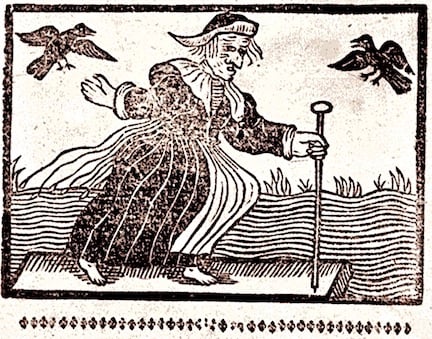
Connecticut hanged its first suspected witch in 1647 outside a meeting house near where the Old State House stands in downtown Hartford. Alice Young, of Windsor, was mother of a young daughter who suspiciously escaped an epidemic that claimed neighboring children.
Over 15 years, 10 others followed her to the gallows.
Last Wednesday, their descendants and others asked the General Assembly’s Judiciary Committee to exonerate them as victims of misogyny, religious intolerance, petty disputes writ large and polarizing political disputes of the time. Nine of the 11 executed were women.
“These were not witches,” state Rep. Jane Garibay, D-Windsor, told the committee. “They were people, women, who were executed for electing to wear certain clothing or being too assertive. They were executed because they might inherit property or because another person simply did not like them.”
A resolution co-sponsored by Garibay names 34 who were indicted on charges of witchcraft, the dozen convicted and the 11 executed. It proclaims the innocence of the convicted and apologizes to all in the name of Connecticut.
Among those convicted was Mercy Disborough, who lived in “Compo,” an area that became part of Westport after the town was formally incorporated. However, records indicate that Disborough’s sentence was not carried out
No reappraisals are demanded of Connecticut’s founders, the men of faith and might who aided or drove the prosecutions.
John Haynes and Thomas Welles, the first and fourth colonial governors, were magistrates at the first trials. In fiery sermons, the Rev. Thomas Hooker, founder of Hartford, endorsed them. The Rev. Samuel Stone, pastor of the First Congregational Church in Hartford, coaxed a confession from Mary Johnson, of Wethersfield, for “familiarity with the Devil.”
A historical account published by the Ancient Burying Ground Association of Hartford reported that, thanks to Stone’s pastoral counseling, Johnson was “judged very Penitent” at her hanging in 1648.
Garibay, who represents the town that formally exonerated Alice Young six years ago, told the committee that her measure is neither frivolous nor a distraction from contemporary concerns.
“The resolution does not detract from any other important issues that the legislature is dealing with in this session,” she said. “Instead, this resolution complements our work in the General Assembly by taking another step towards the justice that this government is constantly working towards. This is a simple and compassionate way of expressing the state’s remorse.”
Some of the descendants to offer testimony discovered their family connections through genealogy and DNA testing. That’s how Susan Bailey, of Hartford, said she learned of the violent end met by her ninth great grandmother, Alice (or Alse, in some references) Young.
A founders’ face-off: Staples vs. Ludlow
Beverly Kahn of White Plains, N.Y., a political scientist who once lived in Fairfield and taught at Fairfield University, testified via video about her eighth grandmother, Goodwife Knapp, of Fairfield. If Arthur Miller was aware of the story of Goody Knapp, “The Crucible” easily could have been set in Fairfield. And, at the time, much of the area that is now Westport was part of Fairfield.
Miller’s play, staged in 1953, was considered a commentary on America’s second Red Scare fueled by the U.S. House Committee on Un-American Activities hearings in 1947 on Communist influence in Hollywood and Sen. Joe McCarthy’s claim in 1950 of a secret Red menace embedded throughout government.
At the time, the U.S. committee had demanded that its Cold War era witnesses name names.
As Kahn tells it, Goodwife Knapp was under the same pressure, a pawn in a power struggle between her accuser, Roger Ludlow (as the name was then spelled), the founder of Fairfield, and his neighbor and political rival, Thomas Staples, whose family became one of the most prominent in Westport’s history.
“Ludlow conspired against Goody Knapp because he wanted her to testify that Goodwife Staples was a witch,” Kahn said. “Despite significant pressure put on her, Goodwife Knapp refused to accuse Goodwife Staples or any other person of witchcraft.”
The Hollywood Ten, artists who refused to name Communists, were blacklisted in the 1940s and ’50s.
Goodwife Knapp was hanged.
State Rep. Doug Dubitsky, R-Chaplin, wanted evidence of Knapp’s innocence, even if the accused had been hanged for familiarity with Satan.
“Typically, when somebody wants to have a convict exonerated, while they’re alive or after they’re dead, they produce evidence that they were innocent,” asked Dubitsky, a lawyer. “Do you have any evidence that this person was innocent?”
Kahn replied that the transcripts of the trial, available in a history of Fairfield, speak for themselves.
The influential Ludlow, a former deputy governor of both the Connecticut and Massachusetts colonies, later accused Mary Staples, wife of Thomas, of being a witch, according to an account published by WestportNow in 2003. The accusation stemmed, in part, after the plain-speaking Mary Staples defended Goody Knapp against the allegations of witchcraft.
Thomas Staples rallied to his wife’s defense, and sued Ludlow for defamation and endangering his wife’s life, using the code of laws Ludlow was instrumental in enacting — a case Staples won. By that time, however, Ludlow had returned to England, never to come back to the town he founded.
Mary Staples, along with her daughter, Mary Harvey and granddaughter, Hannah Harvey, faced allegations of witchcraft again decades later at the same time Mercy Disborough was similarly charged. The three Staples women were acquitted at trial, according to the WN article by Alice Shelton.
Mary Staples survived to become great, great, great grandmother of Horace Staples, the philanthropist responsible for Westport’s Staples High School. Another of her descendants, Samuel Staples, was the benefactor of the academy that became Samuel Staples Elementary School in Easton.
Other descendants seek justice
Dr. Suzanne Vogel-Scibilia, a practicing psychiatrist, came from Beaver County, Pa., to testify in person, steeped in details of the case against her 10th great grandparents, John Carrington Sr. and Joan Carrington. She provided a text of the indictment.
“John Carrington, thou art indicted by the name John Carrington of Wethersfield, carpenter, that not have the fear of God before thine eyes thou has Entertained familiarity with Satan, the great Enemy of God and mankind and by his help hast done works above the Course of nature for which both according to the Lawe of God and of the Established Lawe of the Commonwealth, thou deservest to die.”
The Carringtons were indicted Feb. 20, 1651, and convicted and executed two weeks later, the only husband and wife to be accused, tried and hanged as witches. They left an 11-year-old son, John Jr., and an infant daughter, Rebecca.
The youngest witness came to talk about other children left behind. He was William Schloat of Avon, a fourth-grader at St. Gabriel School in Windsor, who gave his age as “9 and three-quarters.”
“If I had a time machine, I would travel back to Hartford in the 1600s to help the people who are being accused of witchcraft,” Schloat said. “I would especially try to rescue the young children whose mothers were being called witches.”
Schloat, whose mother Jennifer teaches literature at St. Gabriel, recounted the stories of several, one a baby boy named Benjamin who was born in jail, where his mother, Mary Johnson, was awaiting execution. Benjamin was raised as an indentured servant to the son of his mother’s jailer.
The children of Mary Barnes of Farmington fared no better, he said. After their mother was hanged in Hartford, her husband remarried and sent their 12-year-old daughter and 11-year-old son to work as servants. Another died at 7, a year after her mother.
“These poor children did not have any control —”
A bell rang, signaling his three minutes had expired. State Rep. Steve Stafstrom, D-Bridgeport, co-chairman of the committee, told him to continue, and the boy picked up in mid sentence.
“ — over the frightening and unjust things that were happening to them.”
“As a proud citizen of the state of Connecticut and the United States of America,” Schloat said, “I hope that in 2023 I have more power than those abused children had in colonial Connecticut.”
Witch exonerations: First step on a slippery slope?
State Sen. John Kissel, R-Enfield, told a later witness he grew up in Windsor where “we certainly had our share of witch situations.”
But he was wary of the state offering exonerations for convictions returned in colonial times.
“I’m concerned about the path that we’re taking, if we have to go and redress every single perceived or real wrong that happened in our history,” Kissel said. “And this may start in colonial times, and we can then march forward and essentially retry and reassess every step along the hundreds and hundreds of years while we have really pressing issues right now.”
Beth Caruso, a founder of the Connecticut Witch Exoneration Project, told Kissel that those seeking exonerations were hardly revisionist historians.
She noted that John Winthrop the Younger, son of the founding governor of the Massachusetts Bay Colony, stopped some executions and discouraged the prosecution of witchcraft cases when he became governor of the Connecticut colony. He acted three decades before the Salem trials.
“If Gov. Winthrop, your predecessor in Connecticut governance, could recognize the accused victims’ innocence in the 1600s,” Caruso said, “why shouldn’t you also acknowledge it by exonerating them and continuing Winthrop’s legacy?”




Nice to see that two of my ancestors (Jennings) might be exonerated. Never imagined that could possibly happen.