


The following is the fifth in a series of articles about the Town of Westport’s finances. Written by ex-Board of Finance Chairman Brian Stern, this piece looks at the finances behind the Westport Public Schools.
Westport Journal presents these pieces of news and analysis to help readers better understand town finance: the dynamics that create the town’s revenue, how that revenue is spent, the major drivers of town budget increases and how the town manages capital and infrastructure expenses. We plan to also put the decisions made by the Board of Finance and the Finance Department into the larger context of continuing to secure a safe and predictable long-term future for the town.
WESTPORT–Recently, Westport Journal met with the Schools Superintendent Thomas Scarice and the Chief Financial Officer Elio Longo to discuss town’s public education system and its finances. We thank them for their time and insight.
We enjoy an outstanding school system
By any measure, Westporters should be proud of the education offered to our students. Accolade after accolade and survey after survey show that our system is a benchmark for excellence. In a recent Niche study, Westport was ranked first out of 120 school districts in Connecticut and 19th out of 10,000 nationally.
Westport schools produce stellar college admissions results, high proficiency scores, excellent SAT/ACT results, a student to teacher ratio of 13:1 and, with a few exceptions, an admired special education program.
Speaking from a parent’s perspective, survey averages and accolades are not as meaningful as the educational and developmental experiences their child receives, and by most anecdotal observations and feedback, the results are outstanding. We are a learning-friendly town as demonstrated by the intense involvement of parents in the schools, partner institutions such as The Westport Library, Earthplace and Wakeman Town Farm, sports participation and more.
Folks spend lavishly to move here and raise their families. They have many reasons to make Westport their home; the Town’s reputation for preeminence in education is at or near the top of that list.
Enormous undertaking
Running the school system and maintaining its excellence is an enormous undertaking. Consider the challenges. Westport parents, and the town as a whole, set high expectations. Our educators must adhere to state and federal regulations. Our schools are not immune to the occasional national crisis (such as Covid). Pressures on students are intensified by ubiquitous cell phones and social media. Aging buildings must be maintained. Curricula need constant modification, even more so with the advent of artificial intelligence. And educators must keep their skills current with staff development and training.
Fortunately, over the past two decades, Westport has been blessed with a dedicated administration that has succeeded under intense public debate and surveillance.
Substantial expense
The Westport Public School system is a substantial expense for the taxpayer, and the taxpayer has been generous. For the fiscal year ending 2025, the town spent $143 million on education. That was about 60% of the town’s total spending of $241 million.
The school system costs approximately $12,000 per household. The per-pupil cost was $27,089 in 2025. By the end of this fiscal year, that cost is expected to rise to $28,528.
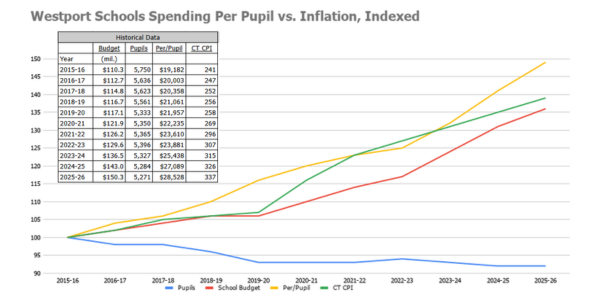
As illustrated in the chart below, over 10 years, education spending increased 36%, lower than inflation in Connecticut, which was 39%. Interestingly, the higher cost-per-pupil growth – 48% over the same time – was driven by an increase in absolute spending that coincided with an 8% decline in student enrollment (even with the influx of New Yorkers since the beginning of Covid).
As is suggested in the graph below, the increase in spending appears to be more a function of inflation than the change in population.
Budget breakdown
Salaries constitute 62% of the budget. The vast majority of education spending goes to teacher pay. This year, our schools employ 391 regular and 62 special education teachers who are working with a contract that specifies general raises plus increases based on longevity of service and qualifications.
For the recent three-year contract negotiation, the pay increase was 4.6%. The starting salaries for a teacher range from $56,000 to $70,000, depending on subject and qualification; after 20 years of service, annual pay can surpass $120,000. Most of our teachers are long-tenured. Over the past 10 years contracted salaries have increased 40% compared to 39% inflation. This inflation includes the post COVID spike of 11% in 2021-2022.
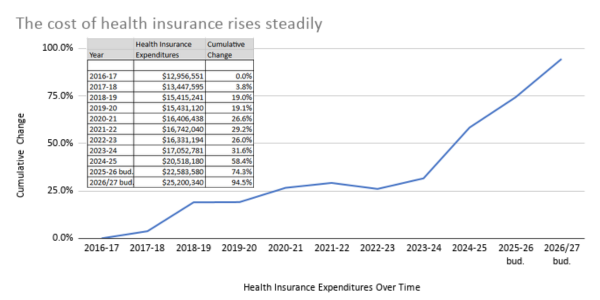
The 10-year spending graphed above shows a challenge in managing health benefits, the second-highest expense at 19% of total costs. It is well known that the rising cost of Connecticut health services, combined with more expensive, sophisticated treatments and medications, accelerates expenses well beyond general inflation.
The Town has deftly managed this upward healthcare cost spiral, largely by changing providers twice in the past 10 years, now relying on the state’s health plan. But the district can’t continue to contain the expenses forever. Over the past four years alone, Westport schools’ healthcare costs have risen by $6.2 million to $22.6 million. That’s a 27% increase over a short period.
The third highest spending item in the system is transportation, which comprises about 5% of the budget.
These top three essential items – salaries, benefits and transportation – account for 86% of all spending.
Where to focus budget discussions?
This does not mean that nothing can be done to control costs. Rather, it points out where the budgetary discussions might be most effective. For example, we can change the mix and numbers of our teachers, and likewise we can aggressively manage health benefits and transportation costs. (This will be a subject of an opinion to be published shortly).
Other significant trends in education create even more challenges. For example, the changes to and burdens of state and federal regulation, the movement of state educational subsidies, the growing numbers of students with individualized education programs (special education) and increased legal liability issues.
These variables inevitably bear negative cost consequences.
We have not addressed the huge issues of capital for school buildings or the associated interest costs in this article but will address this subject later in the fall.
We thank Tom Scarice, Elio Longo and their staff for providing the quantitative basis for the cost descriptions above and hope that a little light shed on the expense fundamentals is useful to our taxpayers.
The bottom line is that we enjoy an exceptional educational system in Westport. We have a Town that invests in our kids at a generous pace. Their success is the best chance we have for an optimistic future.
As they say in Latin “semper sursum,” loosely translated as “ever upward.”

Brian Stern
Brian Stern spent 40 years at the Xerox Corporation in a variety of executive capacities. He earned an MBA from the Harvard University Graduate School of Business Administration. He spent 14 years on Westport’s Board of Finance, eight of them as Chairman.








Brian presents a thoughtful overview that is valuable in many ways.
However when placed in the context of affordable housing… specifically the ability of a teacher to afford to rent in Westport. — using the salary range ($56,000–$70,000 starting), the short answer is: for most beginning teachers, renting alone in Westport is financially very difficult; renting in Westport likely requires either a roommate, a partner with income, unusually low housing costs, or income-restricted housing.
Current rental data puts a typical 1-bedroom Westport apartment around $3,000/month, with studios often in the mid-$2,500s and broader market averages much higher because of luxury inventory.
Affordability math
A common benchmark is spending no more than 30% of gross income on housing.
New teacher at $56,000
* Gross monthly income: $4,667
* 30% housing target: ~$1,400/month
* Likely take-home after federal/state taxes, pension contributions, benefits: roughly $3,000–$3,400/month
A $3,000 Westport 1-bedroom would consume:
* 64% of gross pay
* potentially 85–100% of take-home pay
That’s effectively unworkable.
New teacher at $70,000
* Gross monthly income: $5,833
* 30% housing target: ~$1,750/month
* Estimated take-home: perhaps $3,800–$4,300/month
A $3,000 apartment would consume:
* 51% of gross
* roughly 70–80% of take-home
Still very strained.
The current model seems to be that developers create rental properties and reap huge profits…
Why isn’t Westport exploring and encouraging cooperative housing which could offer teachers and other public servants opportunities for truly afforable housing and a chance to build (modest) equity.
The last parent satisfaction survey with respect to special education services was conducted by the District around 2009. That survey identified significant trust issues. No such comprehensive survey of all special education families appears to have been conducted since, despite an external consultant CES recommending in December 2017 that the last survey be updated. If you have data to support your assertions about few families having issues with the services their children receive, please publish it for transparency. With respect to the current system wide evaluation of special education in Westport that is being considered by the Board of Education, perhaps the Board could benefit from having an external consultant, such as WestEd, present how evaluations are conducted today and the methodologies and modern tools they use.
Thank you for sharing your thoughts. As a parent of a special education student, I wanted to respond to your statement regarding our “admired special education program.”
I am interested in understanding the range of perspectives you considered, beyond those of Tom Scarice and Elio Longo, in forming your assessment of our special education program. My experience and feedback from numerous educational advocates and specialists suggest that Westport faces significant challenges and ranks poorly. Concerns have been raised about administrative practices and the denial of services thereby preventing meaningful progress for our children.
From a fiscal standpoint, this approach raises questions about the efficient use of public funds, particularly regarding expenditures on legal proceedings rather than early, effective interventions. Research indicates that providing timely support can help avoid higher costs associated with outplacement and ongoing legal fees.
To promote both student outcomes and financial responsibility, a truly independent review of the special education program from a reputable consultant firm is urgently needed. This is the clearest and most responsible path to reduce spending on external placements and litigation.
I could not agree more, Michelle. In the 30+ years I’ve lived here, the logic has always seemed to be, “But if we actually provide services, we’ll be swamped with families moving into town to take advantage.” The short-sightedness of this approach is astounding, and we’re long overdue for an independent, professional audit.
At the moment, all we know is what happens when we limit services and open the town up to litigation: Underserved kids and angry parents who must often go outside the system to get their children the education they are legally entitled to. An audit would give stakeholders–including taxpayers–other options to consider, and may well show that developing a robust and effective special ed program (vs. working so hard to limit services) would make special education in Westport more effective AND more economical.
A petition is circulating on change.org about the evaluation of the special education system and the process for selecting the consultant and the scope of the evaluation. The last review was in 2017 and centered primarily on staffing and the number of assistant principals, as well as elevating the role of the director of special education. Furthermore the review was conducted by an entity that does a substantial amount of business annually with Westport and whose governing board is comprised of Board of Education Representatives from the region. From a procurement perspective, the conflict of interest could not be more apparent. Westport children deserve an independent and transparent review. The administration that is in charge of special education services cannot be tasked with either self-policing or with evaluating itself. Bids for qualifications from consultants are already being discussed yet there is no RFQ that has been published. Listen to the Board of Education discussions about this topic on April 23 and May 21. Almost 500 people have voiced their concerns about the upcoming evaluation by signing the petition. And over 100 families came before the Board of Education to discuss the special education system review on May 20 – with several speaking valiantly on systemic issues with the system and in great fear of retaliation. These issues affect all Westport students. Please read the various articles that have been written on the topic and listen to the recordings of the Board of Education meetings and the Community Conversation on Special Education – this last one is posted on the 06880 blog.