
By Gretchen Webster
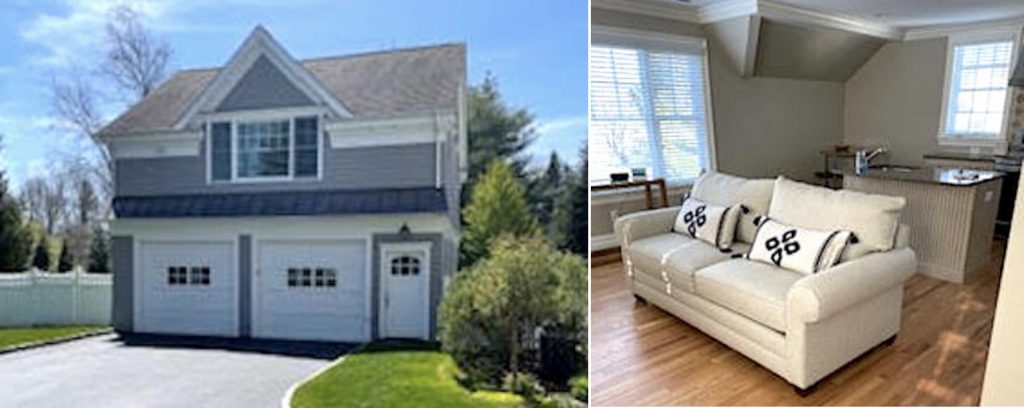
WESTPORT — A growing number of local properties, with small outbuildings near a primary dwelling, are adding rental units under a new regulation. Some of the conversions once were garages, pool houses or artist studios, while others are new structures.
These are “Accessory Dwelling Units,” which some people think might help provide a little more affordable housing in Westport. Others believe the units’ impact on the affordable housing market may be negligible, but that they can help residents in other ways.
Westport zoning has allowed internal accessory apartments since 1972, but detached, free-standing units have been permitted only since ADU regulations were adopted in April 2021, according to Michelle Perillie, Westport’s deputy director of planning and zoning.
Text Amendment #791, as the ADU regulation is called, also removed limits on internal accessory apartments, such as allowing only two “water features” per unit including sinks, toilets and showers, a limitation that made it difficult to construct a complete apartment. It also removed a requirement that the unit had to be re-certified by the town for occupation every year, Perillie said.
Since the amendment went into effect 18 months ago, approximately 20 additional free-standing accessory units have been approved, with more in the process. The Planning and Zoning Department has a record of approximately 187 internal accessory apartments currently approved in town, she said.
New plans for free-standing units are popping up at recent town meetings, such as at an October selectwomen’s meeting when property owners asked for separate sewer connections for ADUs on two properties on North Avenue, or when the selectwomen approved a coverage variance for conversion of an artist’s studio into an accessory housing unit on Compo Road South at a meeting last week.
One Westport resident who decided to develop a free-standing housing unit on her property is Jennifer Conn, who lives in the Red Coat Road neighborhood.
The family moved to Westport in 2015 and sent their children to Coleytown elementary and middle schools and Staples High School. “We love the community,” she said. “We have really great access to the Merritt [Parkway] and to town.”
The Conns had no plans to use a free-standing structure on the lot when they purchased the property, she said, but when her parents needed extra help, they decided to adapt the detached unit for them. Unfortunately, after preparing the unit for them, her father died and plans for use of the unit had to be changed.
As a result, “We kind of fell into” renting out the one-bedroom unit, she said.
First, there was a college student interning at a local business who needed a place to stay for the summer. Then, when the summer was over, Conn saw a notice on a community Facebook page from a woman looking for a place to live so her son could start elementary school while the family waited for their own home in town to be ready.
“I reached out to her,” Conn said. “She was surprised how difficult it was to find … more flexible living and more affordable living. She let me know that the rates we had were more affordable.”
Now that their second renter has moved into her own home, Conn is not certain what will be done with the ADU, calling the plans “open for the future.” However, she did find that it was helpful to have someone living on the property, especially when the Conns were away.
“There is something about having some physical presence around the house — to have someone keeping their eye on things,” she said.
Conn is also evaluating another reason some homeowners are considering adding an accessory unit — it adds value to the property, real estate agents have told her. Since her work takes her often to the West Coast, one possibility the Conns are considering is selling their Westport property and moving closer to her work.
“Some of the feedback we’ve gotten is that [an accessory unit] is such a huge asset,” when selling the property, she said. In addition to renting to tenants, the unit could be used as an in-law or multi-generational suite, or as an additional work space, realty agents told her. The units provide space that “is close to home, but not like working at home,” Conn has been told. “They found this flexible space to be a real asset.”
Although an ADU may be an asset to property owners for a number of reasons, will more ADUs help expand Westport’s inventory of affordable housing?
“I don’t think this is the end-all, be-all resolution to the lack of affordable housing in Westport,” said Danielle Dobin, the chairwoman of the Planning and Zoning Commission. “But it’s a tool in the tool box. It allows property owners to use their property better.”
Internal and external units can be converted relatively inexpensively, she said, turning basements or an upper floor or an out building into an apartment, “allowing people to create an income stream so they can remain in their home.”
Accessory apartments can help homeowners who need more revenue because of divorce, to help send children to college or for other reasons, “all the while preserving the sense of place and the aesthetics of the neighborhood,” Dobin said.
ADUs don’t necessarily help Westport meet the state threshold for affordable housing under the 8-30g law, because Westport does not require the units to be deed-restricted at “affordable” rental levels. Deed restrictions would include a cap on the rent that could be charged for the ADU.
“No one wants to build them if they are deed-restricted,” Dobin said. Requiring an affordable deed restriction would diminish the number of ADUs that homeowners would consider building in Westport, she said, noting that the units are adding to diversification of Westport’s housing stock.
The intent of the accessory dwelling unit regulation was to help people remain in Westport by making the property they already own more affordable for them, as well as offering some tenants a less expensive place to live, according to Perille.
Building additional units of any kind helps with general supply and demand for housing, she said. And the small size of both ADUs and internal accessory apartments makes them “naturally affordable,” she said. “It’s exciting … having more housing available will hopefully bring the prices down.”
Dobin agreed, saying that having more accessory units in town can help by providing a broader range of housing options. “Hopefully over time there will be more and more accessory units,” she said.
Freelance writer Gretchen Webster, a Fairfield County journalist and journalism teacher for many years, was editor of the Fairfield Minuteman newspaper for 10 years and currently teaches journalism at Southern Connecticut State University.







Recent Comments