
By Linda Conner Lambeck
WESTPORT — Once a COVID-19 vaccination is approved for children ages 5 to 11, local school officials say they are unsure if the district can help get shots into arms.
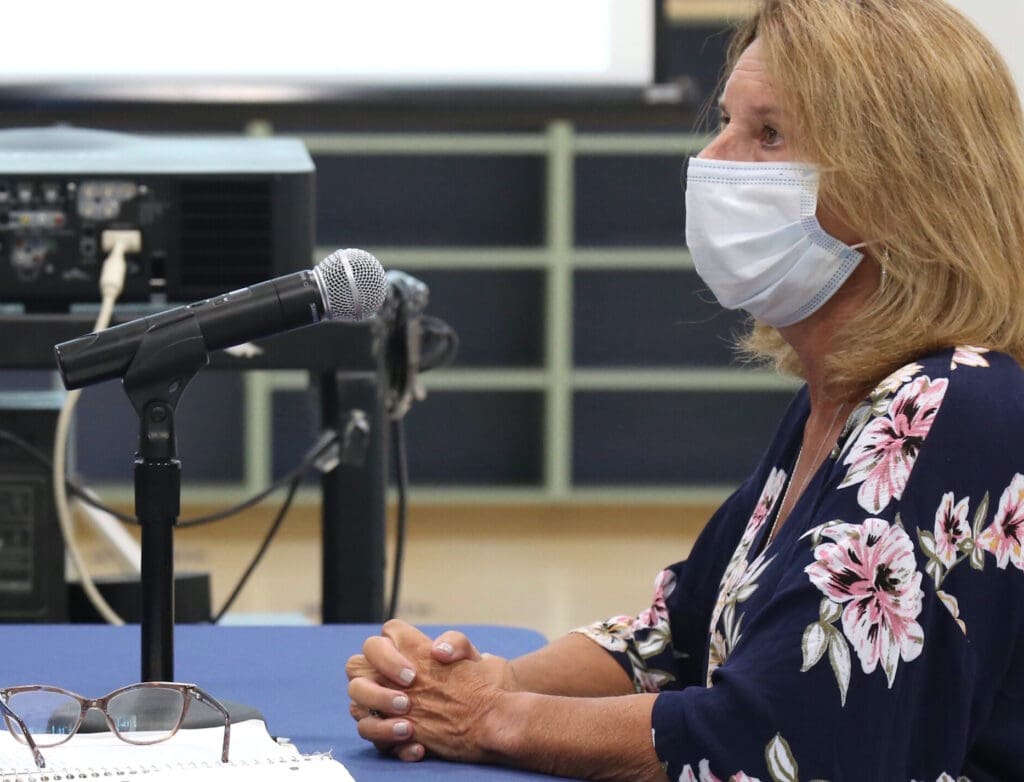
“I would love to,” Suzanne LeVasseur, supervisor of health services told the Board of Education on Monday. “We are looking at avenues to doing that. I am unsure if we will be able to.”
LeVasseur said since the vaccine closest to being approved for younger children is Pfizer, which relies on stricter temperature and storage protocols, setting up a school-based clinic may prove problematic.
Still, LeVasseur said with FDA approval of the vaccine not expected for another four to five weeks, there possibly is time to partner with neighboring school systems or send families to local clinics once the vaccine is approved.
“We will keep our ears open,” LeVasseur said.
Board Chair Candice Savin called news of an imminent vaccine for children an enormous relief.
The school board was told that, unlike other parts of the nation, Connecticut’s COVID infection rate has been relatively stable with no big spikes. However, the more contagious Delta variant is responsible for 99 percent of cases in the state.
And while Westport saw a spike in cases — rising from 16 to 45 a week ago — this week it is back down to 23 cases townwide, according to official data.
“That doesn’t mean we can let our guard down,” LeVasseur said.
Since the 2021-22 academic year started, 34 cases of the virus have been reported in the school district.
Supt. of Schools Thomas Scarice said some of those cases involve clusters of siblings.
Almost exclusively it is among students not eligible for the vaccine, the board was told.
Scarice said there has been only case possibly tied to a school transition this year. He credits that to social distancing — keeping students three feet apart as much as possible — and mask wearing.
This year, because of more targeted contact tracing, there are fewer students being put in quarantine and for shorter periods of time, LeVasseur said.
In most cases, quarantined students can go back to school after five days if they get a negative test.
Scarice said there has been only one or two cases where quarantines were longer because of sibling positivity. The district is looking into short-term, home-bound instruction for those students.
The district began offering federally funded, free weekly testing for unvaccinated students in grades K-6 last week.
So far, the district has had about 30 students per school participate in the program, administered by Progressive Diagnostics. Participation requires parental permission.
The test is a lower nasal swab, not the so-called brain tickler COVID test. Samples are pool tested and parents can check results online.
If a specimen tests positive, individual tests are conducted and students in that sample are asked to remain out of school for 24 hours until the individual who tested positive can be identified
False positives, said LeVasseur, are rare.
She said efforts to provide parents with weekly updates could start as early as next week.
Some concern was expressed about whether the cost of surveillance testing would remain free for the district, particularly for unvaccinated staff who successfully get a medical exemption.
Scarice said the district is seeking clarification, adding it would be problematic if the school district had pay for that testing.












Recent Comments