
By Linda Conner Lambick
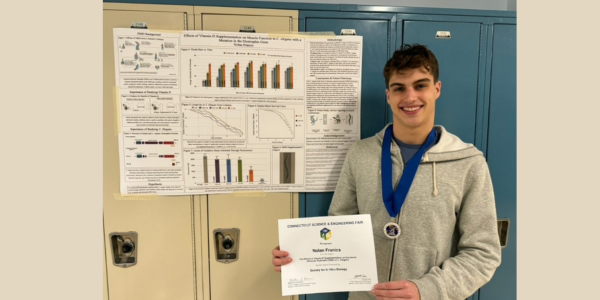
WESTPORT–Staples High School senior Nolan Francis’s efforts to determine if Vitamin D3 can improve muscle function and the lifespan of individuals with Duchenne Muscular Dystrophy continues to be recognized.
His work received a special merit award at the 63rd annual Connecticut High School Science and Humanities Symposium held at UConn Health in Farmington on Feb. 28, 2026.
Of more than 80 applicants, Francis’ project was among 16 selected for oral presentations. The top prize went to Tyler Malkin, a sophomore at Greenwich High School for his work on a novel drug delivery system for surgent proteins to more safely and effectively prevent neonatal respiratory distress syndrome.
In January, Francis was recognized as one of the top 300 science students nationwide in the Regeneron Science Talent Search for the same project.
For the past couple of years Francis has worked under the tutelage of Amy Parent, a Staples science teacher, to determine the cellular impact of vitamin D3 on Duchenne Muscular Dystrophy _ the most common, severe and rapidly progressive form of muscular dystrophy in children, usually boys.
Francis has a childhood friend who suffers from the genetic disorder which causes progressive muscle wasting and weakness.
Francis’ investigation is called: Vitamin D3 Supplementation Ameliorates Muscle Degeneration through Calcium Regulation in a Caenorhabditis elegans Model of Duchenne Muscular Dystrophy (DMD).
It has found that vitamin D3 may offer protective effects against muscle damage in DMD through muscular calcium regulation. These preliminary results suggest vitamin D3 could be an affordable strategy to improve muscle function and extend lifespan in affected individuals.
Given its established safety, accessibility, and low cost, prospective vitamin D3 supplementation in DMD patients warrants further investigation to determine long-term benefits, underlying mechanisms, and dose concentration, according to judges.
“It is always inspiring to witness the caliber of research our Connecticut students bring forward,” said Dr. Brittany Knight, site director of the CT HSSHS program. “Having once trained in this scientific community myself, it is especially meaningful to now help create space for the next generation to showcase their work. Despite significant funding challenges this year, our leadership team remained steadfast in ensuring that students’ voices and discoveries were celebrated.”
Funding challenges occurred when the federal government stopped funding the program this year after more than six decades. Connecticut is one of a handful of regions nationwide that forged ahead to hold their own symposium this year.
In addition to UConn Health, this year’s symposium was made possible by support from the Cato T. Laurencin Institute for Regenerative Engineering at UConn Health, the Connecticut Academy of Science and Engineering, the Connecticut Department of Public Health Infrastructure Grant and the Connecticut Science Supervisors Association.
Unlike past years, winners will not go on to compete in a federally funded national competition. Instead, the Alabama symposium’s director is spearheading an interstate event for the regions that organized a competition this year. Each region’s top finishers will be invited to compete virtually with peers from other regions on April 25.

Linda Conner Lambeck
Linda Conner Lambeck covers education for Westport Journal. She was a reporter for more than four decades at the Connecticut Post and other Hearst publications. She has covered education throughout Fairfield and New Haven counties. She is a proud member of the Education Writers Association.






Recent Comments