
By Linda Conner Lambeck
WESTPORT — Focus on results.
That’s what speakers told the Board of Education after a lengthy discussion Thursday about potential Code of Conduct changes and questions regarding a soon-to-be-released survey of the climate in local schools.
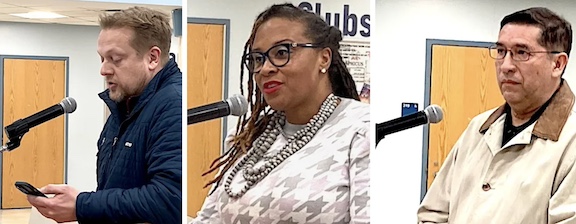
“What I care about as a parent is not this stuff, it’s outcomes,” Adrian Curtis, a parent, told the board. “Start fixing things … What is the bar and how do we hit it?”
The meeting came three weeks after Dr. Carol Felder, her husband Richard Anderson and a group of other parents recounted a series of racist incidents that their children have endured at schools in town.
Felder asked the school board for help.
After the meeting Thursday, Felder said some board members seem to be listening and she understands change takes time.
“But when things are intolerable how patient can you be?” she added.
Parents advocate for detailed policy changes
Advocating changes in the disciplinary process, a group of parents sent a letter to school officials Wednesday, outlining suggestions for addressing what they say is an increasing prevalence of antisemitism, racism and overall protected-class harassment in the district. (Read the full letter at the end of this article.)
In the short term, the group wants students who violate anti-bias policies to be blocked from sports and other school leadership positions or clubs during a suspension from classes. They want the punishment to be added to the student’s academic record until completion of a reflective essay and bias training specific to the offense.
“Start fixing things … What is the bar and how do we hit it?”
Adrian Curtis
They called for bias training to be mandatory for all students.
The group also wants a review of curriculum to make sure students understand biases and how to avoid harming others with their behavior. They suggest community service and volunteering for projects outside overwhelmingly white Westport.
The parents say school officials should keep track of and publicly account for the number of cases and suspensions reported for violating policies.
The current Code of Conduct, according to the parents, has loopholes that fail to keep bullying victims safe.
Consequences for hate speech, bullying
Donisha Diagne, a parent who spoke at the meeting, said the district should look to others that have successfully tackled the issue. She cited Stratford public schools as having a policy that clearly defines hate speech and bullying and spells out the outcome for offenses.
“I know you have a lot in front of you, but you need to be more prescriptive,” Diagne said. “This is what happens if you do x, y and z.”
Consequences also need to be spelled out for repeat offenses, such as persistent use of the “n-word,” she said.
Survey of school climate sparks questions
The school climate survey, administered every two years, is an online questionnaire given in the spring to students, parents and staff. It touches on how connected students feel to their schools, how safe they feel and how exciting their classes are.
After two meetings of tweaking survey questions, the document was approved by a 5-2 vote Thursday, with board members Robert Harrington and Jill Dillon dissenting.
Dillon had said she wanted some of the questions worded so students and teachers could base them on personal experiences. She also wanted a question for teachers addressing their comfort in discussing race with students broadened to include other current events, such as the terror attacks last Oct. 7 in Israel.
Harrington questioned the impactfulness of the survey in light of what parents have been telling the board. “There are pages and pages of questions, but I feel as a board we don’t rarely talk or address the issue,” he said.
Harrington said he is not concerned about having such a discussion by board members.
“You separate our kids into identity groups, you tell them that America is a racist nation, you divide the groups into oppressors and oppressed, you promote animosity among the groups and when the kids begin to misbehave, you wash your hands and blame the parents or the town.”
Camilo Riano
During public comment several speakers suggested the survey could be improved.
Monique Hodges said she doesn’t have any children in Westport schools, but said what she is hearing about the district is alarming.
As for the survey helping to inform the district, Hodges said, “If something is not happening it’s because you don’t want it to happen.”
Another speaker, Camilo Riano, who has complained about the survey in the past, called the exercise a joke.
“There is an agenda behind it,” said Riano, adding that he feels the survey questions are leading, it has no statistical meaning and tries to promote a certain ideology.
Update in the works for discipline policy
The update on the district’s student discipline policy was presented by board member Kevin Christie, who said the still-in-progress document is in its fifth iteration.
“We are close to the finish line,” Christie said.
The 29-page document lists many ways the district seeks to promote respect of self, others and property through discipline practices, education and reinforcement.
A Code of Conduct that goes with the policy is generally an administrative task, but Supt. of Schools Thomas Scarice is bringing the document to the board later this month for feedback and approval.
The code lists dozens of potential infractions and a range of consequences. The hope is that the document will outline specific, predictable outcomes based on infractions without violating privacy laws.
“There is definitely an appetite and a call for what happens next,” Scarice said. Judgments, he added, have to be aligned with community values.
The plan is to create a document that will have a glossary of terms, so words like “bully” and “suspension” are defined.
The cut and dry of some situations, however, depends, administrators told the board.
“There is not a direct line for every infraction,” said Assistant Supt. Michael Rizzo. “You need to consider the context of the situation.”
Scarice said there is also a difference between zero tolerance for certain behaviors and a zero tolerance policy. The latter generally levels the most severe penalty every time something happens. Sometimes that is dictated by the state.
For example, there is a mandatory one-year expulsion for a student caught bringing a firearm to school.
“I know you have a lot in front of you, but you need to be more prescriptive .. This is what happens if you do x, y and z.”
Donisha Diagne
Harrington asked what the range of consequences would be for someone who repeatedly used the word gorilla or the n-word to taunt another student. Scarice said there is a range of consequences that could include expulsion.
Student reps provide insights
Calum Magidan, a Staples High School junior and student representative to the school board, told the panel the best way to make sure students are aware of the conduct policy is to make it part of the curriculum.
He said all students deserve second chances, but also need to show they are aware of what they did wrong.
“Just suspension is not going to solve the problem,” added Anya Nair, a Staples senior and the other board’s other student rep.
Nair said some students don’t know when and who to reach out to if they are being harassed. “It’s not discussed a lot,” she said.
Anti-bias policies debated, value questioned
During public comment, speaker Mary Patel suggested the board get a independent third-party to evaluate its handling of bias complaints.
Riano, who ran unsuccessfully for a seat on the school board last November, told the panel its policies promoting diversity, equity and inclusion, or DEI, contribute to the problem.
He called DEI hate speech. “You separate our kids into identity groups, you tell them that America is a racist nation, you divide the groups into oppressors and oppressed, you promote animosity among the groups and when the kids begin to misbehave, you wash your hands and blame the parents or the town,” Riano said.
Tara Welch, standing beside her biracial son, disagreed, telling the board that the district has failed her child.
Curtis, and his wife Rosie told the board is failing parents if its policy doesn’t differentiate the guilty from the wrongly or falsely accused.
As it is, Curtis said transparency is lacking and fair investigations into accusations are not taking place.
“There is no due process to protect the students’ legal right to an education,” he said. “Racism, antisemitism, discrimination will always spread as a hate virus if an open dialogue doesn’t happen.”
Freelance writer Linda Conner Lambeck, a reporter for more than four decades at the Connecticut Post and other Hearst publications, is a member of the Education Writers Association.
__________________________________
Following is the letter sent by parents to school officials regarding disciplinary steps they feel should be implemented in cases of racist, antisemitic and other biased bullying and speech by students.






Westport’s RTM bears some responsibility for the perpetuation of this egregious issue. As the representatives of ALL our Town residents, they could have proactively engaged with the parents, students, educators, administrators and the entire community to investigate the degree of this problem within our schools and our community at large, help develop preventative programs and disciplinary actions, and monitor results for effectiveness.
Here are the charges of two of the RTM’s committees:
EDUCATION (9 members)
The proper sphere of business of the Education Committee shall include STUDY OF THE OPERATIONS OF THE SCHOOL SYSTEM and the budget appropriations for these systems.
HEALTH AND HUMAN SERVICES (9 members)
The proper sphere of business of the Health and Human Services Committee SHALL COVER ALL HEALTH AND WELFARE MATTERS, including the provisions by the town of social services to the young, the elderly, the disabled and others with special needs, along with the activities of the Human Services Department, the Commission for Senior Services, the Youth Commission, the Westport Weston Health District, and similar town or regional committees or organizations, and the budget appropriations therefor.
This situation represents yet another example of our reliance upon “compartmentalization” to resolve issues having community wide concerns falling short. Abdicating this important issue to the Board of Education “silo” might be convenient for the RTM to do, but by so doing it relegates the issues of bias, prejudice, discrimination, racism, xenophobia, anti-semitism, harassment, intolerance, meanness, bullying, threatening, ostracization, alienation, unkindness – and its deleterious impact upon vulnerable individuals (adult and children) and our community’s health & well being – to concealment within a corner of our Town when this issue reverberates upon us all.
Lawn signs espousing that “Hate Has No Home” may make a few individuals feel good; but signs are inert. By themselves their implication (despite good intentions to the contrary) serves only to perpetuate a utopian myth. The belief that hate SHOULD have no home in Westport IS the worthy aspiration – but it will not become sufficiently realized without broad community conversation and involvement. THAT’s the purpose of the RTM.
I commend Dr. Felder & Mr. Anderson, and the Goldberg family for having the fortitude to bring their painful experiences to community-wide attention. They have done us all a great service. As a resident of the Westport community, I apologize to them and their children who have suffered from these incidents. It is now up to the greater Westport community to become actively engaged to ENSURE that things effectively change.
The Board of Education is obviously taking steps to rectify part of this important problem. The recommendations outlined in the above Memorandum have merit for leading our schools in the right direction. Actions require appropriate investigation, fair adjudication and meaningful consequence. Reporting and monitoring is essential.
However, while it is in the Board of Education’s purview to implement the necessary policy and disciplinary changes, the RTM should become involved to assist in ensuring a desired resolution, both within our schools and in our broader community.
Parents, students and other residents should petition the RTM to place “Prejudice, Intolerance and Bullying in Westport” on their agenda to promote a community discussion on this individually impactful and Town defining subject, to help define meaningful and appropriate recommendations for action. The above memorandum is an excellent beginning document for the RTM to work from.
Perhaps some will conclude that the involved parents and the Board of Education has already done sufficient work on this “school issue” making the RTM superfluous at this moment in time. AND most certainly, many RTM representatives will once again opine that “this matter does not belong at the RTM for discussion” and continue to censor resident concerns.
I disagree. After all, the RTM committees’ charges are to: “STUDY OF THE OPERATIONS OF THE SCHOOL SYSTEM” and “COVER ALL HEALTH AND WELFARE MATTERS” impacting Westport’s residents. This is one of the more immediately important and consequential issues that they should be engaged in at this time IF the entire Westport community cares to ensure this issue gets resolved appropriately in a manner that we wish. THIS is what the RTM representatives have been elected to do – so what are they waiting for? Ignoring the broad oversight purposes of their committees in essence makes their defined charges meaningless. Our RTM sitting back and just watching is an embarrassment.
After all, inert community lawn signs do not suffice.
Dr J
A long time (now retired) Westport teacher, I find what Dr J suggests resonates with my experience. His comments about the necessary involvement of our most representative electoral body are completely on target…
I have witnessed countless instances of problems such as bullying, cheating, plagiarism, discrimination, snobbery, and entitlement which are rampant throughout the larger community showing up in the classrooms and halls of our schools and been frustrated with how elected officials lay responsibility on educators or play dumb.
Of all the suggestions above, I think an independent review panel would be most helpful.
While on one hand, I don’t deny bias or bullying exists, on the other, details that have come out about some of the more well-publicized events that suggest that the situations may be more complicated than they seem. Because of the nature of the investigations, of course the information about them can not be released to the public.
While, frankly, the superintendent seems to be completely out of his depth in this role, for this community, the residents are in no position to judge how these situations have been handled because of the lack of information available. An independent panel, as opposed to a BOE that largely wants to make itself look good, would be the way to go.
I highly urge everyone to watch the antisemitism/ anti- bias in Westport public Schools meeting at Temple Israel last night on 3/13/24. The recording is available here: https://www.youtube.com/watch?v=bcsYQfE-0xE
I a PROUD to send my kids to Westport Public Schools and be a resident here!
Tom, the teachers, the administrators, and the BOE are doing an OUTSTANDING job!!!!
STOP blaming teachers, STOP blaming TOM, STOP blaming the BOE! Learn the FACTS about how the district handles very few instances of bias, racism, and antisemitism. Learn by watching the recording and attending board of Education meetings!
STOP the blame game! Start PARENTING your children properly! Start learning the FACTS!
Thank you Tom and all the others at the meeting last night! Keep up the good work!