
By Kerri Williams
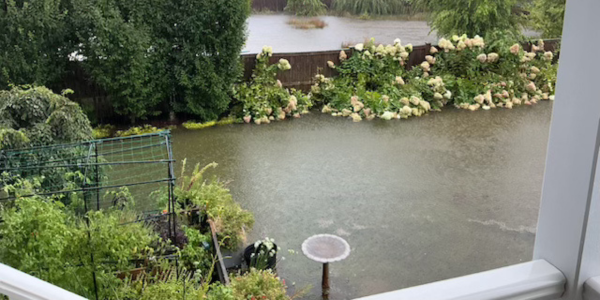
WESTPORT – In addition to all the other ways the flooding rain affected homeowners this week, dealing with flooded gardens can be traumatizing.
Nathalie Fonteyne, president of the Westport Garden Club and a UConn master gardener, knows firsthand how it feels after seeing her Fairfield garden under 18 inches of water. “It was awful,” Nathalie said of the experience, adding that this is the second time her garden flooded this summer.
For now, both Nathalie and Cathy Gilbertie, who handles communications for Gilbertie’s Garden Center, agree that the best advice is to do nothing.
Cathy said that Gilbertie’s was lucky to not have experienced the flooding, but she still had some advice for homeowners dealing with the situation. “Let it dry out on a beautiful day like today,” Gilbertie said on Monday.
Fonteyne went further, explaining that walking on a recently flooded garden or attempting to do chores like weeding can further compact the soil.
“The best thing to do is to let it alone,” Fonteyne said. Walking in the garden now can take out the air pockets that are necessary for healthy soil. “Don’t go trampling around,” she said.
Fonteyne added that sometimes automatic sprinkler systems will come on because they sense that the air is dry rather than the soil. “Please turn off your sprinkler systems,” she said. “You need to let it drain. Let it dry.”
In the days ahead, gardeners should watch closely for fungal or bacterial disease on their plants, according to Paul Rossi, also a UConn master gardener who is on the board of Wakeman Town Farm. Keep checking before automatically spraying, he advised, since that may not be necessary.
Vegetable gardeners may notice some unusual effects from the rain, Rossi added. Tomatoes can develop cracking rings or rough scarring after an influx of water. Peppers, eggplants, cucumbers and melons can also crack. Fruit should be harvested promptly, especially if additional rain is expected.
Rossi pointed out that there is an important distinction between a garden that received a large amount of rain and one that was inundated by floodwater. “If vegetables or fruit came into contact with floodwater that may contain runoff, sewage or other contaminants, they should not be eaten,” he said.
Both Gilbertie and Fonteyne also agree that planting resilient gardens can help them endure flooding situations that have been occurring more often in recent years. Fonteyne is very familiar with the problem, having recently moved from her property on the Aspetuck River. During the last few years, floodwater there was reaching the 100-year storm level, she said.
“We are getting into (weather) extremes,” Fonteyne said. “Planting a resilient garden can help.”
By a resilient garden, Fonteyne means one that can withstand both droughts like last year and the recent flooding rains. “When we’re being dumped on with seven inches of rain in a span of four hours, there is no way any sewer is keeping up,” she said.
More resilient plants are ones with deep roots that anchor the soil. For the most part, planting native perennials and grasses meets that goal. The deep roots anchor the soil, making them more resilient both during dry spells and when water is rushing through.
Some resilient native plants include purple coneflower, bee balm, asters, and butterfly weed. Trees and grasses to consider planting are: Eastern Red Cedar, Eastern Redbud and little bluestem, a native ornamental grass with a massive root system.
Fonteyne added that planting for extreme weather events is different from planting for a part of your garden that is usually wet, where a swamp milkweed would generally thrive. In contrast, resilient gardening is meant to handle both weather extremes.
For Rossi, the most important advice in the coming days is to be patient. “Gardeners are remarkably resilient,” he said. “Get rid of standing water, let the soil breathe again, and give your plants a little time before deciding what really needs intervention.”

Kerri Williams
Kerri Williams is an award-winning writer and journalist. She has worked as a reporter at the Norwalk Hour, as Living editor at the Darien News-Review, and managing editor for the Norwalk Citizen-News. For Westport Journal, she is a reporter as well as a gardening columnist, writing ‘Cultivating with Kerri.’ Williams moved from Connecticut to upstate New York in 2021.







Recent Comments