
By Ken Valenti
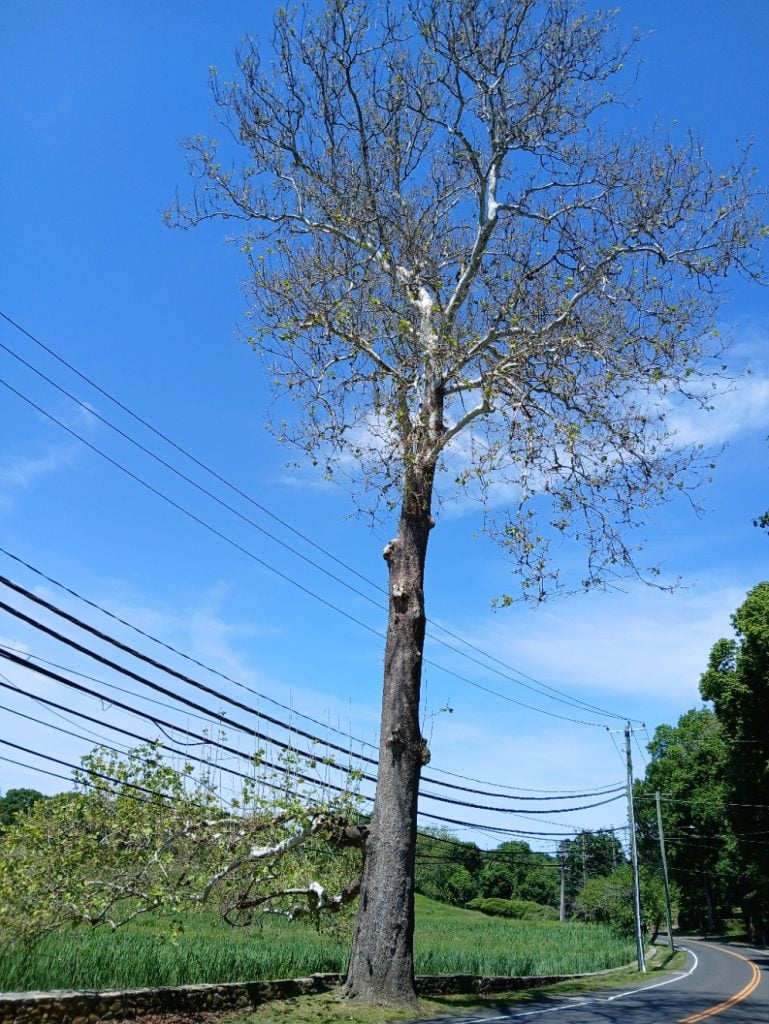
WESTPORT–Beech trees here – and throughout the Northeast – are under attack by beech leaf disease, an affliction so unstoppable that the experts are more focused on replacing the trees with other species when they die than with saving them.
“It’s affecting virtually every (beech) tree in Connecticut” among other states, said Elisabeth Ward of the Department of Environmental Science and Forestry with the Connecticut Agricultural Experiment Station (CAES).
In Westport, Public Works Director Peter Ratkiewich is preparing for a multi-year effort to replace beech trees as they become dangerously unstable. Beech trees are quite popular–one reader counted 14 of them along a 4½-mile stretch of Greens Farms Road.
“If we don’t take these trees down, they’re just going to be hazards during storms and…every day, because they could fall at any time,” Ratkiewich told several Representative Town Meeting committees at a joint meeting on April 16.
Ratkiewich said he planned to submit a request for $100,000 per year for five years to address the issue.
Town tree warden Ben Sykas said the funds “would be used primarily to remove hazardous beech trees along roads, and to replant with appropriate, site-specific species. The goal is to manage public safety while gradually rebuilding a more diverse, resilient tree canopy, not just to take trees down.”
Parks Superintendent Nicholas Quatrano is managing the disease in the parks much the same way – by replacing diseased trees with healthy specimens of other types of trees.
“Based on my conversations with licensed arborists, there are only marginally effective control measures,” he said. “Due to the extent of the disease, it is not cost effective or practical to scout and treat individual trees.”
Beech leaf disease is caused by a nematode – a microscopic worm – believed to have come from Asia, according to a May 14, 2025 update on the disease from CAES.
“Affected leaves may…appear cupped, deformed, or smaller than normal. In some cases, they become thickened and develop a leathery texture,” according to an Integrated Pest Management web page of the Cornell College of Agriculture and Life Sciences. “Buds, small twigs and branches can be killed. Over time, trees decline from bud death and the resulting reduction in leaf area for photosynthesis.”
In the U.S., the disease was first found in Ohio in 2012. Researchers believe it was blown east as the wind carried aerosolized water droplets with the worms. The 2025 CAES update reported that it has spread to 13 states in the Northeast, as far south as Virginia, as well as Ontario.
It was first seen in Connecticut in the New Canaan-Greenwich area, in 2019, said Robert Marra from the CAES Department of Plant Pathology and Ecology.
“By 2023, it was in every county in the state,” he said.
The disease affects both American beech trees in the forests and woods, and European beeches used as prominent ornamental trees on parks, estates and city hall grounds, Marra said. Efforts to protect a single ornamental tree – Marra recommended spraying it with phosphates that stimulate the trees to protect themselves from infestation – may be more practical than trying to treat large numbers in the woods, some said.
“There is one copper beech on the golf course at Longshore that has had nutrient supplements in the past,” Quatrano said. “That tree’s health does get monitored.”
Meanwhile, researchers continue to work on treatments and defenses.
“The precipitous decline is underway,” Marra said. “They are working out ways to protect some to survive the beech tree apocalypse.”

Ken Valenti
A career journalist and lifelong resident of the New York City region, Ken Valenti has enjoyed decades of reporting local, regional and national news in New York and Connecticut. Topics of special interest are development, the environment, Long Island Sound and transportation. When not reporting, he’s always on the lookout for the perfect coffee shop or used book sale.










Recent Comments