
By Gretchen Webster
WESTPORT — Black soldiers fighting for the Union in the Civil War served in “colored” regiments, led by white commanders, including Lt. Louis McDonough of Westport.
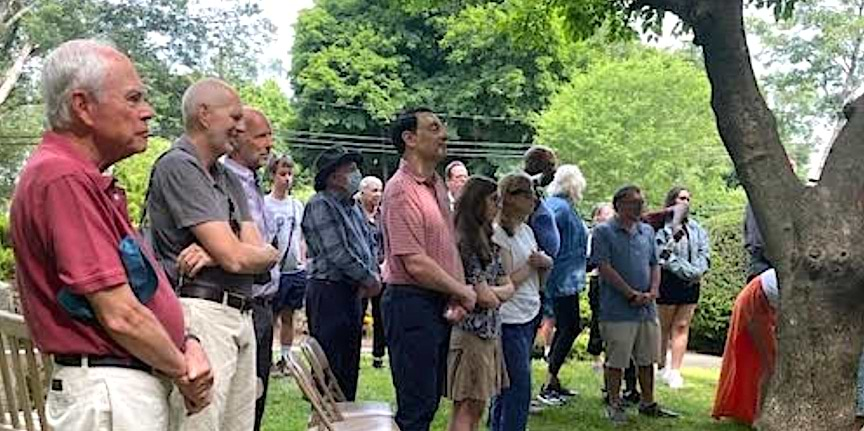
McDonough and the Black men he led in the 29th Regiment (Colored) from Fairfield County were honored Wednesday at a Juneteenth ceremony at Evergreen Cemetery, where McDonough is buried.
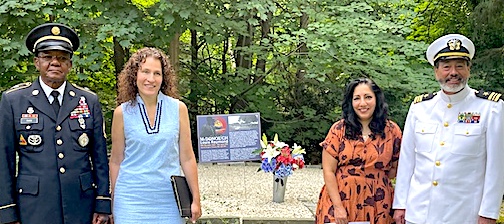
The ceremony, arranged by the Westport Museum for History and Culture and Saugatuck Congregational Church, which maintains the cemetery, paid tribute to both the Black soldiers and their commander by placing a plaque at McDonough’s grave site
Juneteenth, now a national holiday, commemorates the date when the Emancipation Proclamation was last enforced to free slaves in western Texas on June 19, 1865, two years after the proclamation was signed by President Abraham Lincoln on Jan. 1, 1863.
Although some believe the slaves who were not released in 1863 did not know they had been freed when the proclamation was signed, that is not true, Ramin Ganeshram, executive director of the museum, told the more than 30 people who gathered for Wednesday’s ceremony.
“There is a lot of misunderstanding about Juneteenth, an important day in history,” she said. Slaves in Texas were aware of the proclamation, “but were held against their will, and against the law.”
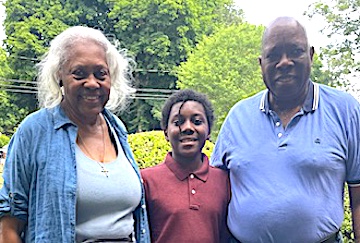
The graveside ceremony commemorated not only the significance of Juneteenth, but also the role that Black soldiers played in the Civil War.
Fifteen Fairfield County men are listed as members of the “Twenty-Ninth Regiment (Colored),” in a book published in 1881, according to Bob Weingarten, a former Westport Historic District Commission member.
The book reported that three of the regiment’s Black soldiers died during the war; one was discharged with a disability, likely a war injury, at the end of the war; eight soldiers in the regiment were mustered out at the end of the war; and the fate of six of them was unknown when the book, “History of Fairfield County, Connecticut, with Illustrations and Biographical Sketches of its Prominent Men And Pioneers,” was published.
More is known about McDonough, who led the regiment, according to research by the Westport museum. McDonough, who grew up on St. John’s Place in Westport, was taken prisoner at Petersburg, Va., in August 1864, and incarcerated in a prisoner of war camp. As a result, he suffered from long-term kidney problems and a weakened, lame leg, caused by iron restraints captors put on him after an escape attempt, according to Ganeshram.
After the war, McDonough became a civil engineer working on the railroad and he died of diabetes in 1914, according to the museum research.
Wednesday’s ceremony at the cemetery included dedication of a plaque honoring McDonough, which was unveiled by retired Lt. Cmdr. Phil Delgado, of the Veterans of Foreign Wars Post 399 in Westport, and retired Sgt. 1st Class Buyile Rani, of American Legion Post 63, also in Westport.
Delgado praised the 29th Regiment for the “bravery and valor” of its members.
“It is not only a tribute to the past, but also a call to action for the future,” he said. “It serves as a reminder that while significant progress has been made, there is still is work to be done to assure justice and equality.”
“These men fought for a better world for us all,” said Joshua Berkowsky, a member of Saugatuck Congregational Church, who attended the event. “It’s our duty as a community to honor them.”
The ceremony was followed by a day of activities at the Westport Museum for History and Culture commemorating Juneteenth. They included screening the film, “The 29th Connecticut,” about the regiment of Black soldiers, and “Destination Westport: Black Stories,” a tour of downtown Westport and other local sites that are significant in the history of Westport’s Black residents.
Freelance writer Gretchen Webster, a Fairfield County journalist for many years, was editor of the Fairfield Minuteman and has taught journalism at New York and Southern Connecticut State universities.









Recent Comments