
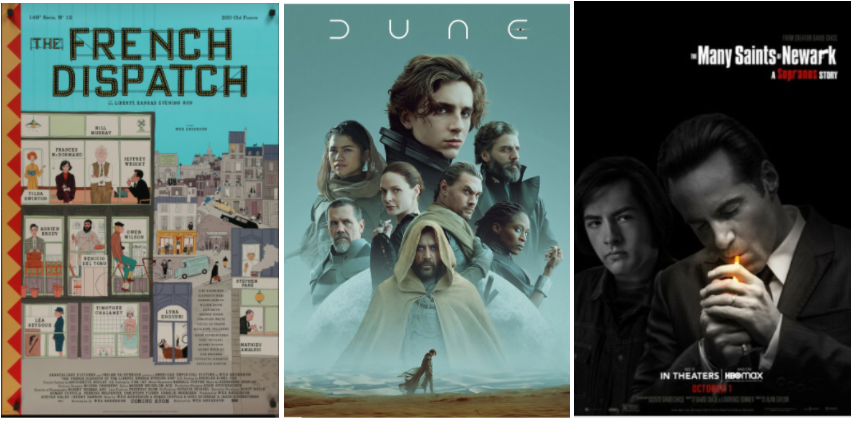
Cannes Film Festival attendees called Wes Anderson’s wryly charming new film a love letter to vintage magazine journalism, specifically The New Yorker – which indeed it is.
Set in the fictional French city of Ennui-sur-Blasé, “The French Dispatch” traces its history as a former Sunday supplement to Liberty, Kansas Evening Sun, publishing for 50 years – until 1975 – according to narrator Anjelica Huston.
Beyond that, the story revolves around the staff of this mid-20th century literary magazine, headed by its impish editor-in-chief, Arthur Howitzer Jr., (Bill Murray). Those familiar with The New Yorker history know he’s a composite of its first two editors: Harold Ross & William Shawn. “No Crying” reads a sign on his office wall, and “Try to make it sound like you wrote it that way on purpose” is his dictum.
Drolly sophisticated Howitzer savors the eccentricity of his quirky writers: Herbsaint Sazerac (Owen Wilson), taking viewers on a bicycle tour, creating a nostalgic cityscape…and Lucinda Krementz (Frances McDormand), conjuring memories of Lillian Ross & Mavis Gallant, joining radical student activists, like chess genius Zeffirelli (Timothee Chalamet), protesting male students’ exclusion from female students’ dormitories
Reminiscent of James Baldwin & A.J. Liebling, Roebuck Wright (Jeffrey Wright) profiles a police chief’s personal chef, evoking memorable meals in a culinary crime drama. Art lecturer (Tilda Swinton) presents imprisoned artist/convicted murderer (Benicio del Toro), his guard/model (Lea Seydoux), and a maniacal dealer/investor (Adrien Brody).
Contributing colorful cameos are Jason Schwartzman, Bob Balaban, Willem Dafoe, Edward Norton, Fisher Stevens, Mathieu Amalric, Tony Revolori, Saoirse Ronan, Liev Schreiber, Stephen Park, Henry Winkler, Christopher Waltz, Lois Smith, Rupert Friend and Elisabeth Moss.
Deftly scripted as an absurdly fanciful anthology, filled with piquant caricatures, it’s meticulously crafted by Wes Anderson as an inventive, whimsical tribute to several generations of mannered storytellers who enriched the American literary landscape….a worthy successor to his “The Grand Budapest Hotel,” “The Darjeeling Limited,” “The Royal Tenenbaums” and “Rushmore.”
On the Granger Gauge of 1 to 10, “The French Dispatch” is an astonishing, elegiac 8, playing in theaters.
Since its publication in 1965, Frank Herbert’s epic tale “Dune” has become one of the most popular sci-fi novels of all time. No wonder that filmmakers have grappled with interpreting its vast, complex story.
French Canadian writer/director Denis Villenueve begins his $165 million extravaganza with “Part I.”
In feudal 10191, the Emperor abruptly withdraws rapacious House Harkonnen from harvesting precious Spice on the desert planet of Arrakis – a.k.a. Dune – where they’ve cruelly oppressed the indigenous, Bedouin-like Fremen, led by Stilgar (Javier Bardem).
Arrakis’ shimmery, sparkling Spice, called Melange, is the most valuable element in the galaxy, essential to interstellar travel; a natural resource, it’s propelled by hot desert winds, leading to blistering sandstorms, and guarded by colossal, writhing sandworms, capable of sensing vibrations from far away.
The noble House Atreides has just been placed in command under Duke Leto (Oscar Isaac), who arrives on Arrakis from his oceanic home on Caladan with his clairvoyant concubine Lady Jessica (Rebecca Ferguson) and their teenage son Paul (Timothee Chalamet).
Priestess Jessica was taught by the matriarchal Bene Gesserit sisterhood, whose members have supernatural powers, yet she has defied the all-female tradition by indoctrinating vulnerable Paul with psychic mysticism, secretly training him in mind control by activating ‘the Voice,’ manipulating how words are spoken.
Meanwhile, Paul has been having prophetic visions of Chani (Zendaya), a Fremen warrior who – finally – near the film’s conclusion – proclaims: “This is only the beginning.”
Could Paul be the genetically superior ‘Kwisatz Haderach,’ fabled Fremen messiah? Is that his destiny?
Rudimentarily adapted by Jon Spaihts, Eric Roth and director Villenueve (“Arrival,” “Blade Runner 2049”), it’s awe-inspiring/magnificent with an enormity of sounds and visual effects: dragonfly choppers, known as ornithopters, and tight stillsuits, turning sweat and tears into drinkable water.
Credit Greig Fraser’s cinematography, Patrice Vermette’s production design, Jacqueline West/Robert Morgan’s costumes and Hans Zimmer’s haunting score.
As of now, Warner Bros. has not announced a date for “Part 2,” which seems inevitable.
Running 2 hours, 35 minutes – on the Granger Gauge, “Dune” is a sumptuous, spectacular 7, available in theaters and streaming on HBO Max through Nov. 21.
Prequels are seductive yet tricky. And since Daniel Craig made his last 007, rumors abound that – instead of finding a ‘new’ James Bond – they’ll make a prequel, introducing the superspy as a young man.
So let’s examine what went wrong with “The Many Saints of Newark,” made 14 years after one of TV’s most controversial, yet celebrated series “The Sopranos” concluded. FYI: David Chase’s Mob drama ran on HBO from 1999 to its blackout finale in 2007.
Narrated from beyond the grave by Christopher Moltisanti (Michael Imperioli), who was killed in the final TV episode by Tony Soprano, this origin story, set in the racially torn city of Newark, New Jersey, in the late ‘60s and early ‘70s, revolves around menacing mobster Dickie Moltisanti (Alessandro Nivola).
Tony Soprano (Michael Gandolfini) was just an impressionable Italian-American teenager when slick, smiling ‘Uncle’ Dickie became his mentor. Then there’s resentful Corrado ‘Junior’ Soprano (Corey Stoll) and Dickie’s sadistic father “Hollywood Dick” Moltisanti (Ray Liotta), who brought his sexy Italian bride Giuseppina (Michela De Rossi) back from the old country.
Closer to home, there’s Tony’s father, ‘Johnny Boy’ Soprano (Jon Bernthal), and bitter, hot-tempered, impossible-to-please mother, Livia (Vera Farmiga). Plus guitarist Silvio Dante (John Magaro), Paulie ‘Walnuts’ Gualtieri (Billy Magnussen), and Salvatore ‘Big Pussy’ Bonpensiero (Samson Moeakiola).
Co-written by David Chase & Lawrence Konner and directed by series stalwart Alan Taylor, it delves into why Tony gave up his dreams of college and playing pro football to join the brutal DiMeo family’s crime syndicate. And 22 year-old Michael Gandolfini does his best to re-create his famous father.
Problem is: despite its superficial authenticity, there’s no “Sopranos” without the late James Gandolfini – so the effect is hollow – at best. Remember what Tony says to his psychiatrist, Dr. Melfi (Lorraine Bracco), in the series premiere? “I feel like I came in at the end. The best is over.”
On the Granger Gauge, “The Many Saints of Newark” is a disappointing, blood-soaked 6, lacking insightful revelations.





Recent Comments