
By Dirk Langeveld
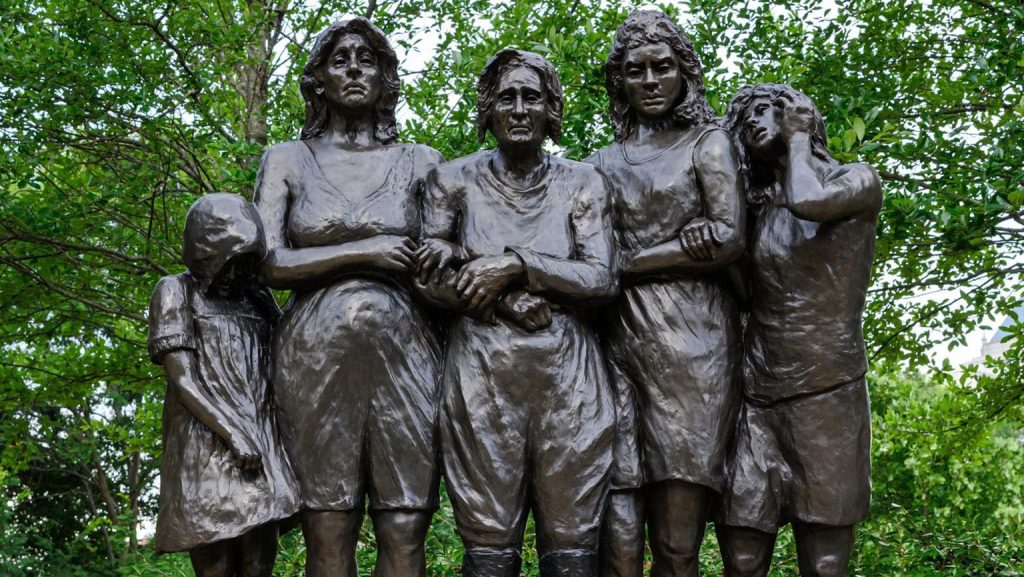
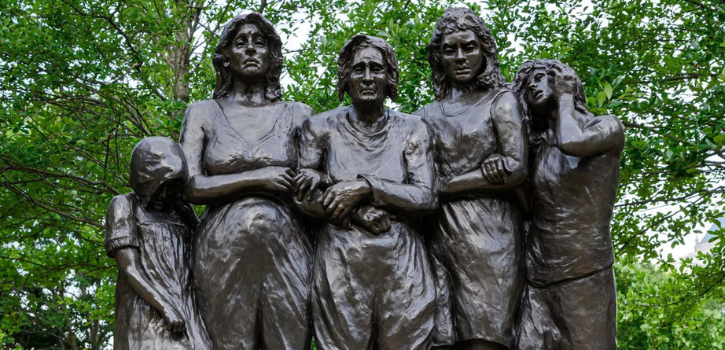
FAIRFIELD — A sculpture honoring the courage and dignity of women and children affected by the Holocaust will be installed at Fairfield University in 2026.
“She Wouldn’t Take Off Her Boots,” the second copy of an existing sculpture in Greensboro, N.C., will be placed at the campus in July. The university says the artwork will serve as “a reminder to stand against injustice and promote peace.”
“The Museum is delighted to accept this monument and to have it take its place among our outdoor sculptures on campus,” said Carey Mack Weber, the Frank and Clara Meditz Executive Director of the Fairfield University Art Museum. “We are looking forward to sharing the educational opportunities this artwork brings with all of our communities — on campus, across Connecticut, and beyond.”
An act of defiance
The sculpture depicts a photograph taken of five Holocaust victims in Latvia who historians believe are showing quiet defiance. After the Nazis began their invasion of the Soviet Union, thousands of Jews in the nation were murdered or deported. Many of the killings were conducted publicly near the city of Liepāja, including 2,749 people — mostly women and children — who were massacred on the beach at Šķēde over the course of three days in December 1941.
The victims were forced to undress down to their underclothes and march to the edge of trenches in groups of 10. There, they were methodically executed by gunfire and buried. A Nazi photographer took pictures of many of them before their deaths.
One photograph, showing four women and a 10-year-old girl huddled together, came to signify hope, courage, and dignity in the face of death. At the center of the group is Frume Purve, an older woman who is still wearing her boots.
Historians have concluded that Purve refused to take off the boots, and that her example seemingly encouraged stoicism among those standing with her. The others in the group were identified as Sorella Epstein, Roza Epstein, Mia-Malka Epstein, and Emma Epstein, all members of the same family.
A Jewish worker later managed to preserve the photograph, risking his own life to make a copy.
A memorial in North Carolina
Victoria Milstein, a painter and sculptor living in Greensboro, was first inspired to create “She Wouldn’t Take Off Her Boots” after seeing the photograph in the 2018 New York Times column “Tell Them I Was Not Afraid.” Bret Stephens recounted how the mother of his relative Raya Mazin refused an offer of forged paperwork to potentially spare herself from the Liepāja massacre. Before her death, she told an acquaintance, “If you meet any of my children, tell them I was not afraid. Tell them to continue living knowing that I was not afraid.”
Milstein, who studied at The School of Visual Arts in New York City and The Bezalel Academy of Art in Jerusalem, is the co-founder of Women of the Shoah. Its goal is to honor the resilience of women and children affected by the Holocaust, and to create public art initiatives that “educate, inform, and challenge viewers’ perspectives about the Holocaust, antisemitism, racism, and all acts of genocide affecting women and children.”
“She Wouldn’t Take Off Her Boots” depicts the five women in the photograph, although it is not a direct copy of the image. For example, 10-year-old Sorella is brought more to the foreground.
The sculpture also includes a bronze camera that invites visitors to view the sculpture through its lens. Engraved on the camera is a quote from Holocaust survivor and writer Elie Wiesel: “The opposite of love is not hate. It is indifference. You are a witness.”
The sculpture was installed in LeBauer Park in Greensboro in April 2023, and was the first women’s Holocaust monument in North Carolina. It is named in honor of Eva Weiner and Sofia Guralnik, who saved their children — Shelly Weiner and Raya Kizherman — by hiding them in Nazi-occupied Poland for almost two years.
Several materials have been developed alongside the sculpture, including a full-length documentary film of the same name and a high school curriculum developed by Holocaust Council of North Carolina with Milstein.
Inspired to repeat
Paul Burger, a native of Fairfield, was in attendance for the Greensboro unveiling of She Wouldn’t Take Off Her Boots and felt compelled to bring a similar monument to his own community. He subsequently founded Shoah Memorial Fairfield, and ultimately decided on gifting a second version of the sculpture to Fairfield University after the school was receptive.
“I am so grateful to Fairfield University for undertaking this important initiative to further Holocaust education in its community,” said Milstein. “The monument will be a sacred space for reflection and meditation and enable all visitors to gather together in unity against oppression and persecution. Through the voice of the women in the sculpture “She Wouldn’t Take Off Her Boots,” Fairfield University will articulate its commitment to fight all forms of hatred, bigotry, and bias.”
“Witnessing how we’ve become numbed to relentless violence — school shootings, political assassinations, and terrorist attacks — this monument urges us to retain our humane sensibilities,” said Special Assistant to the President for Arts and Culture Philip Eliasoph, PhD. “Through her harrowing artistic vision, Victoria Milstein forces our confrontation with unspeakable evil.”
As in North Carolina, a dedicated curriculum for middle and high school students is connected to the sculpture to support Holocaust education initiatives. An endowment fund has also been created at Fairfield University for the maintenance and care of the sculpture in perpetuity.
For more information on Shoah Memorial Fairfield, click here.
Expanded coverage of Fairfield County cultural events is made possible with support from the Fairfield University Quick Center for the Arts.





Recent Comments