
By Kerri Williams
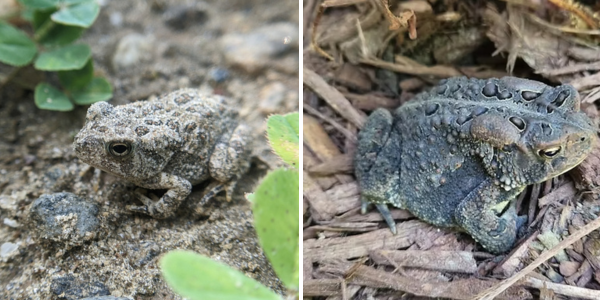
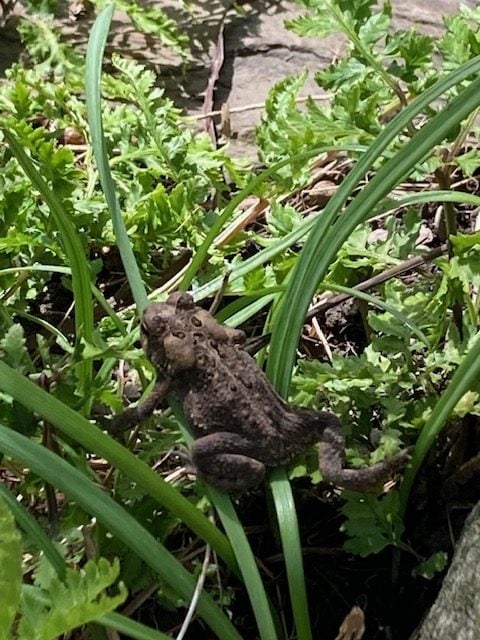
I was digging in the rock garden by my back door recently when I ran into a couple of unexpected visitors. Two garden toads hopped out from underneath some leaves and settled on a nearby stone to check out my progress.
I was delighted to meet these new friends, so much so that I decided to find out a little more about the creatures living in my yard. Turns out that toads are friends that we should all be looking to attract to our gardens and yards.
Besides adding charm to your habitat, toads are a natural controller of bugs in the garden. And they thrive in areas that are free of pesticides, which is also good for the pollinators in your yard and for the environment.
Siobhan Prout, senior naturalist at Earthplace, is a big fan of toads, which she calls “the little guys.” She points out that toads are voracious bug-eaters, consuming up to 1,000 insects in a single day. They primarily hunt beetles, slugs, snails, caterpillars and ants.
Toads are amphibians that start their lifecycles as tadpoles. So, many people who have toads also have a nearby source of fresh water. We have ponds and creeks nearby.
However, adult toads, unlike frogs, can live away from their water source and travel up to several miles from their breeding ponds. They primarily travel at night or during cool, wet or rainy weather, pausing to hide in moist areas.
There are two types of toads in Connecticut – American toads and Fowler’s toads. They are similar in appearance, according to Siobhan, but American toads are more commonly seen. They can be identified by their rough skin and large swelling behind the eyes.
So, how to attract these creatures to your yard? The best way, according to Siobhan, is to stop using pesticides because toads are particularly sensitive to these chemicals. Amphibian skin is semi-permeable, which allows them to breathe through their skin. Unfortunately, their skin also absorbs chemicals such as those in synthetic fertilizers and pesticides. In fact, the presence of toads in your yard is a good sign of a healthy, pesticide-free space.
Providing a damp environment can also be helpful for toads. This can be achieved by watering or by having a part of your garden with moist soil and shade. My shady garden was a perfect spot for toads to take up residence.
Another way to attract them is to create hiding spaces. You can leave some damp leaves, like the ones in my rock garden, or even a couple of old logs. Leaving some areas of your garden a little wild can help provide some natural shelter.
If you are even more motivated to attract them, you can create your own “toad abode” very simply with an old, unused terra cotta garden pot. It could be fun to get the kids involved in this project by first decorating the pot with natural materials, including moss.
The pot should be turned over and elevated slightly at one end with a small rock so that it is accessible to the toad. If your pot is next to a pile of leaves or in a garden with many bugs to offer, that’s even better, Siobhan says.
Although toads can be cute, humans living nearby should admire them from afar and avoid touching them, she added. It’s a myth that toads cause warts in humans. But toads can be harmed by our hands. Even the natural oils on our hands and chemicals from lotion, bug spray and sunscreen can be absorbed through their skin.
So, this summer, in addition to admiring the butterflies, bumblebees and dragonflies that come to share your garden spaces, why not create a yard that is also attractive to toads? You’ll be happy when you have fewer of those pesky bugs around the yard.

Kerri Williams
Kerri Williams is an award-winning writer and journalist. She has worked as a reporter at the Norwalk Hour, as Living editor at the Darien News-Review, and managing editor for the Norwalk Citizen-News. For Westport Journal, she is a reporter as well as a gardening columnist, writing ‘Cultivating with Kerri.’ Williams moved from Connecticut to upstate New York in 2021.






Recent Comments